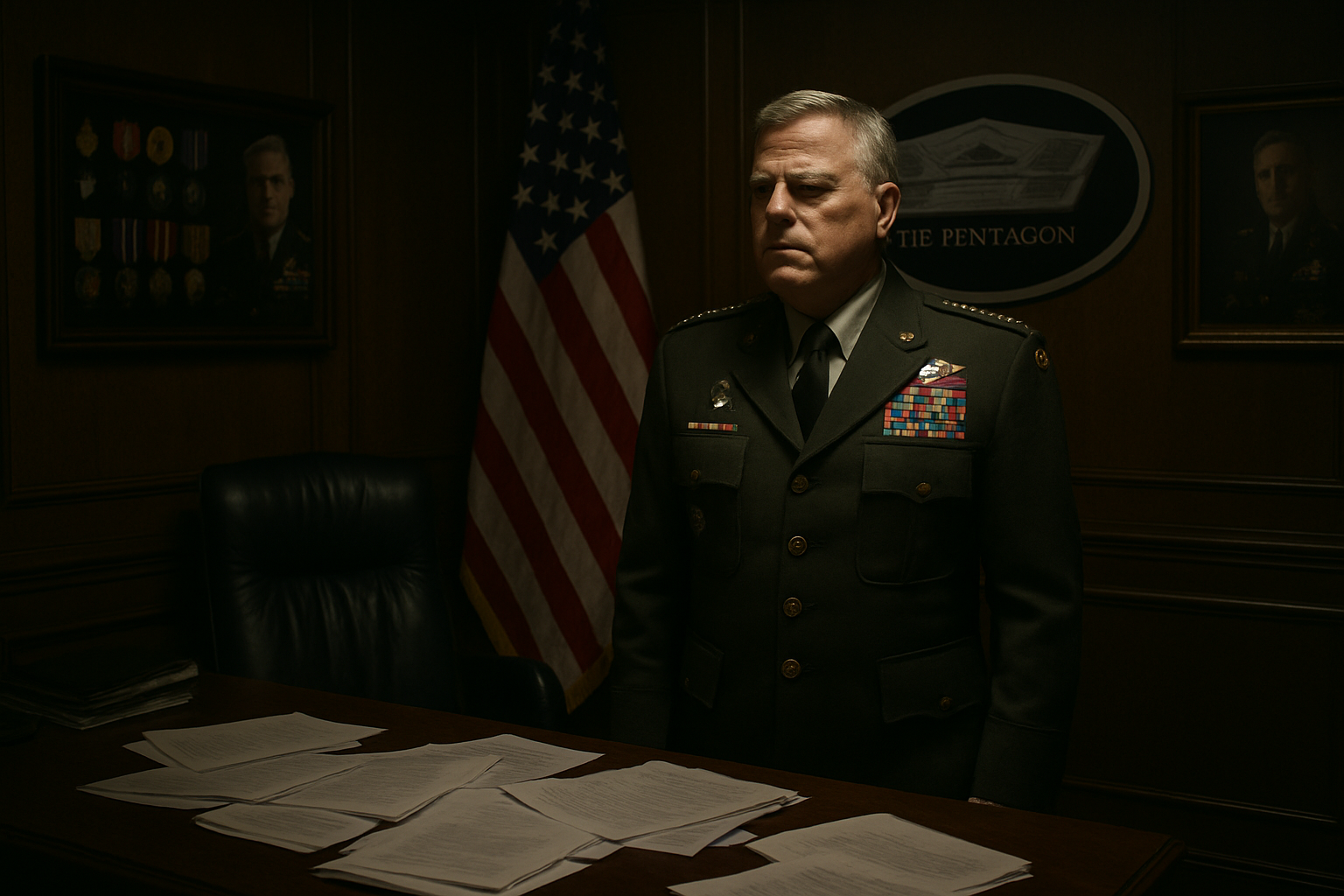
Defense Secretary Pete Hegseth has abruptly forced Army Chief of Staff General Randy George into immediate retirement amid the ongoing war with Iran, multiple US defense officials confirmed Thursday, marking one of the most consequential Pentagon leadership upheavals in decades during active military operations.
The dismissal of the 41st Chief of Staff of the Army comes as the United States continues Operation Epic Fury, the largest coordinated US-Israeli military campaign since 2003, which has now cost over $27 billion and shows no signs of abating. Pentagon spokesperson Sean Parnell confirmed that George "will be retiring from his position as the 41st Chief of Staff of the Army effective immediately," though no official reason was provided for the stunning decision.
Unprecedented Military Leadership Crisis
According to sources familiar with the matter, Hegseth also removed General David Hodne, head of the Army's Transformation and Training Command, and Major General William Green, chief of the Army Chaplain Corps, in what multiple outlets described as a sweeping purge of senior military leadership. The Washington Post first reported these developments, with CBS News and other major networks subsequently confirming the dismissals.
The timing of George's removal is particularly striking, occurring during what UN Secretary-General António Guterres has called "the greatest test of multilateral cooperation in the modern era." The Iran conflict has already resulted in over 18,000 flight cancellations worldwide, oil prices surging past $100 per barrel, and the effective closure of the Strait of Hormuz, which handles 40% of global oil transit.
"We are grateful for his service, but it was time for a leadership change in the Army," Hegseth stated during a Pentagon briefing, adding that the administration needed officials who could "implement the President's vision for the armed forces."
— Pete Hegseth, Defense Secretary
Operation Epic Fury's Mounting Costs
The leadership shake-up comes as Operation Epic Fury enters its fourth week with mounting casualties and costs. The operation has already resulted in 150 US troops wounded, including 8 in critical condition, and 3 confirmed American deaths—the first US casualties in a major Middle Eastern operation since 2003. The USS Charlotte submarine made history by sinking the Iranian frigate IRIS Dena near Sri Lanka, marking the first enemy vessel sunk by a US submarine since World War II.
Congressional opposition to the conflict has reached unprecedented levels, with only 25% of Americans supporting the military action according to recent polling—historically low support for early-stage operations. Senator Richard Blumenthal, a key member of the Armed Services Committee, expressed being "more concerned than ever" about potential ground troop deployment, while the Pentagon has confirmed operations will continue through September, far beyond the initial 4-6 week timeline.
Iran War Escalation and Global Impact
The conflict began following the confirmed death of Iran's Supreme Leader Ali Khamenei on March 1, 2026, triggering a constitutional crisis and the first hereditary succession in the Islamic Republic's 47-year history. Mojtaba Khamenei, the Supreme Leader's son, has consolidated power under Revolutionary Guards control, marking a fundamental shift from clerical to military governance.
The war's global implications have been severe. Iran's deployment of 2,000-6,000 naval mines in the Strait of Hormuz has effectively closed the critical shipping route, leading to the International Energy Agency's largest strategic petroleum reserve release in its 50-year history—400 million barrels from 32 countries. The aviation industry has faced COVID-scale disruption with eight Middle Eastern countries simultaneously closing their airspace.
European Territory Attacked for First Time Since WWII
In a dramatic escalation, Iranian drones struck RAF Akrotiri in Cyprus, marking the first attack on European territory since World War II. This unprecedented assault prompted the largest Eastern Mediterranean naval coalition in decades, with HMS Dragon leading Spanish, Italian, French, Dutch, and Greek vessels in what the EU has described as a historic deployment. The European Union activated its ESTIA crisis mechanism for the first time in its history to coordinate the Cyprus evacuation.
Nuclear Diplomacy Collapse
The military confrontation emerged from the complete breakdown of nuclear negotiations despite what had been described as "broad agreement on guiding principles"—the most significant diplomatic progress since the JCPOA collapse in 2018. The fundamental disagreement remained insurmountable: Iran insisted on nuclear-only discussions, excluding ballistic missiles and proxy groups as "red lines," while the US demanded comprehensive agreements covering missiles, armed groups, and human rights.
The crisis occurs amid a broader nuclear governance breakdown, with the New START treaty having expired in February 2026—the first time in over 50 years that the US and Russia operate without nuclear constraints. Iran continues uranium enrichment at 60% purity with over 400 kilograms of weapons-grade material, sufficient for multiple nuclear weapons if weaponized.
Trump's Unconditional Surrender Demands
President Trump has escalated his rhetoric to demanding Iran's "unconditional surrender" and has claimed the right to personally choose Iran's next Supreme Leader, rejecting Mojtaba Khamenei as a "lightweight." This represents the most direct assertion of American control over Iranian internal affairs since the 1979 revolution, effectively eliminating any possibility of negotiated solutions.
The President has also issued a 48-hour ultimatum threatening to "obliterate" Iranian power plants if the Strait of Hormuz is not reopened, marking an unprecedented escalation to civilian infrastructure targeting.
Regional Coalition Under Severe Strain
The conflict has fractured the unprecedented regional coalition of Saudi Arabia, UAE, Qatar, and Egypt that had initially backed diplomatic solutions. Iranian retaliation under "Operation True Promise 4" has directly targeted coalition member territories, with casualties reported in the UAE (1 civilian killed in Abu Dhabi), Kuwait (32 injured in airport strikes), and Qatar (8 injured despite Patriot missile intercepts). Egyptian President Abdel Fattah el-Sisi has condemned attacks on "sisterly Arab countries" and warned of "comprehensive chaos" spreading throughout the region.
Humanitarian Crisis Mounting
The humanitarian toll continues to escalate with Iran's Red Crescent reporting over 787 civilian casualties from US-Israeli strikes. The Pentagon has confirmed responsibility for an elementary school attack that killed 165-185 students due to what officials termed "outdated targeting data," prompting calls for Geneva Conventions investigations. In Lebanon, over 832,000 people have been displaced as Hezbollah has joined the conflict, completely collapsing the November 2024 ceasefire.
International evacuations have reached levels not seen since the 2011 Arab Spring, with Australia reporting 115,000 nationals trapped in the region and Germany evacuating 30,000 tourists.
Energy Architecture Under Threat
The conflict has exposed fundamental vulnerabilities in global energy infrastructure. Natural gas prices have surged 24% in Europe and 78% in the US, while Qatar's LNG production—representing 20% of global exports—has been halted due to Iranian attacks. Major shipping companies Maersk and MSC have suspended Persian Gulf operations, leaving over 150 tankers stranded with billions of dollars in cargo.
Airlines have implemented emergency fuel surcharges as jet fuel prices jumped from $85-90 per barrel to $150-200, representing increases of up to 122%. The crisis has demonstrated the catastrophic vulnerability of modern logistics to single chokepoint failures, requiring fundamental restructuring of global energy architecture.
Template-Setting Historical Significance
Military analysts describe the current crisis as the most dangerous international confrontation since the Cold War's end, with implications extending decades beyond current events. The rapid transition from diplomatic breakthrough to military escalation demonstrates the fragility of crisis management in the multipolar era.
Success in containing the conflict could provide a framework for resolving future nuclear crises, while failure may accelerate military solutions over diplomatic approaches, fundamentally reshaping international relations and encouraging nuclear proliferation globally. The stakes include regional war prevention, global energy security, nuclear governance credibility, and international law enforcement—all testing post-WWII order principles simultaneously.
"This represents the greatest test of multilateral cooperation and crisis management in the modern era. The outcome will establish precedents for 21st-century conflict resolution that will affect global governance mechanisms for decades to come."
— António Guterres, UN Secretary-General
Congressional Oversight Intensifies
The sudden dismissal of General George has intensified already unprecedented congressional scrutiny of the administration's Iran policy. Bipartisan lawmakers are demanding comprehensive briefings on strategy, costs, and the potential deployment of ground troops. With Pentagon operations planned through September and costs running at $1 billion daily, financial markets have emerged as what analysts term the "ultimate constraint" on continued escalation.
The Pakistan Stock Exchange suffered its largest decline in history (-8.97%), while South Korea's KOSPI triggered circuit breakers with a -12% drop, demonstrating how regional conflicts now instantly create global economic consequences in an interconnected world.
The Road Ahead
As the Pentagon leadership shake-up unfolds against the backdrop of the most dangerous international crisis in decades, the fundamental question remains whether diplomatic solutions can be restored or if military approaches will become the template for 21st-century dispute resolution. The dismissal of senior military leaders during active operations suggests the administration is preparing for a prolonged confrontation, with implications that will reshape not only Middle Eastern geopolitics but the entire framework of international cooperation and conflict resolution for generations to come.
The coming days and weeks will prove decisive in determining whether this crisis can be contained or whether it marks the beginning of a broader transformation in how nations resolve their most critical disputes—a transformation that could affect global stability, energy security, and nuclear governance for decades beyond the current administration.