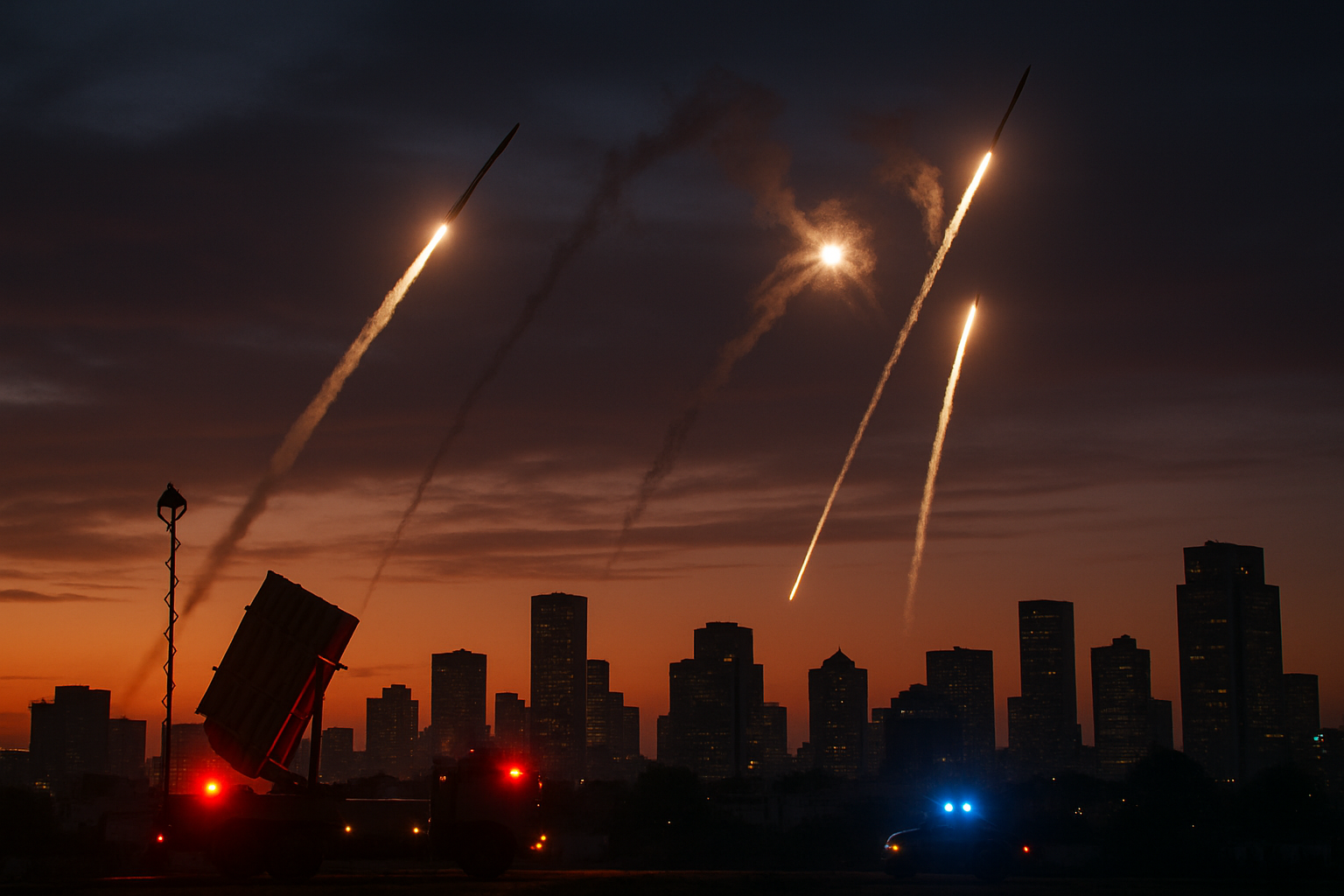
Hezbollah launched a barrage of six rockets targeting central Israel on Tuesday evening, injuring at least one woman who was running to shelter, as Iranian state media simultaneously claimed missile strikes against Israeli defense ministry facilities in Tel Aviv, representing a dangerous escalation in the ongoing Middle East crisis.
The rocket attack on central Israel marked the latest in a series of escalating exchanges between Iranian-backed forces and Israel, coming amid what international observers describe as the most dangerous Middle East crisis since the Cold War ended. According to Israeli sources, the woman was moderately injured while seeking shelter during the rocket barrage, highlighting the civilian impact of the expanding conflict.
Iranian Claims of Tel Aviv Strikes
Iranian state news agency TASS reported that Hezbollah claimed responsibility for attacking the Israeli Defense Ministry compound in Tel Aviv using "missiles of various types." The report also indicated that military intelligence barracks near the city were targeted in the coordinated assault, though Israeli authorities have not confirmed the extent of any damage to government facilities.
Additional Iranian media reports described missile fragments being found in two locations following what they characterized as Iran's missile attack on central Israel, resulting in three people injured according to their accounts. These competing narratives underscore the fog of war that has characterized the rapidly escalating regional conflict.
Context of Regional Escalation
The attacks come during the fourth week of what has become the most serious Middle East crisis in decades, following the death of Iranian Supreme Leader Ali Khamenei on March 1 and the subsequent collapse of diplomatic negotiations. The conflict has evolved from a bilateral Iran-Israel confrontation into a broader regional war involving multiple proxy groups and threatening global energy security.
Based on historical context from recent weeks, this latest exchange occurs within a pattern of systematic targeting that has already resulted in significant casualties and infrastructure damage across the region. Iran's Islamic Revolutionary Guard Corps (IRGC) has declared that "no red lines remain," while Israel has conducted extensive operations targeting Iranian leadership and military infrastructure.
Broader International Crisis
The rocket attacks and claimed strikes on Tel Aviv represent just the latest incidents in a conflict that has triggered unprecedented global disruptions. More than 18,000 flights have been cancelled worldwide, oil prices have surged past $100 per barrel, and the Strait of Hormuz—critical for 40% of global oil transit—has been effectively closed by Iranian naval mining operations.
European territory has been attacked for the first time since World War II, with Iranian drones striking RAF Akrotiri in Cyprus, prompting an unprecedented naval coalition response from Britain, France, Spain, Italy, the Netherlands, and Greece. The European Union has activated its ESTIA evacuation plan for the first time in the bloc's history.
Humanitarian and Economic Impact
The expanding conflict has created a humanitarian crisis across multiple fronts. In Lebanon, where Hezbollah has joined the broader confrontation, over 800,000 people have been displaced, with more than 800 killed including systematic targeting of medical personnel—26 paramedics have been killed and 51 wounded, raising serious concerns about violations of international humanitarian law.
The International Energy Agency has conducted its largest strategic petroleum reserve release in 50 years, releasing 400 million barrels from 32 countries to counter the energy crisis. Major shipping companies including Maersk and MSC have suspended Persian Gulf operations, with over 150 tankers stranded carrying billions of dollars in cargo.
Nuclear Diplomacy Collapse
The current military escalation emerged from the complete breakdown of nuclear negotiations between the United States and Iran, despite what diplomats described as achieving "broad agreement on guiding principles"—the most progress since the 2018 collapse of the Joint Comprehensive Plan of Action (JCPOA).
However, fundamental scope disagreements proved insurmountable, with Iran maintaining that ballistic missiles and regional proxy groups represented "red lines" that should be excluded from nuclear-only discussions, while the United States demanded comprehensive agreements covering missiles, armed groups, and human rights issues.
Congressional and International Responses
The escalating crisis has drawn unprecedented congressional scrutiny in Washington, with Senator Richard Blumenthal expressing being "more concerned than ever" about potential ground troop deployments. The conflict has achieved only 25% public support in the United States, which analysts describe as "almost unprecedented" for early-stage military operations.
Operation Epic Fury, the U.S.-Israeli military campaign, has cost $11.3 billion in its first week alone, with Pentagon officials preparing for operations extending through September—far beyond the initial 4-6 week timeline projected by the White House.
Regional Coalition Under Strain
The expanding conflict has severely strained the unprecedented regional coalition of Saudi Arabia, UAE, Qatar, and Egypt that had supported diplomatic engagement. Egyptian President Abdel Fattah el-Sisi has condemned attacks on "sisterly Arab countries" and warned of "comprehensive chaos" spreading throughout the region as Iranian retaliation has targeted coalition member territories.
Kuwait has intercepted dozens of Iranian missiles and drones, while the UAE has reported civilian casualties from Iranian attacks. Qatar has been forced to halt LNG production at facilities that supply 20% of global exports, further exacerbating the global energy crisis.
Template-Setting Crisis
United Nations Secretary-General António Guterres has characterized the current situation as "the greatest test of multilateral cooperation in the modern era." The rapid transition from diplomatic breakthrough to military confrontation demonstrates what analysts describe as the fragility of crisis management mechanisms in the multipolar era.
The stakes extend far beyond the immediate participants, affecting global energy security, nuclear governance credibility, international law enforcement, and post-World War II order principles. The success or failure of containing this crisis is likely to establish precedents for diplomatic versus military solutions in 21st-century territorial and nuclear disputes worldwide.
Looking Forward
As Hezbollah's rocket attacks on central Israel and Iranian claims of striking Tel Aviv defense facilities represent the latest escalation, international mediators face the challenge of managing not only the Iran succession crisis but also the expanding involvement of proxy groups across the region.
The coming days and weeks will be crucial in determining whether the crisis can be contained through renewed diplomatic efforts or will continue to expand into a broader regional war with devastating humanitarian consequences and global implications extending decades beyond the current events.
The current trajectory suggests that what began as a bilateral Iran-Israel confrontation has evolved into a template-setting crisis that will influence international approaches to conflict resolution, energy security architecture, and nuclear proliferation prevention for years to come.