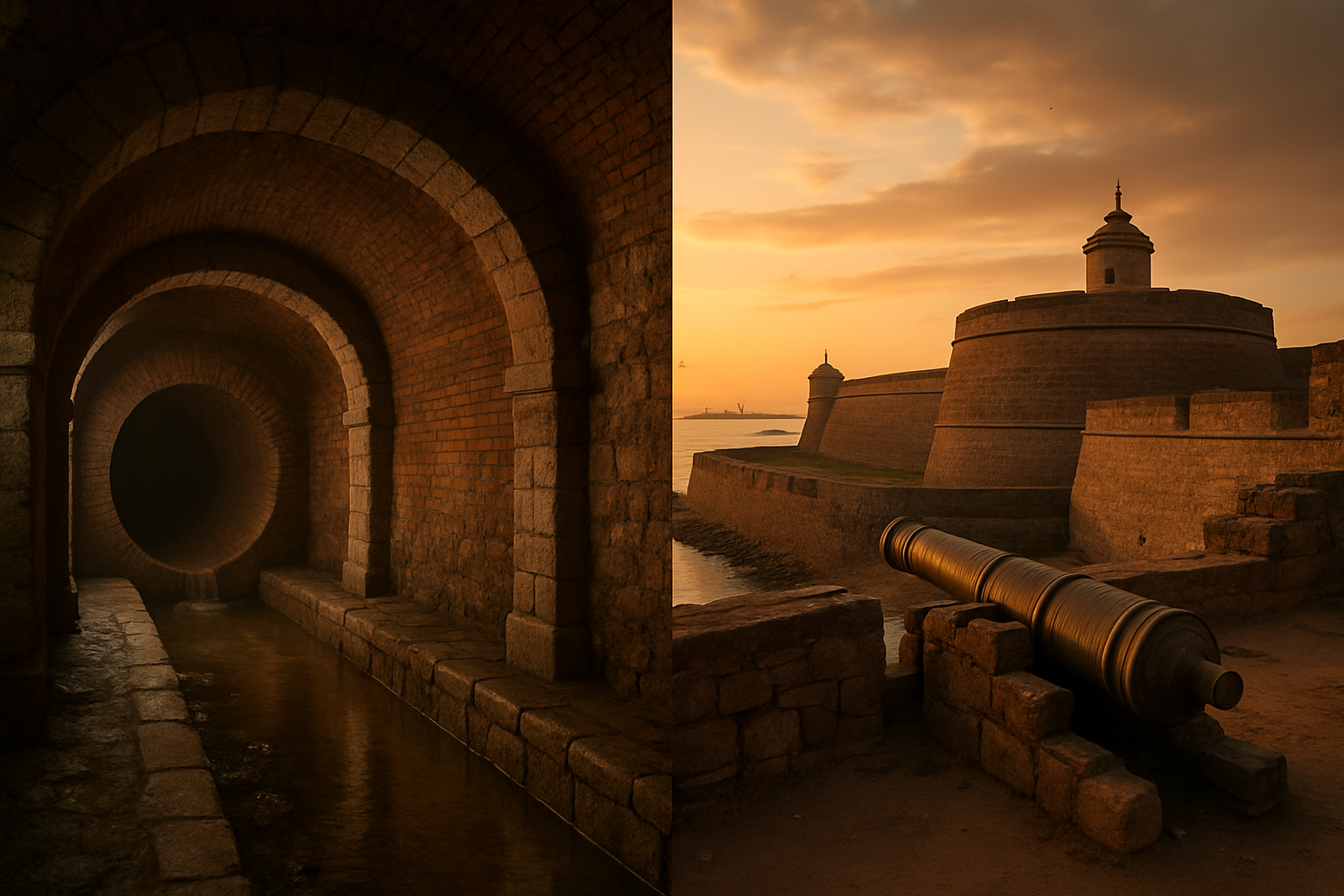
Two remarkable archaeological discoveries are reshaping our understanding of urban development and historical memory, as Prague's 120-year-old sewer systems and Peru's neglected Real Felipe fortress emerge from obscurity to reveal sophisticated engineering achievements and forgotten independence narratives that have been hiding in plain sight.
The discoveries, documented through comprehensive photographic exhibitions and historical research, represent a broader archaeological renaissance occurring across multiple continents in 2026. These findings demonstrate how infrastructure archaeology and overlooked historical sites can provide unprecedented insights into urban planning evolution and national independence struggles that traditional historical narratives have marginalized.
Prague's Underground Marvel: 120 Years of Hidden Engineering
Prague's historic sewer system, now the subject of a groundbreaking photographic exhibition, represents one of Europe's most sophisticated examples of late 19th and early 20th-century urban infrastructure engineering. The exhibition, titled "From the Sewers with Love," celebrates 120 years of Prague's underground world, revealing the remarkable engineering achievements that transformed the Czech capital from a medieval city into a modern metropolis.
The Prague Old Wastewater Treatment Plant, currently on UNESCO's indicative list, stands as testament to the city's pioneering approach to urban sanitation. Built during the height of the Austro-Hungarian Empire, these underground systems showcase engineering innovations that were decades ahead of their time, incorporating sophisticated hydraulic principles and durable construction techniques that continue functioning today.
"These underground systems represent a hidden layer of Prague's urban heritage that tells the story of modernization, public health advancement, and engineering excellence that most visitors never see."
— Dr. Pavel Novák, Urban Heritage Specialist
The photographic documentation reveals intricate stone archways, Victorian-era brick tunnels, and elaborate water management systems that demonstrate the sophisticated understanding of hydraulic engineering possessed by late 19th-century urban planners. The systems incorporated gravity-fed flow management, strategic ventilation systems, and maintenance access points that enabled continuous operation for more than a century.
Peru's Forgotten Bastion: The Real Felipe's Independence Legacy
While Prague's underground marvels showcase urban engineering evolution, Peru's Real Felipe fortress represents a crucial yet systematically overlooked chapter in Latin American independence history. The fortress, built by Spanish colonial authorities in the 18th century to defend Lima's vital port at Callao, became the final stronghold of Spanish resistance during Peru's independence struggle.
The Real Felipe fortress represents what historians are calling "the ignored last bastion" of Peru's independence process. Under the command of José Ramón Rodil, Spanish forces held this fortification long after the decisive battles of Junín and Ayacucho had effectively ended Spanish colonial rule in South America. This prolonged resistance, lasting until January 1826, represents a critical yet underexamined aspect of Peru's transition to independence.
Archaeological investigation of the fortress reveals sophisticated defensive architecture incorporating European military engineering principles adapted to coastal South American conditions. The massive stone fortifications, designed to withstand both naval bombardment and land-based siege warfare, demonstrate the strategic importance Spanish authorities placed on maintaining control over Peru's principal port.
Urban Development and Historical Memory
Both discoveries highlight crucial aspects of how societies develop and remember their past. Prague's sewer systems illustrate the invisible infrastructure that enabled rapid urbanization, while the Real Felipe fortress demonstrates how political transitions create complex narratives that subsequent generations may choose to emphasize or minimize in their national memory.
The Prague exhibition emerges during a broader European trend toward infrastructure archaeology, recognizing that understanding historical urban development requires examining not just monumental architecture but also the utilitarian systems that made modern city life possible. These investigations reveal that 19th-century urban planners possessed remarkable foresight, creating systems designed for longevity and adaptability.
Similarly, the renewed attention to Peru's Real Felipe fortress reflects growing scholarly interest in the complex, non-linear nature of independence processes throughout Latin America. Rather than simple narratives of liberation, these investigations reveal independence as prolonged, contested processes involving multiple actors, shifting allegiances, and gradual transitions of authority.
Technological Integration and Modern Archaeological Methods
Both archaeological investigations exemplify the integration of traditional historical research with cutting-edge documentation techniques. The Prague sewer exhibition employs advanced photographic methods, digital mapping, and virtual reality technologies to make these hidden spaces accessible to public understanding while preserving their historical integrity.
For Peru's Real Felipe fortress, archaeological teams are utilizing ground-penetrating radar, 3D modeling, and chemical analysis of construction materials to understand building techniques, phases of construction, and the fortress's evolution during its period of active military use. These methods enable researchers to uncover historical layers that traditional documentary research alone cannot access.
The convergence of traditional historical scholarship with modern analytical techniques represents a broader trend in contemporary archaeology, where international cooperation and technological innovation enable discoveries that fundamentally alter understanding of past societies and their achievements.
Economic and Cultural Impact
Both discoveries demonstrate the economic potential of archaeological heritage tourism while serving broader educational and cultural preservation functions. Prague's sewer exhibition attracts visitors interested in urban history, engineering heritage, and the hidden aspects of European city development, contributing to sustainable cultural tourism that celebrates authentic historical achievement.
Peru's renewed focus on the Real Felipe fortress positions the site as a crucial component of Lima's historical tourism offerings, complementing existing colonial and independence-era attractions while providing more nuanced understanding of the complex process by which Peru achieved independence from Spanish rule.
These developments occur within the broader context of 2026's documented "archaeological renaissance," where systematic investment in heritage preservation and archaeological research is generating substantial economic returns through cultural tourism, educational partnerships, and enhanced international recognition for countries effectively preserving and presenting their historical legacy.
Climate Change and Preservation Urgency
Both sites face challenges from climate change and urban development pressure that add urgency to current documentation and preservation efforts. Prague's historic sewer systems require careful maintenance to preserve their structural integrity while continuing to serve modern urban needs. Rising groundwater levels and extreme weather events pose threats to these underground heritage sites.
Peru's Real Felipe fortress, located on the Pacific coast near Lima, faces erosion from sea-level rise, increased storm activity, and urban expansion pressures that threaten the archaeological integrity of this crucial historical site. The current research efforts serve partly as emergency documentation to preserve knowledge before potential environmental damage.
These preservation challenges reflect broader patterns affecting archaeological sites worldwide, where the combination of climate change, urban development, and tourism pressure requires systematic international cooperation to preserve humanity's shared archaeological heritage.
Future Research Directions
The Prague and Peru discoveries open numerous avenues for future research that could fundamentally expand understanding of urban development patterns and independence processes throughout Europe and Latin America. Comparative studies of 19th-century urban infrastructure across Central European cities could reveal broader patterns of modernization during the Austro-Hungarian period.
Similarly, systematic investigation of other Spanish colonial fortifications throughout Latin America could provide comprehensive understanding of how European powers adapted military engineering to diverse American environments and how these installations influenced the complex processes by which Latin American nations achieved independence.
International collaboration will prove essential for these research programs, requiring partnerships between European and Latin American institutions, sharing of technological expertise, and coordinated approaches to preservation that transcend national boundaries while respecting local cultural ownership of historical heritage.
Implications for Historical Understanding
Together, these discoveries challenge simplified narratives about both urban development and political independence processes. Prague's sophisticated 19th-century infrastructure demonstrates that historical urban planners possessed remarkable technical competence and long-term vision that contemporary city planning can learn from today.
Peru's Real Felipe fortress revelation emphasizes that independence processes involved prolonged negotiations, multiple perspectives, and complex transitions rather than simple moments of liberation. This understanding contributes to more nuanced appreciation of how societies transform politically and socially over time.
Both discoveries illustrate archaeology's capacity to recover historical knowledge that documentary sources alone cannot provide, demonstrating the essential role of physical evidence in understanding how past societies functioned, adapted to challenges, and created lasting achievements that continue influencing contemporary life.
As archaeological techniques continue advancing and international cooperation in heritage preservation strengthens, discoveries like Prague's underground systems and Peru's forgotten fortress will likely multiply, fundamentally enriching human understanding of the complex processes by which societies develop, remember their past, and build foundations for future generations.