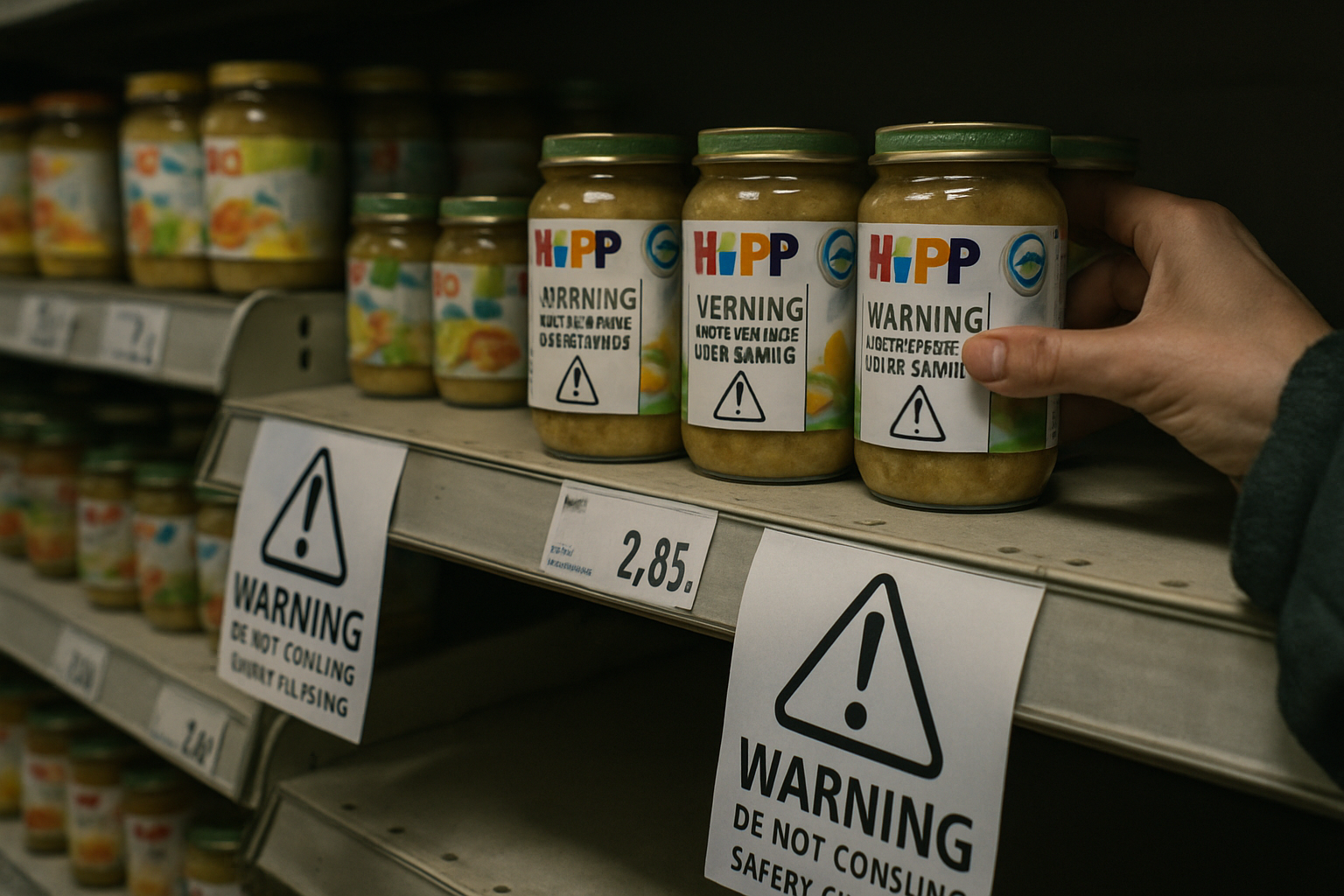
Austrian federal police have confirmed that rat poison was deliberately introduced into HiPP baby food jars following a sophisticated criminal extortion scheme targeting the German manufacturer, marking the most serious deliberate infant food contamination case in European history.
The crisis emerged on April 17, 2026, when Austrian supermarket chain SPAR issued an immediate recall of all HiPP baby food glass jars across its retail network following police investigations into suspected product manipulation. Landespolizeidirektion Burgenland authorities confirmed they could not rule out "dangerous substances" introduced into products, specifically HiPP "Carrots and Potatoes" baby food jars weighing 190 grams.
Criminal Operation Unfolds
According to multiple European sources, an extortion email was sent to HiPP Germany in late March 2026, which the company allegedly did not read until after the deadline expired. This triggered the deliberate contamination of baby food products with rat poison, federal police confirmed through laboratory validation following customer reports in the Eisenstadt-Umgebung district of Austria's Burgenland province.
The Federal Criminal Police are now coordinating an international manhunt with German authorities and Europol. Romanian media reports indicate coordinated police searches were conducted Sunday, targeting what appears to be a sophisticated criminal network with insider knowledge of food distribution systems across multiple European jurisdictions.
"This represents the most serious deliberate infant food contamination case in European history, targeting our most vulnerable populations."
— Austrian Health Official
International Scope of Investigation
The investigation has expanded beyond Austria to include authorities in the Czech Republic and Slovakia. Swiss sources confirm that HiPP Germany has voluntarily recalled its entire baby food jar assortment from affected markets and suspended distribution pending the completion of investigations.
Austrian Health Minister Johannes Schuhmann advised "heightened caution" regarding baby food products, marking the highest infant food alert in recent Austrian history. Parents are being warned to look for specific warning signs including red circle stickers on jar bottoms, damaged or missing safety seals, unusual odors, and any evidence of tampering.
Estonian and Lithuanian authorities have also issued safety warnings, with Lithuania's State Food and Veterinary Service (VMVT) confirming that one contaminated jar was identified through their monitoring systems, suspected to have been deliberately tampered with according to Austria's health and food safety agency (AGES).
Broader European Food Safety Crisis
This criminal extortion case occurs within the context of an unprecedented European food safety crisis that has been unfolding since early 2026. The continent has already been grappling with a devastating infant formula contamination crisis involving cereulide toxin from Bacillus cereus bacteria, which affected more than 36 infants across the UK, France, Luxembourg, and Greece from Nestlé and Danone products.
The current crisis takes place during the 21st consecutive month of global temperatures exceeding 1.5°C above pre-industrial levels, creating optimal pathogen growth conditions and disrupting traditional food preservation methods. This climate stress has been identified as a "threat multiplier" that allows various pathogens to co-circulate simultaneously, overwhelming food safety systems designed to handle sequential rather than simultaneous challenges.
Consumer Response and Market Impact
Consumer confidence in multinational food corporations has been steadily declining throughout 2026, with a measurable shift toward local sourcing and supply chain transparency. The HiPP extortion case has accelerated these trends, with parents increasingly demanding to know the exact origins and safety protocols for their children's food.
Social media has emerged as a powerful enforcement tool, with viral exposure of food safety violations accelerating regulatory responses and enabling citizens to participate directly in quality control monitoring. The democratization of food safety oversight has put additional pressure on manufacturers to maintain the highest standards.
Enhanced Safety Protocols
The European Food Safety Authority (EFSA) has been developing standardized international protocols and coordinated early warning systems for cross-border contamination prevention. Enhanced molecular testing protocols have been implemented to detect heat-stable toxins that can survive conventional pasteurization processes.
The Austrian health agency AGES has increased its inspection protocols by 300%, implementing mandatory molecular testing for heat-stable toxins that traditional bacterial screening methods cannot detect. This represents a fundamental shift from reactive to proactive food safety management.
Economic and Industry Implications
The economic implications of this crisis are substantial. Insurance costs for food manufacturers are rising rapidly, mandatory molecular testing infrastructure requires significant investment, and companies face potential long-term market share losses, especially in the trust-dependent infant formula sector.
Some jurisdictions are implementing criminal executive liability frameworks, making corporate executives personally responsible for food safety failures. This represents a fundamental shift in corporate accountability for public health protection.
Local food producers are gaining competitive advantages through transparency and simplified supply chains, while multinational corporations struggle to maintain consumer confidence during repeated contamination incidents. Premium pricing for authentic, traceable products has become economically viable as consumer awareness of food safety vulnerabilities increases.
Law Enforcement Precedent
Food safety experts describe this case as the most serious test of democratic governments' capacity to regulate multinational supply chains and protect vulnerable populations from criminal exploitation. The success or failure of cross-border enforcement capabilities will determine whether criminals can exploit regulatory gaps or face coordinated international response.
The investigation represents a critical precedent for how European law enforcement agencies coordinate to address sophisticated criminal threats to public health. The case requires unprecedented speed and coordination to address both immediate threats and systemic vulnerabilities in food safety systems.
Prevention-Focused Transformation
Industry experts identify 2026 as a critical transformation turning point requiring enhanced international coordination, climate-adaptive processing technologies, and prevention-focused approaches that integrate traditional wisdom with modern safety science.
Countries implementing comprehensive prevention programs are reporting superior cost-effectiveness through decreased crisis interventions and improved population outcomes. The shift from reactive crisis management to proactive resilience building is becoming essential for maintaining food security in an era of climate change and sophisticated criminal threats.
International Cooperation Response
Despite funding challenges facing traditional multilateral organizations like the WHO, bilateral partnerships and peer-to-peer knowledge sharing networks continue to drive food safety innovation. This distributed cooperation model allows for flexible, culturally responsive approaches while maintaining evidence-based safety standards.
The HiPP extortion case demonstrates that food safety has evolved from a regulatory concern to a national security issue requiring the highest levels of international coordination and criminal justice response to protect vulnerable populations from increasingly sophisticated threats.
Future Implications
The resolution of this case will have far-reaching implications for global food security. Success in apprehending the perpetrators and strengthening food safety systems could establish new standards for international cooperation in protecting public health. Failure could embolden other criminal organizations to target vulnerable populations through food contamination.
As the investigation continues, parents across Europe are being advised to exercise extreme caution when purchasing baby food products, to report any suspicious packaging or unusual characteristics immediately to authorities, and to stay informed through official health agency communications.
The HiPP extortion crisis represents a watershed moment in food safety history, demonstrating that protecting the most vulnerable members of society requires unprecedented international cooperation, advanced detection technologies, and the unwavering commitment of democratic institutions to public health and security.