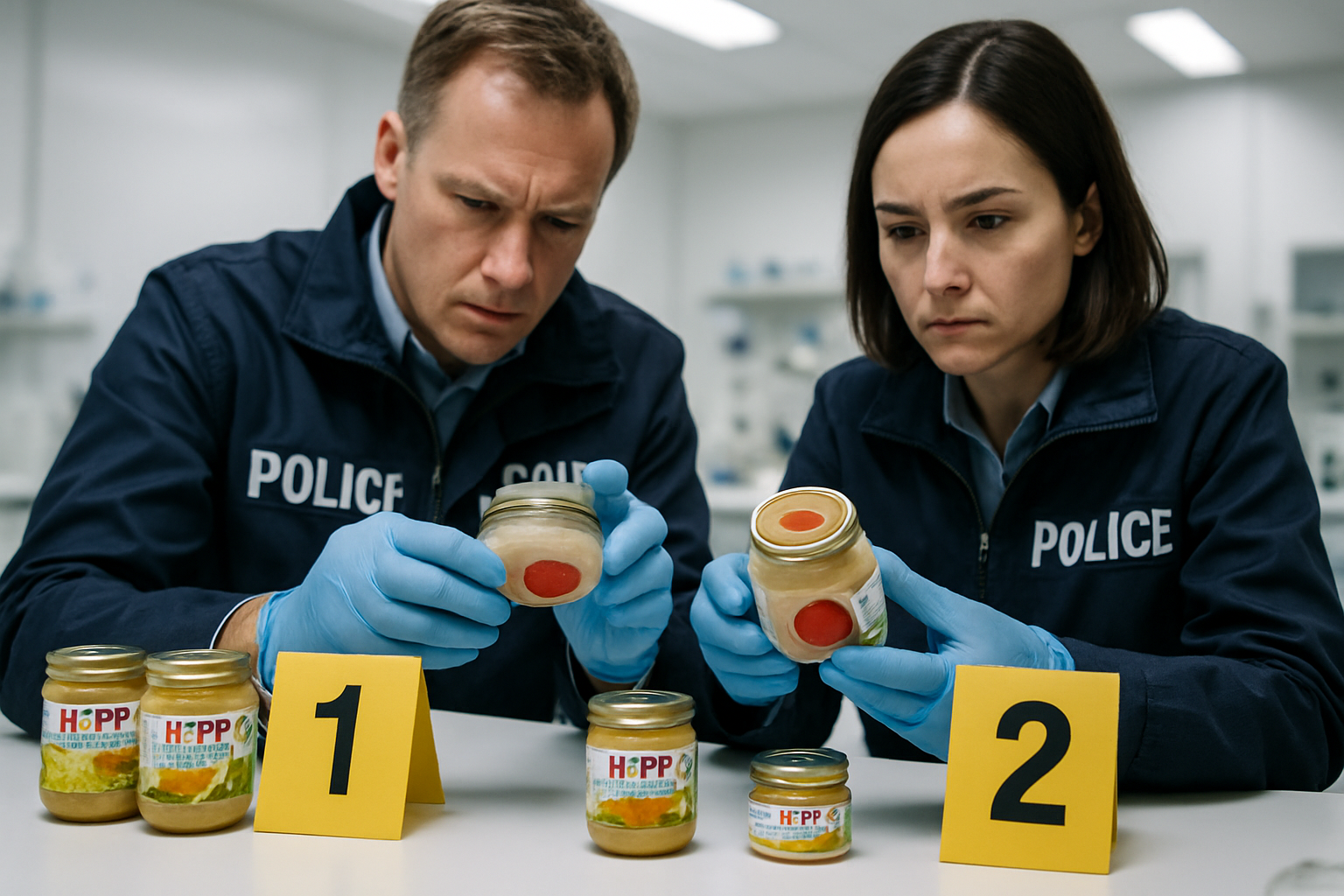
Austrian police have confirmed the discovery of rat poison in HiPP baby food jars as part of what authorities describe as a sophisticated criminal extortion scheme targeting one of Europe's most trusted infant nutrition brands, with investigations now expanding across international borders to Czech Republic and Slovakia.
The Burgenland police in Austria announced late Saturday that laboratory tests conducted on a 190-gram jar of "Carrots and Potatoes" baby food had tested positive for rat poison, following a recall of the product from more than 1,500 SPAR supermarkets across the country. The contaminated jar was reported by a customer in the Eisenstadt-Umgebung district, prompting immediate safety warnings from both police and health authorities.
International Criminal Investigation Launched
The investigation has rapidly evolved into a cross-border operation involving law enforcement agencies in Austria, Czech Republic, and Slovakia. Romanian media reports indicate that police in all three countries conducted coordinated searches on Sunday as part of their investigation into what appears to be a deliberate criminal campaign targeting infant food products.
According to German manufacturer HiPP, the contamination could not be ruled out as accidental, stating that their "HiPP Vegetable Carrot with Potato jars may have been tampered with." The company has emphasized that consuming the contents of affected jars could be life-threatening, particularly for infants whose developing systems are especially vulnerable to toxic substances.
"This represents a deliberate act of criminal endangerment targeting our most vulnerable population - infants and young children."
— Austrian Federal Criminal Police spokesperson
Identifying Contaminated Products
Austrian authorities have provided specific guidance to help consumers identify potentially dangerous products. According to the police statement, affected jars display several warning signs:
- A sticker with a red circle on the bottom of the jar
- Lids that have been opened, damaged, or are missing safety seals
- Products exhibiting unusual odors
- Any signs of tampering with original packaging
The Federal Criminal Police are coordinating with German authorities and Europol to conduct what they describe as a "comprehensive international manhunt" for those responsible for the contamination scheme.
European Food Safety Crisis Escalation
This incident represents a dangerous escalation in what food safety experts are calling the most severe European food contamination crisis in recent memory. The rat poison discovery builds upon an already devastating pattern that has affected more than 36 infants across the United Kingdom, France, Luxembourg, and Greece due to cereulide toxin contamination in major baby formula brands including Nestlé and Danone products.
The timing is particularly concerning as it occurs during what climate scientists have identified as the 21st consecutive month of global temperatures exceeding 1.5°C above pre-industrial levels - conditions that create optimal environments for pathogen growth while disrupting traditional food preservation methods.
Supply Chain Vulnerabilities Exposed
The sophisticated nature of the contamination suggests the perpetrators possess detailed knowledge of food distribution networks and supply chain operations. HiPP has implemented voluntary recalls and suspended distribution pending completion of the investigation, while Austrian health agency AGES has enhanced inspection protocols with a 300% increase in random testing and mandatory molecular testing for heat-stable toxins.
The crisis has accelerated a broader shift in consumer behavior, with measurable declines in confidence toward multinational food corporations and increased demand for local sourcing and transparent supply chains. This transformation reflects growing awareness of vulnerabilities in complex international food distribution networks.
Economic and Regulatory Impact
The contamination crisis is driving significant economic changes across the European food industry. Insurance costs for manufacturers have risen substantially, while investments in molecular testing infrastructure have become mandatory requirements rather than voluntary measures. Some European jurisdictions are now considering criminal liability frameworks that would hold executives personally responsible for food safety failures.
The European Food Safety Authority (EFSA) is accelerating development of standardized international protocols and coordinated early warning systems designed to prevent cross-border contamination incidents. These enhanced systems represent a fundamental evolution in how European authorities approach food safety regulation in an interconnected global marketplace.
Social Media as Enforcement Tool
One unexpected development in the crisis has been the emergence of social media platforms as powerful enforcement mechanisms. Viral exposure of food safety violations has dramatically accelerated regulatory responses, with citizen reports and public awareness campaigns proving more effective than traditional regulatory oversight in some cases.
This democratization of food safety oversight has empowered consumers to participate directly in quality control processes, while simultaneously putting pressure on manufacturers to maintain higher standards knowing that violations can achieve global visibility within hours.
Climate Change as Threat Multiplier
Food safety experts emphasize that the current crisis cannot be understood separately from broader climate pressures. Dr. Ali Younis from Cairo University's Faculty of Sciences describes climate change as functioning as a "threat multiplier" that enables pathogens typically active during different seasons to co-circulate simultaneously, overwhelming safety systems designed for sequential rather than simultaneous challenges.
Traditional food preservation methods developed over centuries are proving inadequate under rapidly changing environmental conditions, forcing rapid adaptation across the entire food production and distribution system.
International Cooperation Framework
The multi-national nature of the investigation highlights both the challenges and necessities of international cooperation in food safety enforcement. The case demonstrates how modern food contamination incidents can quickly cross borders through multinational supply chains, requiring unprecedented levels of coordination between national law enforcement and regulatory agencies.
Success in addressing this crisis will depend on sustained political commitment, enhanced multi-sector coordination, and increased financial commitments that recognize food safety as essential infrastructure for human prosperity and public health rather than merely a regulatory burden.
Prevention-Focused Transformation
Industry experts identify 2026 as a critical transformation turning point that will require enhanced international coordination, climate-adaptive processing technologies, and prevention-focused approaches that integrate traditional dietary wisdom with modern safety science. The current crisis has accelerated discussions about shifting from reactive crisis management to proactive resilience building.
Countries implementing comprehensive prevention programs are reporting superior cost-effectiveness through decreased crisis interventions while achieving improved population health outcomes. This approach emphasizes community empowerment, technological innovation, and international cooperation as templates for addressing food security challenges.
"We are witnessing a fundamental transformation in how we must approach food safety in the 21st century - one that requires unprecedented international cooperation and recognition that food security is a global public good."
— European Food Safety Authority spokesperson
Consumer Protection Guidance
Austrian authorities are urging immediate action from consumers who may have purchased HiPP baby food products. Any jars showing signs of tampering should be immediately disposed of, and parents are advised to seek medical consultation if infants have consumed products from potentially contaminated batches.
The investigation represents what experts describe as an evolution in food safety threats - from accidental contamination to deliberate criminal targeting of vulnerable populations. This shift requires new approaches to both prevention and response that account for the malicious intent behind contamination incidents.
Future Implications
The window for building resilient and equitable food systems is narrowing rapidly as environmental pressures accelerate and global demands increase. The choices made regarding safety protocols, cooperation frameworks, and prevention strategies during this critical period will likely prove decisive for food security trajectories for decades to come.
Success in overcoming this crisis will require coordinated action that addresses immediate safety threats while building long-term resilience. The human dimension remains central, as millions of farmers, food workers, and vulnerable communities depend on stable and fair food systems capable of protecting public health while adapting to unprecedented environmental and social challenges.