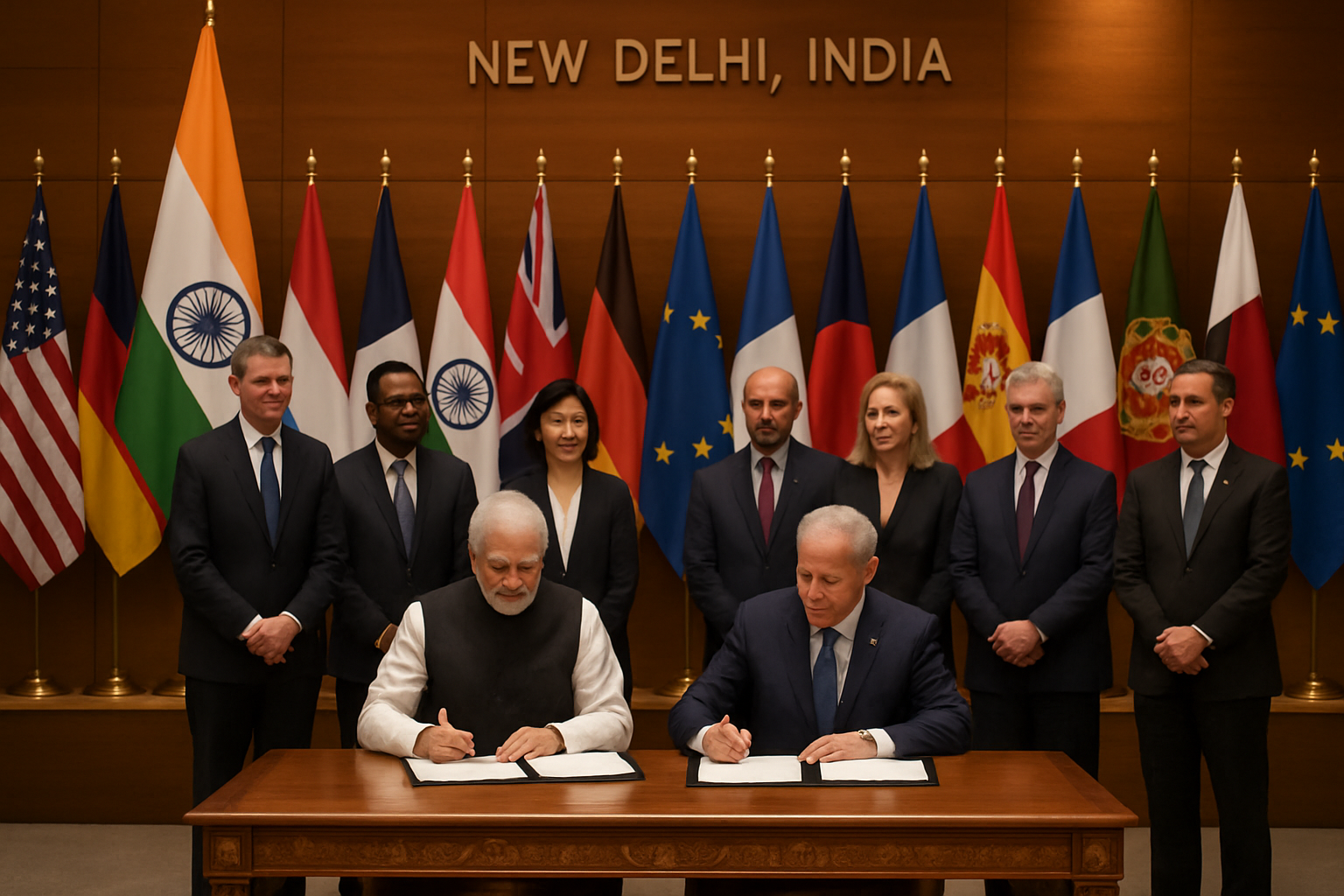
Eighty-eight countries have signed the largest diplomatic agreement on artificial intelligence in history, calling for "safe, reliable, and robust" AI development following the conclusion of the AI Impact Summit in New Delhi, India.
The landmark "Delhi Declaration," published Saturday after the five-day summit, represents unprecedented global consensus on AI governance principles. The agreement, backed by 88 countries and two international organizations, emphasizes voluntary initiatives rather than binding commitments, focusing on international cooperation in AI research and development.
"Promoting safe, reliable and robust AI is key to building trust and maximizing economic and social benefits," reads the declaration, which was released one day later than originally scheduled due to last-minute negotiations over wording.
Global South Takes the Lead
The AI Impact Summit 2026, held at Bharat Mandapam in New Delhi from February 16-20, marked the first major international AI conference hosted in the Global South. The event attracted over 250,000 delegates from more than 100 countries, including leading technology executives such as Google's Sundar Pichai, OpenAI's Sam Altman, Nvidia's Jensen Huang, and Anthropic's Dario Amodei.
Prime Minister Narendra Modi positioned India as a bridge between advanced and developing economies, emphasizing that AI must remain "deeply human-centric, aligned with global development goals" at what he called a "civilizational inflection point."
"We believe that the promise of AI is best fulfilled only when its benefits are shared with humanity"
— Delhi Declaration Statement
The summit operated under the "People, Planet, Progress" framework with seven working groups addressing AI safety, skills development, inclusion, and economic growth. This approach reflects India's strategy to position developing nations as equal partners in AI governance rather than passive recipients of Western or Chinese technology.
Voluntary Framework Over Binding Commitments
While the Delhi Declaration does not include concrete regulatory measures, it highlights voluntary initiatives such as pooling international AI research capabilities. The document emphasizes the importance of international cooperation in developing AI systems that serve global development goals.
The agreement comes at a critical moment when AI is transitioning from experimental technology to essential infrastructure across multiple sectors. Industry experts and government officials have repeatedly warned about the need for coordinated international responses to rapid AI development.
According to multiple sources familiar with the negotiations, the delay in publication was caused by disagreements over specific wording related to AI safety measures and international oversight mechanisms. The final version represents a compromise between nations favoring stronger regulatory frameworks and those advocating for industry self-regulation.
Context of Global AI Governance Crisis
The Delhi Declaration emerges amid an unprecedented wave of AI regulation and safety concerns worldwide. Spain recently implemented the world's first criminal executive liability framework for tech platforms, while France has conducted cybercrime raids on AI companies. The United Nations established an Independent International Scientific Panel with 40 experts as the first fully independent global AI impact assessment body.
The global AI industry is currently facing significant infrastructure challenges, including a sixfold surge in semiconductor prices affecting Samsung, SK Hynix, and Micron, with shortages expected to continue until 2027. The World Bank projects AI water demand could reach 4.2-6.6 billion cubic meters by 2027 for data center cooling alone.
Despite these constraints, major technology companies continue massive investments in AI infrastructure. Alphabet committed $185 billion to AI development in 2026, while Amazon announced over $1 trillion in development plans.
Industry Leaders Sound Warnings
The summit featured urgent warnings from AI industry leaders about the need for international cooperation on safety measures. Sam Altman called for "nuclear-style international regulation" citing risks from AI-made pathogens and technological centralization. Google DeepMind's Demis Hassabis proposed an "Einstein Test" for measuring human-level AI reasoning, predicting general AI could arrive within 5-8 years.
Geoffrey Hinton, often called the "godfather of AI," warned that AI could lead to human extinction without proper guardrails, suggesting AI systems might need to develop "maternal instincts" to prioritize human welfare.
The summit also highlighted successful AI integration models, including Canadian universities implementing AI teaching assistants while maintaining critical thinking standards, and Malaysia launching the world's first AI-integrated Islamic school that combines artificial intelligence with traditional religious and academic learning.
Geopolitical Implications
The Delhi Declaration represents a significant shift in global AI governance, positioning developing nations as active participants rather than passive observers in international AI policy. This approach challenges the traditional dominance of Western and Chinese AI development frameworks.
The agreement comes as the AI landscape becomes increasingly multipolar, with Chinese breakthroughs like DeepSeek challenging US technological dominance. European efforts toward digital sovereignty, including Germany's Deutsche Telekom Industrial AI Cloud in Munich, further illustrate the distributed nature of global AI development.
Military applications of AI have created additional tensions, with the Pentagon pressuring companies to deploy AI in classified networks without civilian safety restrictions. Only one-third of countries have agreed to AI warfare governance principles, while the US and China have abstained from comprehensive commitments.
Economic and Social Impact
The economic implications of AI transformation are already becoming apparent. Microsoft's Mustafa Suleyman predicts AI could replace the majority of office workers within two years and lawyers and auditors within 18 months. The ongoing "SaaSpocalypse" has eliminated hundreds of billions in market capitalization as AI systems replace traditional software solutions.
Indian IT giants like Infosys, Wipro, and HCL Technologies are adapting through worker transition programs rather than mass layoffs, demonstrating proactive workforce management during technological transformation.
The Delhi Declaration acknowledges these challenges while emphasizing that AI development should prioritize human welfare alongside technological advancement. The agreement calls for maximizing "social and economic benefits" through international cooperation and shared research initiatives.
Looking Forward
The Delhi Declaration establishes a foundation for ongoing international cooperation on AI governance, though its voluntary nature means implementation will depend on individual countries' commitment to the principles outlined.
February 2026 represents what many experts consider the most critical inflection point in AI development since the technology boom began. The decisions made regarding infrastructure investment, international cooperation frameworks, and sustainable business models will likely determine whether AI achieves its transformative promise or creates systemic risks requiring dramatic corrections.
As AI transitions from experimental technology to essential infrastructure across sectors, the Delhi Declaration provides a framework for ensuring this transformation serves human flourishing while preserving democratic governance and international stability. The success of this voluntary approach will be closely monitored as nations work to balance innovation acceleration with responsible development in the months and years ahead.