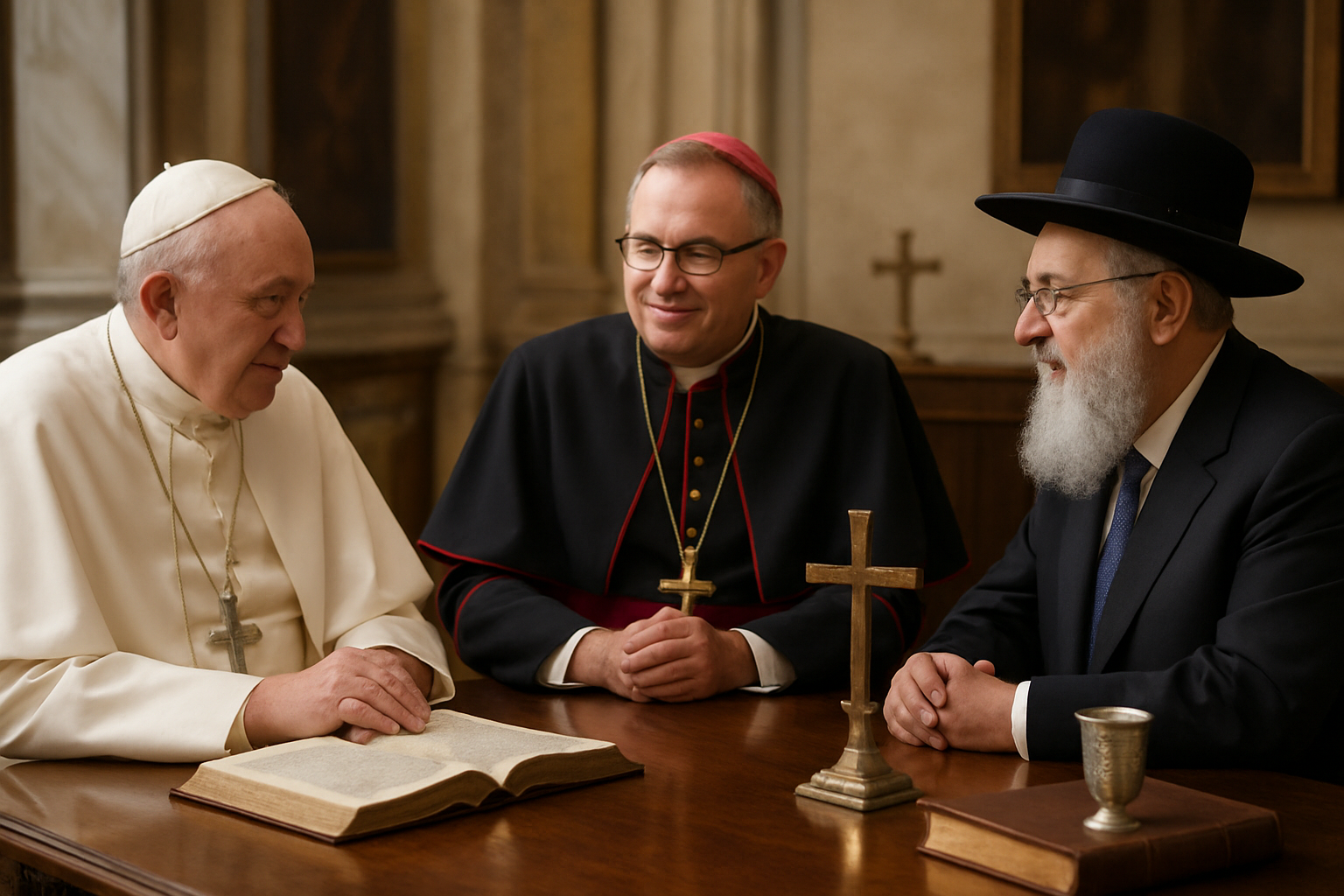
The global religious landscape witnessed unprecedented developments this week as Pope Leo XIV met with the first female Archbishop of Canterbury while three women made history by becoming the first to take Chief Rabbinate examinations in Israel, marking a watershed moment in interfaith relations and women's religious leadership worldwide.
Vatican-Anglican Historic Summit
In a ceremony steeped in both tradition and transformation, Pope Leo XIV welcomed Dame Sarah Mullally, the newly appointed Archbishop of Canterbury and first woman to lead the Anglican Communion, to the Vatican's ornate Apostolic Palace on Monday. The meeting marked the 60th anniversary of the first official ecumenical declaration between the Anglican and Roman Catholic Churches, signed in 1966.
The encounter, described by Vatican sources as "profoundly symbolic," saw the leaders of the world's 1.4 billion Catholics and 85 million Anglicans exchange gifts and pray together in what both churches characterized as a renewed commitment to Christian unity. Pope Leo XIV, the first American pontiff, emphasized that theological differences should not prevent shared witness to Christ's message.
"The differences must not stop the common mission of announcing Christ and giving joint witness in the world. It would be a scandal not only to fail in that shared mission, but also to stop striving to overcome divisions, however intractable they may seem."
— Pope Leo XIV, Vatican Press Office
Archbishop Mullally, who made history in March as the 106th Archbishop of Canterbury, described her four-day pilgrimage to Rome as both a personal spiritual journey and an institutional milestone. Her appointment represents the culmination of a decades-long movement toward women's ordination within Anglican tradition, following the consecration of the first women bishops in 2015.
Breaking Barriers in Jewish Religious Leadership
Simultaneously in Israel, three women made history by becoming the first to sit for Chief Rabbinate examinations, following years of legal battles and a court-ordered emergency injunction. The women took the examination on laws of mourning in a separate location from male candidates, a compromise that preserved Orthodox sensibilities while opening new pathways for female religious scholarship.
The breakthrough came after extensive legal proceedings that challenged traditional barriers to women's participation in formal rabbinical education and certification within Israel's Orthodox establishment. While the women were tested separately from their male counterparts, their participation represents a significant precedent in Orthodox Judaism's approach to women's religious authority.
Jewish legal scholars note that the development reflects broader conversations within Orthodox communities worldwide about women's roles in religious leadership, ritual participation, and Torah scholarship. The Israeli Chief Rabbinate's accommodation, while limited, signals a potential evolution in institutional approaches to gender and religious authority.
Pope Leo XIV's Revolutionary Diplomacy
The Vatican meetings occur against the backdrop of Pope Leo XIV's increasingly assertive diplomatic approach, which Vatican sources describe as prioritizing "moral authority over diplomatic comfort." This represents a fundamental departure from traditional Vatican protocols, as evidenced by the Pope's recent completion of a historic 11-day African tour that included the first papal visit to Algeria in Catholic Church history.
During his African journey, which concluded on April 23, Pope Leo XIV established new precedents for Vatican engagement with Muslim-majority nations, conducting spiritual pilgrimages to sites associated with Saint Augustine while fostering Catholic-Muslim dialogue. The tour, spanning Algeria, Cameroon, Angola, and Equatorial Guinea, acknowledged Africa as the fastest-growing Catholic region worldwide, representing over 1.4 billion believers.

Anglican Communion Transformation
Archbishop Mullally's appointment represents more than symbolic progress; it fundamentally alters the institutional landscape of global Christianity. As spiritual leader of the Anglican Communion, she oversees churches across diverse cultural contexts from Africa to Asia to the Americas, each with distinct approaches to theology, social issues, and church governance.
Her background as a former nurse and civil servant brings a unique perspective to religious leadership, emphasizing healthcare ethics, social justice, and practical spirituality. During her enthronement ceremony at Canterbury Cathedral in March, she was honored with nurses and caregivers in the congregation, reflecting her commitment to bridging secular and sacred service.
Bishop Rachel Treweek, a pioneering figure in women's Anglican leadership, observed the rapid pace of change: "I don't think any of us thought we'd have a female Archbishop this quickly." The comment reflects both surprise and recognition that institutional transformation can accelerate when supported by broader social movements.
Interfaith Dialogue Renaissance
The convergence of these developments signals a broader renaissance in interfaith dialogue and religious institutional reform. Pope Leo XIV's meeting with Archbishop Mullally demonstrates Catholic commitment to ecumenical progress despite theological differences on issues including papal authority, clerical celibacy, and women's ordination.
The timing proves particularly significant given the Pope's recent emphasis on interfaith bridge-building through his African tour, where Catholic-Muslim dialogue during Ramadan's conclusion created what Vatican sources termed "spiritual convergence." This approach extends beyond Christianity to encompass broader religious cooperation addressing global challenges.
Religious scholars note that the simultaneous advancement of women's leadership in both Anglican and Jewish contexts reflects evolving interpretations of sacred texts and traditions in contemporary settings. While Orthodox Judaism and Roman Catholicism maintain traditional positions on women's ordination, other denominations demonstrate increasing openness to expanded roles.
Global Implications for Religious Freedom
These developments occur within a broader context of religious freedom challenges worldwide. Recent months have witnessed restrictions on religious observances in conflict zones, including unprecedented limitations on access to Jerusalem's holy sites during major religious holidays affecting billions of believers.
The positive trajectory of institutional dialogue contrasts sharply with geopolitical tensions affecting religious communities. Pope Leo XIV's African tour included strong condemnations of global "tyrants" who prioritize military expenditure over humanitarian needs, positioning the Vatican as an increasingly assertive moral voice in international affairs.
"These meetings represent hope that ancient spiritual traditions can provide contemporary guidance for a world seeking peace, justice, and human dignity across religious boundaries."
— Vatican diplomatic source
Women's Religious Leadership Evolution
The parallel advances in Anglican and Jewish women's religious participation reflect broader patterns of institutional adaptation to contemporary social expectations. Archbishop Mullally's appointment follows decades of Anglican women's ordination movements, while the Israeli rabbinical examinations represent incremental progress within more traditionalist frameworks.
Religious historians emphasize that these changes emerge from extensive theological scholarship, legal advocacy, and community organizing rather than sudden institutional decisions. The methodical approach suggests sustainable transformation rather than temporary accommodation to external pressure.
In Protestant denominations, women's ordination has become commonplace, with female bishops, pastors, and theological professors serving throughout Europe, North America, and other regions. The Anglican Communion's embrace of female archiepiscopal leadership represents a culmination of this trajectory within one of Christianity's most influential traditions.
Constitutional and Legal Dimensions
Archbishop Mullally's role extends beyond religious leadership to include constitutional responsibilities within the Church of England's relationship with the British state. As senior bishop, she holds significant moral authority in national affairs, contributing to parliamentary debates and social policy discussions.
Her appointment occurs during a period of increased attention to women's leadership across British institutions, from corporate governance to political representation. The symbolism of female leadership in Britain's established church resonates beyond religious communities to broader conversations about institutional modernization and representative leadership.
Similarly, the Israeli rabbinical examination breakthrough reflects legal system engagement with religious authority questions. Courts balanced Orthodox religious autonomy with gender equality principles, creating accommodation that respects traditional sensibilities while opening new possibilities for women's religious scholarship.
Future Trajectory of Interfaith Relations
The Vatican-Anglican summit and Jewish women's rabbinical advancement suggest accelerating institutional change within global religious communities. Pope Leo XIV's direct diplomatic approach, combined with Archbishop Mullally's groundbreaking leadership, creates new frameworks for addressing contemporary challenges through spiritual authority.
Religious diplomacy experts anticipate that these precedents will influence interfaith dialogue strategies, particularly regarding women's participation in religious leadership and institutional decision-making. The successful accommodation of traditional theological positions with progressive social expectations provides templates for other religious communities facing similar pressures.
The timing proves particularly significant given global challenges requiring coordinated religious community responses, from climate change to economic inequality to conflict resolution. Effective interfaith cooperation increasingly depends on inclusive leadership that reflects diverse community perspectives and experiences.
Template for Religious Institutional Reform
The methodical approach to institutional change demonstrated in both Anglican and Jewish contexts offers valuable lessons for religious communities worldwide. Rather than dramatic confrontation with traditional authorities, these advances reflect patient advocacy, legal scholarship, and incremental accommodation that preserves core spiritual values while expanding participation opportunities.
Vatican sources indicate that Pope Leo XIV's approach to interfaith dialogue emphasizes moral authority derived from authentic spiritual witness rather than diplomatic accommodation to secular expectations. This framework potentially strengthens religious voice in international affairs while maintaining theological integrity.
The convergence of female religious leadership advancement with intensified interfaith dialogue suggests that institutional modernization and spiritual authenticity can reinforce rather than contradict each other. This synthesis may prove crucial for religious communities' continued relevance in addressing 21st-century global challenges through ancient wisdom adapted to contemporary contexts.