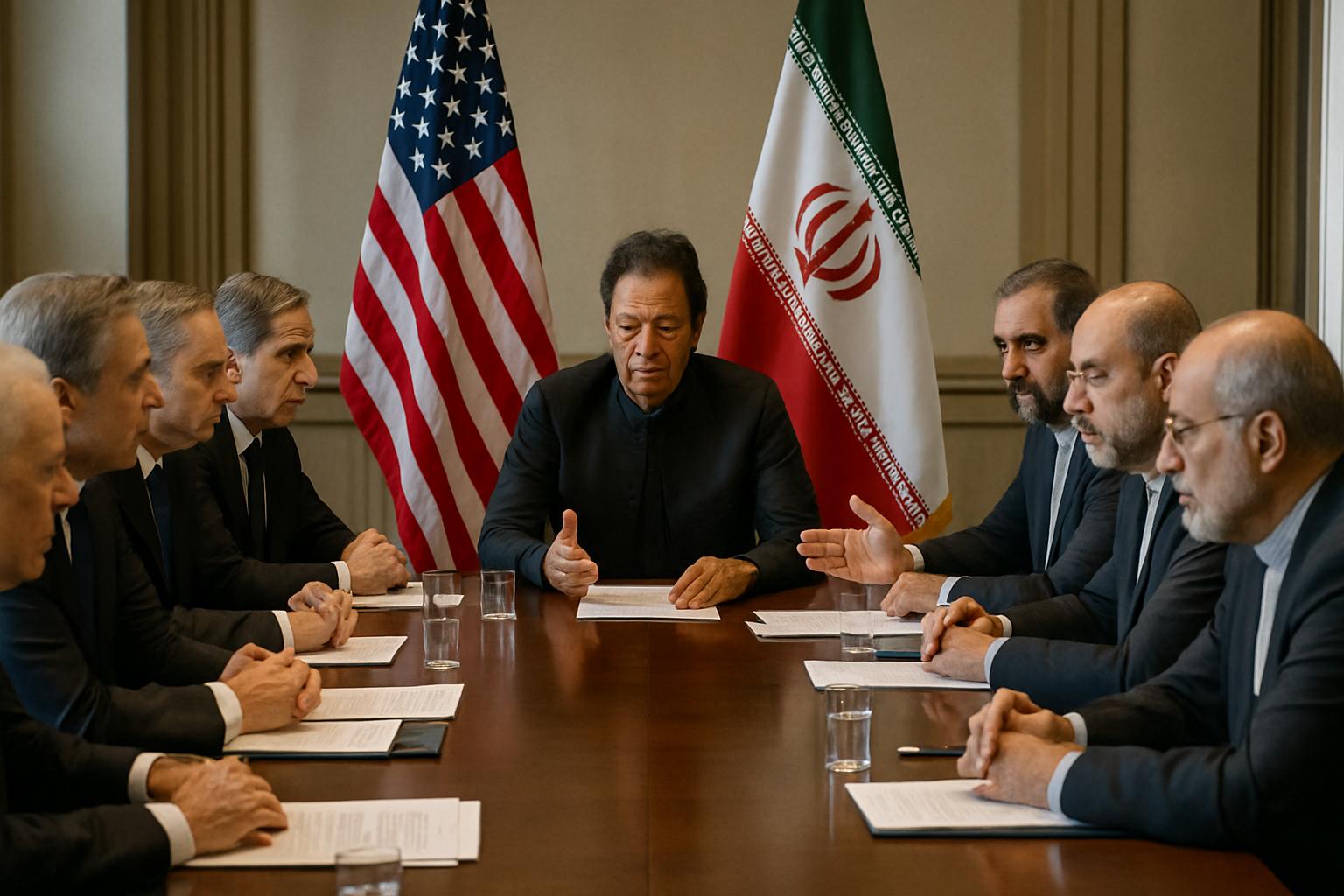
The United States and Iran reached a historic two-week ceasefire agreement just over an hour before President Trump's apocalyptic deadline to destroy Iranian "civilization," ending the most dangerous international crisis since the Cold War and triggering the steepest oil price collapse in six years.
The breakthrough diplomatic agreement, mediated by Pakistan and announced at 10:43 PM ET Tuesday via Trump's Truth Social platform, immediately crashed global oil prices nearly 20% from crisis peaks of $119.50 per barrel to below $100, providing instant relief to economies worldwide that had been reeling from the unprecedented energy shock.
Last-Minute Diplomacy Prevents Catastrophe
The ceasefire came after Pakistan's Prime Minister Shehbaz Sharif and Field Marshal Asim Munir maintained round-the-clock contact with both sides, presenting Iran's 10-point proposal to the Trump administration as a "workable basis for negotiations." Iranian Foreign Minister Abbas Araghchi confirmed Tehran's agreement to reopen the Strait of Hormuz for "safe passage" during the two-week period "in coordination with Iranian armed forces."
"I have agreed to back off attacks for two weeks, subject to Iran reopening the Strait," Trump declared, stepping back from earlier warnings that "a whole civilization will die tonight."
— President Donald Trump, Truth Social
The agreement represents a dramatic reversal from Trump's earlier threats to "destroy every bridge and power plant in Iran" if the strategic Strait of Hormuz remained closed. The waterway, which handles 40% of global oil transit, had been effectively blocked by Iranian naval mines for weeks, creating the worst energy crisis since the 1970s oil shocks.
Global Markets Surge on Crisis Resolution
Asian stock markets opened with explosive rallies Wednesday morning, with traders celebrating the diplomatic breakthrough. Oil futures collapsed 18% in overnight trading, while airlines began planning resumptions of Middle East routes that had been suspended during the crisis. The IEA announced it would begin reducing its record 400-million-barrel emergency reserve release, the largest intervention in the agency's 50-year history.
The agreement immediately ended the aviation crisis that had seen over 18,000 flights cancelled worldwide—the most extensive disruption since COVID-19. Dubai International Airport, the world's busiest with 86 million passengers annually, which had been shuttered by missile damage, announced preparations for reopening operations.
Pakistan's Diplomatic Triumph
Pakistan emerged as the crucial mediator in the crisis, with Prime Minister Shehbaz Sharif confirming the ceasefire would take "immediate" effect and cover "all fronts including Lebanon." The breakthrough demonstrates the capacity of middle powers to bridge major adversary divides during international crises when traditional mechanisms fail.
China's Foreign Minister Wang Yi expressed "full support" for Pakistan's initiative, while Germany noted "positive signs" for the direct talks scheduled to begin Friday in Islamabad under the proposed "Islamabad Accord" framework—the most direct US-Iran diplomatic engagement in decades.
Iran's Revolutionary Victory Claims
Iran's Supreme National Security Council called the ceasefire a "historic victory," claiming it had "forced Trump to accept Iran's 10-point plan." The statement represents a major shift from Iran's earlier categorical rejection of temporary measures, with Tehran now accepting negotiations on broader regional arrangements while maintaining Revolutionary Guard control over Strait of Hormuz coordination mechanisms.
"Iran has achieved a great victory and forced the United States to accept its 10-point plan, which includes controlled passage through the Strait of Hormuz and the necessity of ending the war against all elements of the 'axis of resistance.'"
— Iran's Supreme National Security Council
The Crisis That Brought the World to Its Knees
The ceasefire ends what UN Secretary-General António Guterres called "the greatest test of multilateral cooperation and crisis management in the modern era." The conflict had reached unprecedented scale, with Operation Epic Fury costing $11.3 billion in its first week alone, making it the largest Middle East operation since the 2003 Iraq invasion.
The human toll was severe, with Iran's Red Crescent reporting 787+ civilian casualties from US-Israeli strikes, including a Pentagon-confirmed elementary school attack that killed 165-185 students due to "outdated targeting data." International evacuations reached Arab Spring 2011 scale, with Australia reporting 115,000 citizens trapped and Germany evacuating 30,000 nationals.
European Territory Attacked for First Time Since WWII
The conflict marked a historic escalation when Iranian drones struck RAF Akrotiri in Cyprus—the first attack on European territory since World War II. This unprecedented assault prompted an extraordinary naval coalition response featuring HMS Dragon alongside Spanish, Italian, French, Dutch, and Greek vessels, with the EU activating its ESTIA evacuation mechanism for the first time in bloc history.
Nuclear Diplomacy Collapse Led to Crisis
The confrontation emerged from the complete collapse of US-Iran nuclear negotiations despite achieving a "broad agreement on guiding principles" in Geneva talks—the most progress since the JCPOA collapsed in 2018. The fundamental scope disagreement proved insurmountable: Iran demanded nuclear-only talks excluding ballistic missiles and regional proxies as "red lines," while the US insisted on comprehensive agreements addressing missiles, armed groups, and human rights.
Iran continues uranium enrichment at 60% purity with over 400kg of weapons-grade material—sufficient for multiple nuclear weapons if weaponized. The crisis unfolded against the backdrop of the New START treaty's expiration in February 2026, creating the first 50-year period without US-Russia nuclear constraints and a broader nuclear governance crisis.
Regional Coalition Severely Strained
The conflict severely tested the unprecedented regional coalition of Saudi Arabia, UAE, Qatar, and Egypt that had supported diplomatic solutions. Iranian "Operation True Promise 4" systematically targeted coalition territories, with casualties including 1 killed in Abu Dhabi, 32 injured at Kuwait airports, and 8 wounded in Qatar despite intercepting 65 missiles and 12 drones.
Egyptian President Sisi condemned attacks on "sisterly countries," warning of "comprehensive chaos" spreading across the region as the coalition faced the difficult choice between maintaining US alliance and avoiding Iranian retaliation.
Congressional Opposition Reached Historic Levels
The conflict faced unprecedented domestic opposition, with only 25% of Americans supporting the military action—an "almost unprecedented" level of unpopularity for early-stage operations. Senator Chris Blumenthal said he was "more concerned than ever" about potential ground troops, while the Pentagon projected operations continuing through September, far beyond Trump's initial 4-6 week timeline.
High-Level US Delegation Expected for Pakistan Talks
Sources indicate the US delegation for Friday's Islamabad talks may include Vice President JD Vance, special envoy Steve Witkoff, and Jared Kushner. Iran's 10-point proposal addresses Hormuz protocols, sanctions relief, regional conflicts, and security guarantees, offering the most comprehensive framework for US-Iran engagement in decades.
Energy Architecture Transformation Imperative
The crisis exposed dangerous vulnerabilities in global energy systems, with the 21-mile Strait of Hormuz proving a catastrophic single-point failure for modern logistics. The over-dependence on strategic chokepoints requires fundamental restructuring to reduce geopolitical volatility, though supply diversification and renewable transitions will require years or decades to implement.
Template-Setting Significance for 21st Century
The successful diplomatic resolution provides a template for crisis management in the multipolar era, demonstrating that innovative solutions remain possible even in the "darkest hours" when stakes reach maximum levels affecting energy security, nuclear governance, and international law enforcement simultaneously.
"This represents the greatest test of multilateral cooperation and crisis management in the modern era. The success demonstrates that diplomatic solutions are possible even in the darkest hours."
— UN Secretary-General António Guterres
Pakistan's mediation success shows that middle powers can successfully bridge major adversary divides, providing a framework for future crisis management when traditional diplomatic mechanisms fail. The breakthrough offers hope that the preference for military solutions can be avoided globally through innovative multilateral cooperation.
What Happens Next
The two-week ceasefire provides a crucial breathing space for innovative diplomatic solutions to bridge US-Iran disagreements that have persisted for decades. The success or failure of the Islamabad talks will have implications extending far beyond the current crisis, potentially reshaping approaches to territorial sovereignty, nuclear governance, and conflict resolution for the 21st century.
While both sides claim victory—Trump calling it a "total and complete victory" while Iran declares it forced US acceptance of its terms—the true test lies ahead in converting this temporary pause into a lasting framework for regional stability and global energy security.
As oil markets stabilize and flights resume across the Middle East, the world can exhale after coming closer to catastrophic conflict than at any time since the Cuban Missile Crisis. The next two weeks will determine whether this watershed moment leads to genuine breakthrough or merely postpones an even more dangerous confrontation.