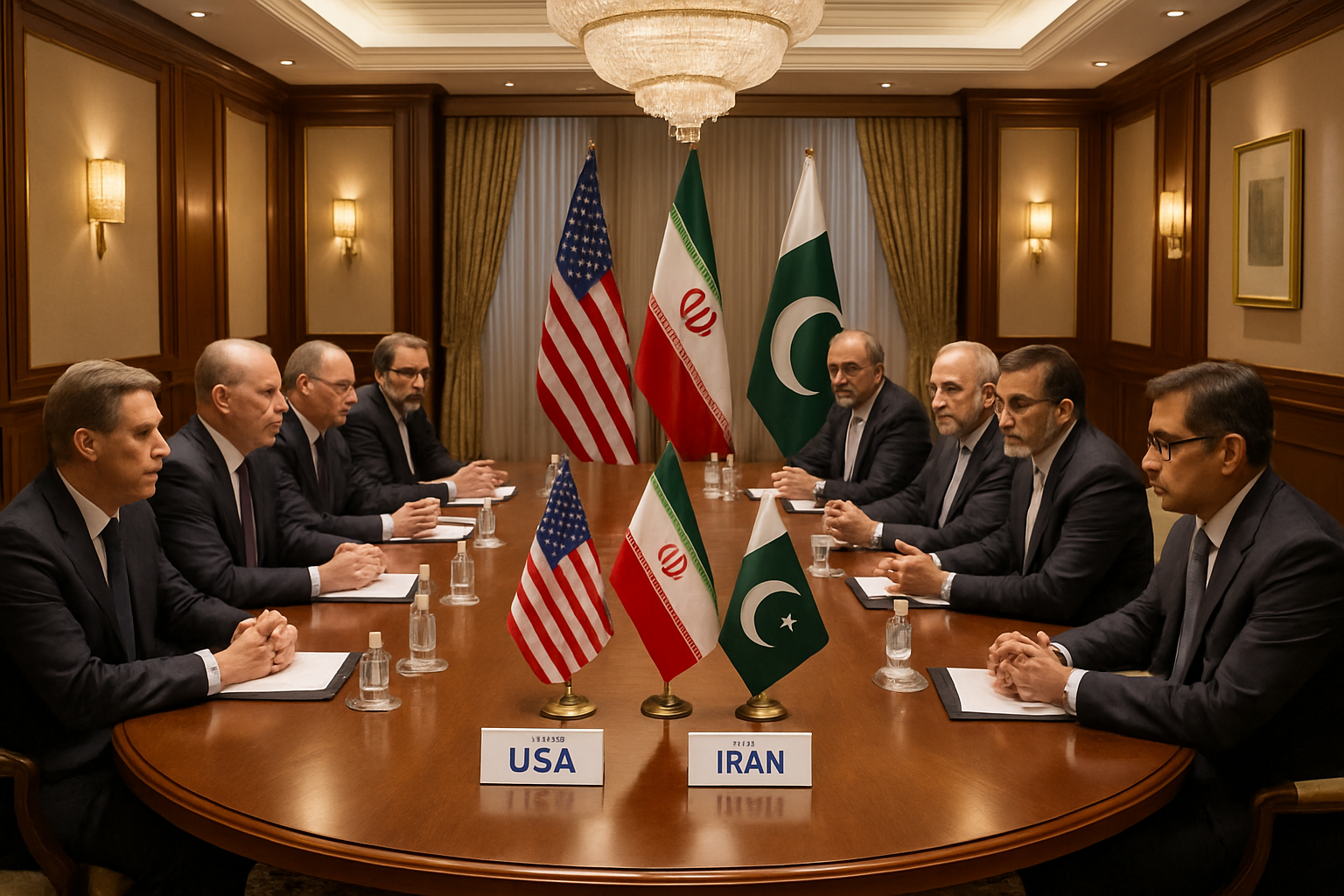
Historic direct negotiations between the United States and Iran have officially commenced in Islamabad, Pakistan, marking the most significant diplomatic engagement between the two adversaries in nearly five decades.
The talks, taking place at the luxurious Serena Hotel in Islamabad's heavily secured Red Zone, represent the culmination of Pakistan's unprecedented mediation efforts that successfully brokered a ceasefire just 88 minutes before what President Trump had called a "whole civilization will die tonight" deadline on April 8, 2026.
Breakthrough Mediation Success
Pakistani Prime Minister Shehbaz Sharif and Field Marshal Asim Munir emerged as the unlikely heroes of international diplomacy, utilizing an innovative "message relay system" to maintain round-the-clock communication between Vice President JD Vance and Iranian Foreign Minister Abbas Araghchi when direct communication had become impossible.
The "Islamabad Accord" framework represents the most direct US-Iran diplomatic engagement since the 1979 Islamic Revolution, with Iran's comprehensive 10-point proposal addressing crucial issues including Strait of Hormuz protocols, sanctions relief, regional conflicts, and security guarantees.
"The fact that the talks are even happening is the biggest achievement thus far. It's significant that the ceasefire is in effect [and] the bombing has stopped in Iran and across most of the Middle East, and the two major [powers] are now negotiating."
— Bilawal Bhutto-Zardari, PPP Chairman and Former Foreign Minister
High-Level Delegations Convene
Vice President JD Vance leads the American delegation, potentially accompanied by Special Envoy Steve Witkoff and senior advisor Jared Kushner. Iranian President Masoud Pezeshkian confirmed his participation following what officials described as a "warm cordial" 45-minute telephone call with Prime Minister Sharif.
The Iranian delegation is headed by Parliament Speaker Mohammad Bagher Ghalibaf and Foreign Minister Abbas Araghchi, representing the highest-level Iranian diplomatic engagement with the United States since the Joint Comprehensive Plan of Action (JCPOA) negotiations in 2015.
Global Crisis Resolution
The diplomatic breakthrough has already yielded dramatic global relief. Oil prices crashed nearly 20% from $119.50 Brent to below $100 per barrel following the ceasefire announcement—the steepest decline in six years. The Strait of Hormuz, which handles approximately 40% of global oil transit, has been partially reopened under Iranian coordination.
The resolution of what UN Secretary-General Antonio Guterres called "the greatest test of multilateral cooperation in the modern era" ended an unprecedented global crisis that saw over 18,000 flights cancelled worldwide and emergency strategic petroleum reserve releases totaling 400 million barrels—the largest in 50-year history.
Critical Challenges Ahead
Despite the diplomatic success, significant challenges remain. A critical loophole has emerged regarding Lebanon, where Israeli Prime Minister Benjamin Netanyahu explicitly excluded the country from the ceasefire framework. This omission threatens the broader peace process, with Iran warning of potential withdrawal from talks unless comprehensive enforcement is maintained across all fronts.
The situation in Lebanon has deteriorated dramatically, with 1.2 million people displaced—representing 25% of the population—and systematic targeting of medical infrastructure resulting in 26 paramedic deaths since March.
Nuclear Diplomacy Window
The talks create a crucial diplomatic window to address Iran's nuclear program. Iran continues uranium enrichment at 60% purity with stockpiles exceeding 400 kilograms of weapons-grade material, sufficient for multiple nuclear weapons if weaponized. The current crisis emerged from the complete collapse of Geneva framework talks despite achieving what negotiators called "broad agreement on guiding principles."
The urgency is heightened by the February 2026 expiration of the New START treaty between the United States and Russia—marking the first time in over 50 years without major power nuclear constraints.
Regional Coalition Resilience
Remarkably, the unprecedented coalition of Saudi Arabia, UAE, Qatar, and Egypt has maintained unity throughout the crisis, despite Iranian attacks on their territories that killed one civilian in Abu Dhabi, injured 32 in Kuwait, and wounded eight in Qatar. Egyptian President Abdel Fattah el-Sisi's warnings of "comprehensive chaos" were heeded, and the coalition has thrown its support behind the Pakistani mediation framework.
Economic Relief and Recovery
Asian markets have exploded in positive rallies, led by Pakistan's KSE-100 index achieving a record 8.15% surge. Aviation industries are planning resumption of Middle East routes after the crisis forced the closure of Dubai International Airport and the suspension of operations by major airlines including Emirates, Air France-KLM, and Wizz Air.
Consumer relief is anticipated globally, with Bangladesh reviewing fuel rationing affecting 170 million people, Pakistan considering reversal of wartime austerity measures, and European households expecting cost reductions. Qatar is resuming LNG production representing 20% of global exports, while shipping companies are mobilizing over 150 stranded tankers carrying billions of dollars in cargo.
Template for 21st Century Diplomacy
Pakistan's emergence as a crucial mediator demonstrates the potential for middle power diplomacy in bridging divides between major adversaries when traditional great power mechanisms fail. China's Foreign Minister Wang Yi expressed "full support" for the Pakistani initiative, while Germany noted "positive signs" for continued diplomatic momentum.
The success provides a template for 21st-century conflict resolution, showing that diplomatic solutions remain possible even in the darkest hours when stakes affect global energy security, nuclear governance, and international law enforcement simultaneously.
Two-Week Critical Window
The current two-week ceasefire window represents a decisive moment for converting temporary peace into a lasting framework. The comprehensive nature of Iran's proposal, addressing everything from maritime protocols to regional security arrangements, offers the most detailed US-Iran negotiation framework since the 2015 nuclear agreement.
Success or failure in these Islamabad talks will determine whether diplomatic innovation can resolve decades-old disagreements or whether the region returns to the most dangerous international crisis since the Cold War ended.
"We hope that this ceasefire is built upon towards a more lasting and permanent resolution to this conflict."
— Bilawal Bhutto-Zardari on the Path Forward
Historical Significance
The April 11, 2026 commencement of talks represents a watershed moment in international relations, demonstrating that multilateral cooperation can succeed in preventing catastrophic conflict even when traditional diplomatic mechanisms appear exhausted. The Pakistani mediation model offers hope for future crisis management in an increasingly volatile and interconnected world.
As negotiations continue at the Serena Hotel under unprecedented security measures involving over 10,000 personnel, the world watches to see whether this diplomatic breakthrough can forge a lasting peace or merely provide temporary respite from one of the most dangerous confrontations in modern history.