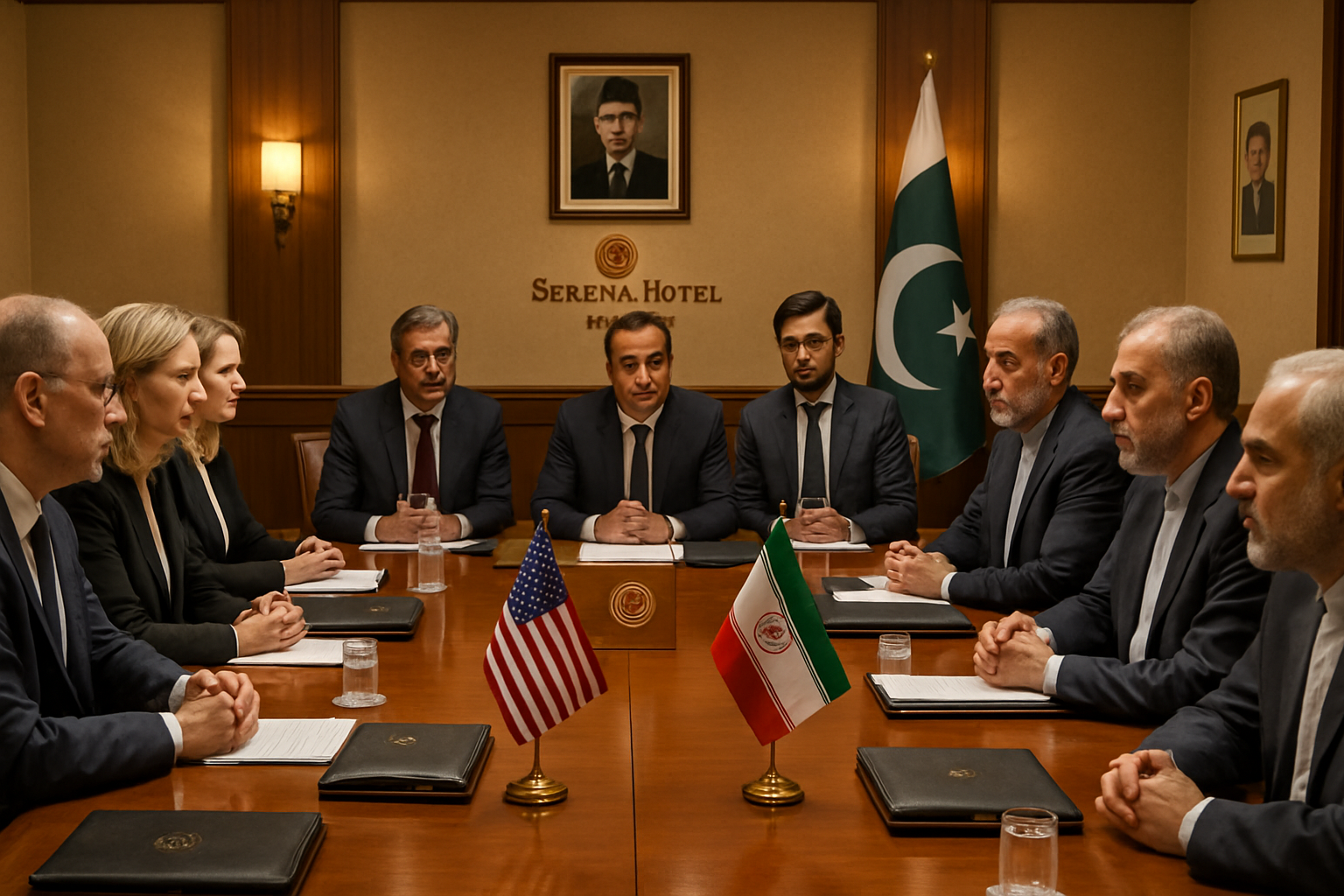
High-stakes diplomatic negotiations between the United States and Iran have commenced in Islamabad, Pakistan, marking the most direct engagement between the two adversaries in decades following Pakistan's successful mediation of a historic ceasefire that averted global catastrophe just days ago.
Vice President JD Vance arrived in Pakistan Friday leading the highest-level US diplomatic mission to engage with Iran since the 2015 nuclear deal, while Iranian President Masoud Pezeshkian confirmed his delegation's participation in what observers are calling the most significant diplomatic breakthrough since the Cold War ended.
Pakistan's Unprecedented Diplomatic Achievement
The talks are the culmination of an extraordinary diplomatic intervention by Pakistan Prime Minister Shehbaz Sharif and Field Marshal Asim Munir, who successfully mediated a ceasefire agreement just 88 minutes before President Trump's "whole civilization will die tonight" deadline on April 8, 2026.
The breakthrough, known as the "Islamabad Accord," represents what UN Secretary-General António Guterres called "the greatest test of multilateral cooperation in the modern era." Pakistan's innovative "message relay system" facilitated indirect communication between Washington and Tehran when direct talks had become impossible.
"This is a proud moment for the entire Muslim world, as Pakistan takes a central role in efforts to ease regional tensions."
— Shehbaz Sharif, Prime Minister of Pakistan
The Pakistani mediation succeeded in crashing oil prices by nearly 20% from their crisis peak of $119.50 per barrel, providing immediate relief to global markets and consumers worldwide. The Strait of Hormuz, which handles 40% of global oil transit, has been partially reopened under Iranian coordination following weeks of closure by naval mining operations.
Comprehensive Framework for Peace
Iran's 10-point proposal, accepted by the Trump administration as a "workable basis for negotiations," addresses the most complex issues dividing the two nations: Hormuz protocols, sanctions relief, regional conflicts, and security guarantees. This represents the most comprehensive US-Iran framework since the 2015 nuclear deal collapsed.
The talks occur during a critical two-week window that could determine whether the temporary ceasefire becomes a lasting peace framework or the world returns to what was described as the most dangerous international crisis since the Cold War.
However, significant challenges remain. Iran continues uranium enrichment at 60% purity—approaching weapons-grade levels—with an estimated 400+ kilograms stockpiled. The collapse of the New START treaty in February 2026 has left the world without US-Russia nuclear constraints for the first time in over 50 years, adding urgency to diplomatic solutions.
Lebanon Crisis Threatens Progress
A critical loophole has emerged that threatens to derail the entire process. Israeli Prime Minister Netanyahu explicitly excluded Lebanon from the ceasefire framework, leading to devastating strikes that killed 254+ people in a single day—the deadliest bombardment since the conflict began. Iran has threatened to withdraw from talks unless the ceasefire is enforced across all fronts.
The humanitarian crisis in Lebanon has displaced 1.2 million people (25% of the population), with emergency shelters overwhelmed and thousands sleeping on Beirut streets. Systematic targeting of medical personnel has resulted in 26 paramedic deaths since March, potentially violating Geneva Convention protections.
Regional Coalition Holds Despite Strain
An unprecedented coalition of Saudi Arabia, UAE, Qatar, and Egypt has maintained support for the diplomatic process despite Iranian attacks during the crisis that caused casualties across member territories. Egypt's President Sisi, who had warned of "comprehensive chaos," has backed Pakistan's mediation efforts throughout.
China's Foreign Minister Wang Yi expressed "full support" for Pakistan's initiative, while Germany noted "positive signs" for the direct talks. This international backing demonstrates the global stakes in the negotiations' success.
The Cost of Conflict
The crisis that brought both nations to the brink cost the United States $11.3 billion in its first week alone—the largest Middle East operation since the 2003 Iraq invasion. Operation Epic Fury resulted in 3 US service members killed and 150 wounded, while Iran reported over 787 civilian casualties from US-Israeli strikes.
The global economic impact was severe: 18,000+ flights were cancelled worldwide in the most extensive aviation crisis since COVID-19, with Dubai International Airport—the world's busiest—remaining shuttered due to missile damage. The International Energy Agency released a record 400 million barrels from strategic reserves, the largest intervention in 50 years.
Nuclear Diplomacy Window
The current crisis emerged from the complete collapse of Geneva nuclear talks in February, despite achieving "broad agreement on guiding principles"—the most progress since the 2018 JCPOA breakdown. The fundamental disagreement remains: Iran demands nuclear-only discussions excluding ballistic missiles and regional proxies, while the US insists on comprehensive agreements addressing all security concerns.
The nuclear dimension adds extraordinary complexity, as Iran maintains sufficient enriched uranium for multiple weapons if weaponized. The talks provide a critical diplomatic window to address these concerns through negotiation rather than military action.
Historic Stakes and Global Implications
The success or failure of the Islamabad talks will have implications extending far beyond the current crisis. The negotiations test whether innovative diplomatic solutions can bridge decades-old disagreements between major adversaries, providing a template for 21st-century conflict resolution.
Pakistan's emergence as a crucial mediator demonstrates how middle powers can successfully bridge major adversary divides when traditional mechanisms fail. The "message relay system" represents diplomatic innovation that could influence future crisis management approaches.
Congressional opposition in the US, which reached an unprecedented 25% support level for military operations, has been relieved by the diplomatic breakthrough. However, Pentagon operations were initially planned to extend through September 2026, far beyond the original 4-6 week timeline, highlighting the military alternative if talks fail.
The Road Ahead
The talks feature the highest-level delegations from both sides in decades. The US delegation potentially includes VP Vance, Special Envoy Steve Witkoff, and advisor Jared Kushner, while Iran is represented by President Pezeshkian, Foreign Minister Abbas Araghchi, and other senior officials.
Security arrangements in Islamabad are unprecedented, with Pakistan's Red Zone completely sealed and the Serena Hotel exclusively reserved for delegations. Over 10,000 security personnel have been deployed, and two local holidays declared to ensure smooth operations.
As the world watches, these negotiations represent what may be the final diplomatic window before broader regional war with global consequences. The template-setting nature of Pakistan's mediation success demonstrates that diplomatic innovation remains possible even in the darkest hours of international crisis.
The coming days will determine whether this breakthrough moment can convert a temporary pause into lasting stability, providing hope that diplomatic solutions can prevail over military escalation in an increasingly volatile world.