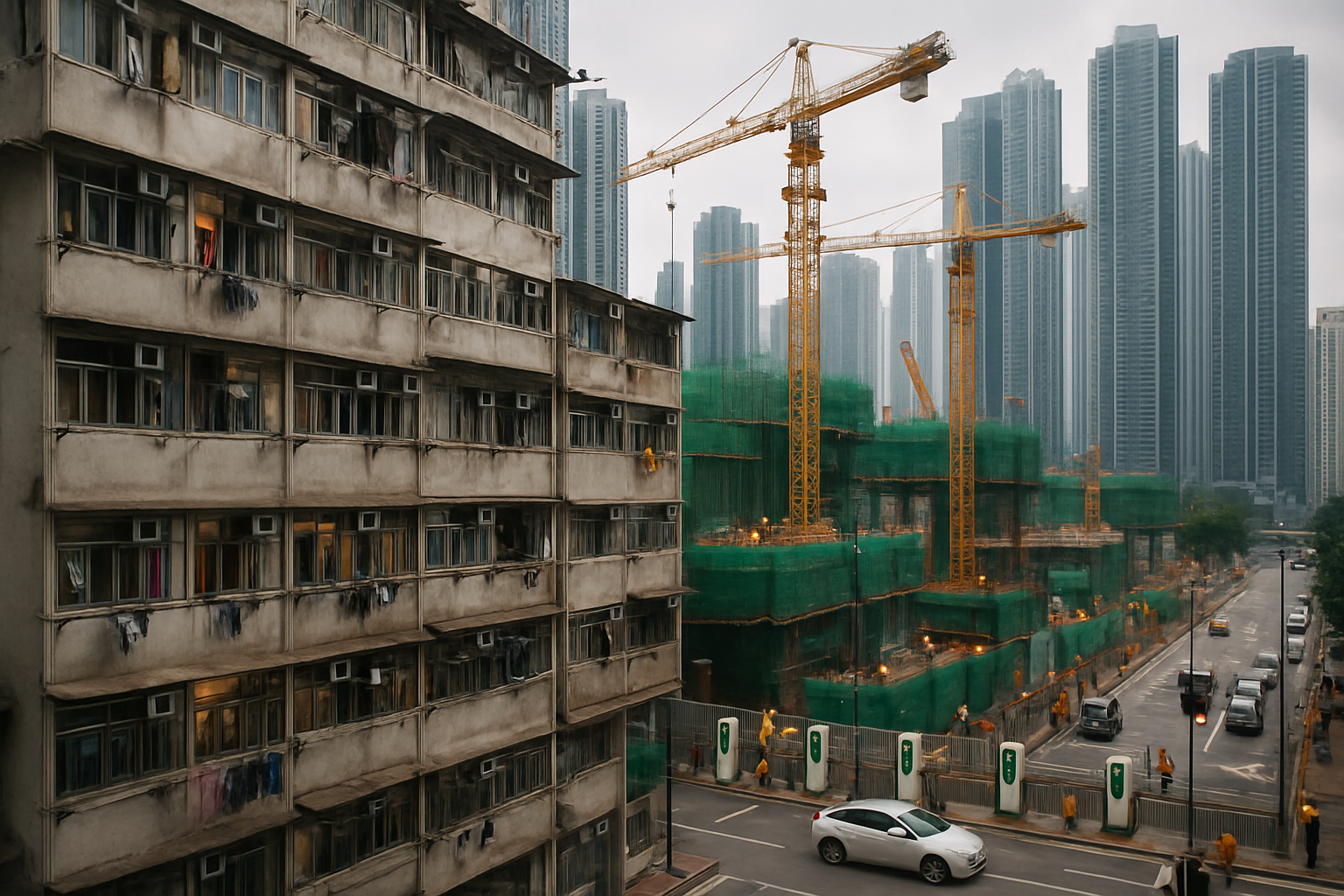
Hong Kong confronts a complex web of urban development challenges as new housing standards create displacement concerns, commercial property owners resort to alternative uses, and the city's slow transition to electric transportation exposes gaps between modern governance aspirations and implementation realities.
The densely populated territory finds itself at a critical juncture where housing affordability, commercial property viability, and sustainable transport infrastructure intersect, creating profound implications for millions of residents and the city's economic competitiveness.
Subdivided Flat Standards Trigger Displacement Wave
New regulatory standards for subdivided flats, intended to improve living conditions for Hong Kong's most vulnerable residents, are inadvertently triggering a wave of evictions that threatens to displace thousands from their homes. The implementation of these safety and space requirements has created an unintended consequence where landlords are choosing to exit the subdivided flat market rather than invest in upgrades.
Chan Sai-chiu, a 72-year-old retiree living in a 60-square-foot subdivided flat in Sham Shui Po's Yee Wa Building, exemplifies the dilemma facing many residents. Despite paying HK$3,000 monthly rent—perfectly suited to his HK$5,000 social security income supplemented by a HK$2,500 rental subsidy—Chan faces potential displacement as building owners assess whether to comply with new standards or convert properties to other uses.
The regulatory framework, designed to address long-standing concerns about substandard living conditions in subdivided flats, requires minimum space allocations, improved ventilation, and enhanced safety measures. However, the costs associated with these improvements have prompted many landlords to consider alternative property uses, creating a shortage of affordable housing options precisely when they are most needed.
"The building suits me perfectly, but I worry about what happens if they decide to renovate or convert it to something else. Where would people like me go?"
— Chan Sai-chiu, Subdivided Flat Resident
Housing advocates warn that the policy implementation lacks adequate transition support for affected residents, creating a situation where well-intentioned regulations may exacerbate the housing crisis they were designed to address. The government faces pressure to develop comprehensive relocation assistance and alternative housing solutions before the full impact of the new standards becomes apparent.
Office Landlords Pivot to Survival Strategies
Hong Kong's commercial real estate sector is undergoing unprecedented transformation as office landlords grapple with intense competition and shifting tenant preferences. With approximately 3.5 million square feet of new premium office space expected for completion in 2026-2027, adding to the 4.5 million square feet delivered in 2024-2025, the market faces a severe oversupply situation that is fundamentally altering property investment strategies.
The "flight to quality" phenomenon has become particularly pronounced, with tenants increasingly relocating to newer, modern offices equipped with advanced technology and sustainable features. This trend has created a divergence in the market where premium properties command strong rents while older buildings struggle to maintain occupancy rates.
In response, struggling office landlords are implementing creative conversion strategies to maintain revenue streams. Co-working spaces have emerged as a popular alternative, offering flexible arrangements that appeal to startups and small businesses priced out of traditional office leases. Student accommodation represents another growth area, capitalizing on Hong Kong's role as a regional education hub and the consistent demand for quality housing near universities and educational institutions.
These adaptive strategies reflect broader changes in how Hong Kong's property market is responding to post-pandemic work patterns, demographic shifts, and evolving business needs. The success of these conversions will likely determine the long-term viability of many commercial properties and influence future development patterns across the territory.
Electric Vehicle Infrastructure Lags Global Standards
Despite Hong Kong's reputation as a modern, globally connected city that excels in finance, education, legal services, and logistics, its approach to transportation electrification reveals a significant gap between rhetoric and reality. The territory's electric vehicle infrastructure development has fallen substantially behind international best practices, raising questions about its commitment to sustainable transportation goals.
The most glaring example of this disconnect appears in Hong Kong's approach to taxi fleet electrification, where a proposed quarter-century timeline for conversion bears little resemblance to the aggressive transition schedules implemented by neighboring jurisdictions. This extended timeframe contrasts sharply with the rapid electrification programs observed in mainland Chinese cities and other regional transportation hubs.
The slow pace of electric bus and taxi adoption carries substantial economic and environmental costs. Delayed infrastructure investment means foregone opportunities for air quality improvements, missed economic benefits from early adoption of clean technology, and potential loss of competitive advantage as other cities establish themselves as leaders in sustainable urban transportation.
Transportation experts point to several factors contributing to this sluggish progress: regulatory complexity, insufficient charging infrastructure, concerns about operational reliability, and resistance from traditional transportation operators. However, these challenges are not unique to Hong Kong, and other cities have successfully navigated similar obstacles through coordinated government leadership and strategic investment.
"Hong Kong has the technical capability and financial resources to lead regional transportation electrification, but lacks the coordinated policy framework and implementation urgency seen in other major cities."
— Transportation Policy Expert
Interconnected Urban Development Challenges
The housing, commercial property, and transportation challenges facing Hong Kong are not isolated issues but interconnected elements of a broader urban development crisis. The displacement of subdivided flat residents compounds transportation problems as people are forced to relocate farther from employment centers. Office building conversions alter neighborhood dynamics and transportation patterns. Meanwhile, inadequate electric vehicle infrastructure limits the city's ability to attract environmentally conscious businesses and residents.
These challenges occur against the backdrop of Hong Kong's unique governance structure and its role as a bridge between China and the international community. The city's ability to address urban development challenges effectively has implications beyond local quality of life, affecting its competitiveness as a financial center and its attractiveness to international businesses and talent.
Recent memory includes Hong Kong's strengthened financial ties with the UAE through deeper regulatory cooperation and the expansion of gold investment retail operations in prime shopping areas, demonstrating the city's continued ability to adapt and innovate in some sectors while struggling with basic urban infrastructure challenges in others.
Global Context and Regional Comparisons
Hong Kong's urban development challenges reflect broader global trends affecting dense metropolitan areas worldwide. Cities from London to Singapore are grappling with similar issues: housing affordability crises, commercial property market volatility, and the complex transition to sustainable transportation systems.
However, Hong Kong's situation is particularly acute due to its extreme population density, limited land availability, and unique political status. The territory's experience offers valuable lessons for other major cities while highlighting the urgent need for coordinated policy responses that address multiple urban challenges simultaneously rather than in isolation.
Regional comparisons reveal mixed results. While Singapore has made substantial progress in public housing and transportation electrification, it has advantages Hong Kong lacks, including greater government control over land use and housing development. Mainland Chinese cities have achieved rapid electric vehicle adoption through substantial government subsidies and mandates, approaches that may not be directly transferable to Hong Kong's different governance framework.
Path Forward: Integrated Urban Planning Solutions
Addressing Hong Kong's interconnected urban development challenges requires comprehensive, coordinated policy responses that recognize the relationships between housing, commercial development, and transportation infrastructure. Successful solutions must balance immediate crisis management with long-term strategic planning that positions Hong Kong for future competitiveness.
For housing policy, this means developing transition assistance programs for subdivided flat residents while creating alternative affordable housing options. Commercial property strategies should encourage adaptive reuse that serves community needs while maintaining economic viability. Transportation electrification requires accelerated infrastructure investment combined with regulatory reforms that encourage rapid adoption.
The window for effective action is narrowing as demographic pressures, climate change impacts, and regional competition intensify. Hong Kong's ability to address these challenges will determine whether it maintains its status as a premier global city or faces decline relative to more adaptive regional competitors.
Success will require unprecedented coordination between government agencies, private sector stakeholders, and community organizations, combined with innovative financing mechanisms and adaptive management approaches that can respond to rapidly changing circumstances. The stakes could not be higher for Hong Kong's seven million residents and its position in the global economy.