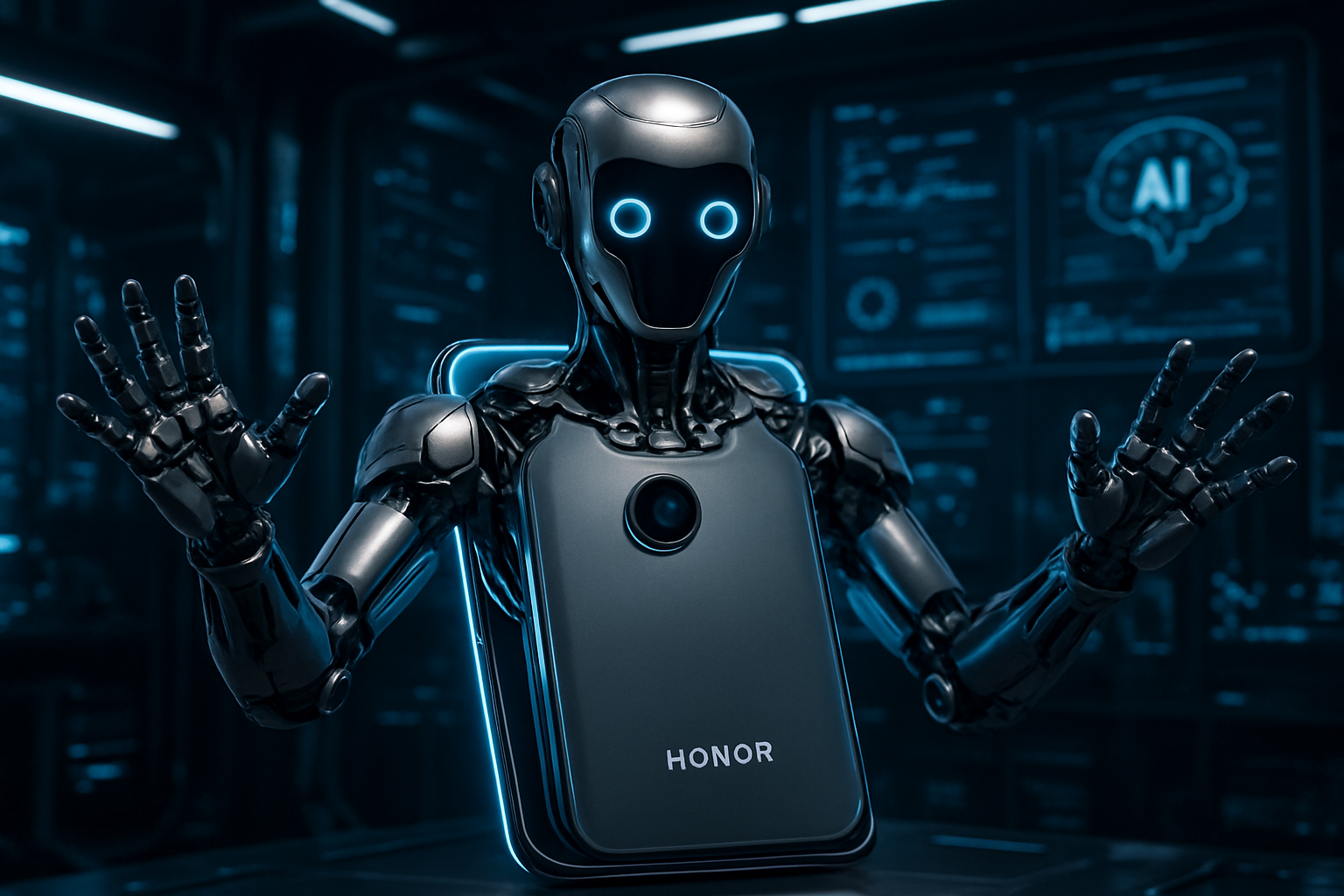
Honor, the former Huawei subsidiary, has entered an ambitious experimental phase unveiling revolutionary "robot phones" and advanced robotic hand technology, positioning the company at the forefront of embodied artificial intelligence and spatial awareness innovation.
The Chinese technology company has reached what industry analysts describe as a critical transformation moment, moving beyond traditional smartphone manufacturing into comprehensive robotic solutions designed to address challenges across multiple sectors. This strategic pivot represents Honor's most significant technological leap since achieving independence from Huawei, demonstrating the company's commitment to pioneering human-centric AI integration.
Revolutionary Robot Phone Concept
At the center of Honor's robotic future vision lies their groundbreaking Robot Phone concept, first unveiled at Mobile World Congress 2026 in Barcelona. CEO James Li presented what he termed a "new species of smartphone" featuring embodied intelligence capabilities that fundamentally redefine device interaction paradigms.
The Robot Phone represents a radical departure from conventional smartphone design, incorporating motion capabilities and environmental interaction systems that enable spatial awareness and autonomous operation. Unlike traditional devices that require human manipulation, Honor's robot phones can navigate physical spaces, respond to environmental stimuli, and perform tasks independently while maintaining seamless connectivity and computational power.
"With Human-centric as our lighthouse, we navigate the growth of AI through meaningful innovation that enhances rather than replaces human capabilities."
— James Li, Honor CEO
The technology builds upon Honor's Augmented Human Intelligence (AHI) vision, implemented through their comprehensive ALPHA PLAN framework comprising three strategic pillars: Alpha Phone, Alpha Store, and Alpha Lab. This systematic approach ensures robotic innovations serve human needs while preserving essential human agency in technological interactions.
Advanced Robotic Hand Technology
Complementing the Robot Phone concept, Honor has developed sophisticated robotic hand technology that demonstrates remarkable dexterity and precision in manipulating both digital and physical environments. These robotic hands integrate seamlessly with Honor's ecosystem, providing tactile feedback and fine motor control capabilities that bridge the gap between virtual and physical interaction.
The robotic hands utilize advanced sensors and AI-powered motion algorithms to perform complex manipulation tasks with human-like precision. Early demonstrations show the technology capable of delicate operations including component assembly, creative tasks, and intuitive gesture-based device control that responds to natural human movements.
Industry experts note that Honor's robotic hand development coincides with global humanoid robotics advancement, particularly from Chinese competitors including Unitree Robotics, which scaled production from 5,500 to 20,000+ units in 2026, and the successful Spring Festival demonstrations by four major companies showcasing kung fu and acrobatic capabilities.
Technology Infrastructure and Challenges
Honor's robotic ambitions face significant infrastructure challenges, particularly the ongoing global memory semiconductor crisis that has driven prices sixfold higher, affecting major manufacturers Samsung, SK Hynix, and Micron. These supply chain constraints, expected to persist until 2027 when new fabrication facilities come online, have forced Honor to develop memory-efficient algorithms and innovative processing solutions.
Despite these constraints, Honor's conservative approach to battery technology implementation provides competitive advantages. The company emphasizes rigorous testing standards and quality requirements before consumer release, contrasting with competitors rushing unproven technologies to market. This methodology has proven particularly valuable during supply chain disruptions where reliability becomes paramount.
The company's vertical integration capabilities, spanning semiconductors, displays, and manufacturing, position Honor strategically during global technology constraints. This comprehensive control over production processes enables continued innovation development while competitors struggle with component availability and rising costs.
Market Positioning and Competitive Landscape
Honor's robotic technology vision emerges during what industry analysts term the "2026 AI Infrastructure Inflection Point," marking the transition from experimental AI applications to essential business infrastructure across all sectors. This timing positions Honor advantageously as consumer and enterprise markets increasingly demand AI-powered solutions that demonstrate practical value.
The company's human-centric philosophy distinguishes Honor from competitors pursuing pure automation approaches. While other manufacturers focus on replacing human capabilities, Honor's Augmented Human Intelligence framework emphasizes enhancement and collaboration between human intelligence and artificial systems.
This strategic positioning addresses growing consumer concerns about AI technology displacing human agency. Honor's approach promises to maintain human control while expanding capabilities through intelligent assistance, addressing market demands for empowering rather than replacing human decision-making.
Ecosystem Integration and Magic V6 Launch
Honor's robotic innovations complement the simultaneous launch of their Magic V6 foldable smartphone, described as the "pinnacle of foldable innovation" with breakthrough silicon-carbon battery technology and dual IP68/IP69 water resistance certification. The Magic V6 becomes the first foldable device achieving complete environmental protection, addressing durability concerns that have historically limited mainstream adoption.
The device features Honor's Super Steel aerospace-grade hinge construction and advanced battery management systems that optimize power distribution between internal and external displays based on usage patterns. These innovations demonstrate Honor's commitment to solving practical consumer challenges while advancing cutting-edge technology development.
Ecosystem expansion includes complementary devices such as the MagicPad 4 and MagicBook Pro 14, creating a comprehensive technology environment where robotic innovations can integrate seamlessly with existing user workflows and preferences.
Global Technology Context
Honor's robotic technology development occurs within a broader transformation of the global technology landscape characterized by intense AI development, supply chain disruption, and evolving regulatory frameworks. Major corporations including Alphabet have committed $185 billion to AI infrastructure development in 2026, while Amazon plans exceed $1 trillion in AI-related investments.
The "SaaSpocalypse" phenomenon, where AI systems replace traditional software functions, has eliminated hundreds of billions in market capitalization from conventional technology companies. This disruption creates opportunities for companies like Honor that successfully integrate AI capabilities with hardware innovation, providing comprehensive solutions rather than isolated applications.
International regulatory developments, including Spain's criminal executive liability frameworks and France's AI company enforcement actions, emphasize the importance of responsible AI development. Honor's human-centric approach aligns with emerging governance expectations for technology that serves human welfare while maintaining appropriate oversight and control.
Future Implications and Industry Impact
Honor's robot phone and robotic hand technology could significantly influence industry standards for intelligent device design, potentially reshaping consumer expectations beyond traditional smartphone functionality. The company's emphasis on embodied intelligence and spatial awareness represents a fundamental shift toward technology that actively participates in physical environments rather than merely processing digital information.
Success in robotic technology implementation could accelerate Honor's expansion beyond traditional smartphone markets into broader consumer electronics, industrial automation, and enterprise solutions. The company's conservative approach to technology deployment may provide sustainable competitive advantages over competitors prioritizing rapid market entry over reliability and user satisfaction.
The Magic V6's environmental protection breakthrough may accelerate mainstream foldable device adoption by eliminating durability concerns that have historically limited consumer acceptance. This success could establish Honor as a leader in next-generation mobile computing devices while demonstrating the company's capability to solve complex engineering challenges.
Strategic Significance
Honor's robotic future technology vision represents more than incremental innovation; it demonstrates a fundamental reimagining of human-technology interaction. At a critical moment when the mobile computing industry faces unprecedented challenges from supply constraints, market saturation, and technological convergence, Honor's approach offers a compelling alternative focused on meaningful human enhancement.
The company's commitment to responsible AI development, combined with practical robotic solutions addressing real-world challenges, positions Honor as a potential leader in the next phase of consumer technology evolution. Their success or failure will serve as an important case study for how established technology companies can successfully navigate industry transformation while maintaining user trust and technological excellence.
As the technology industry approaches a critical inflection point where AI transitions from experimental to essential infrastructure, Honor's robotic innovations represent a template for human-centered development that could influence competitor strategies and consumer expectations for intelligent device interaction throughout the remainder of the decade.