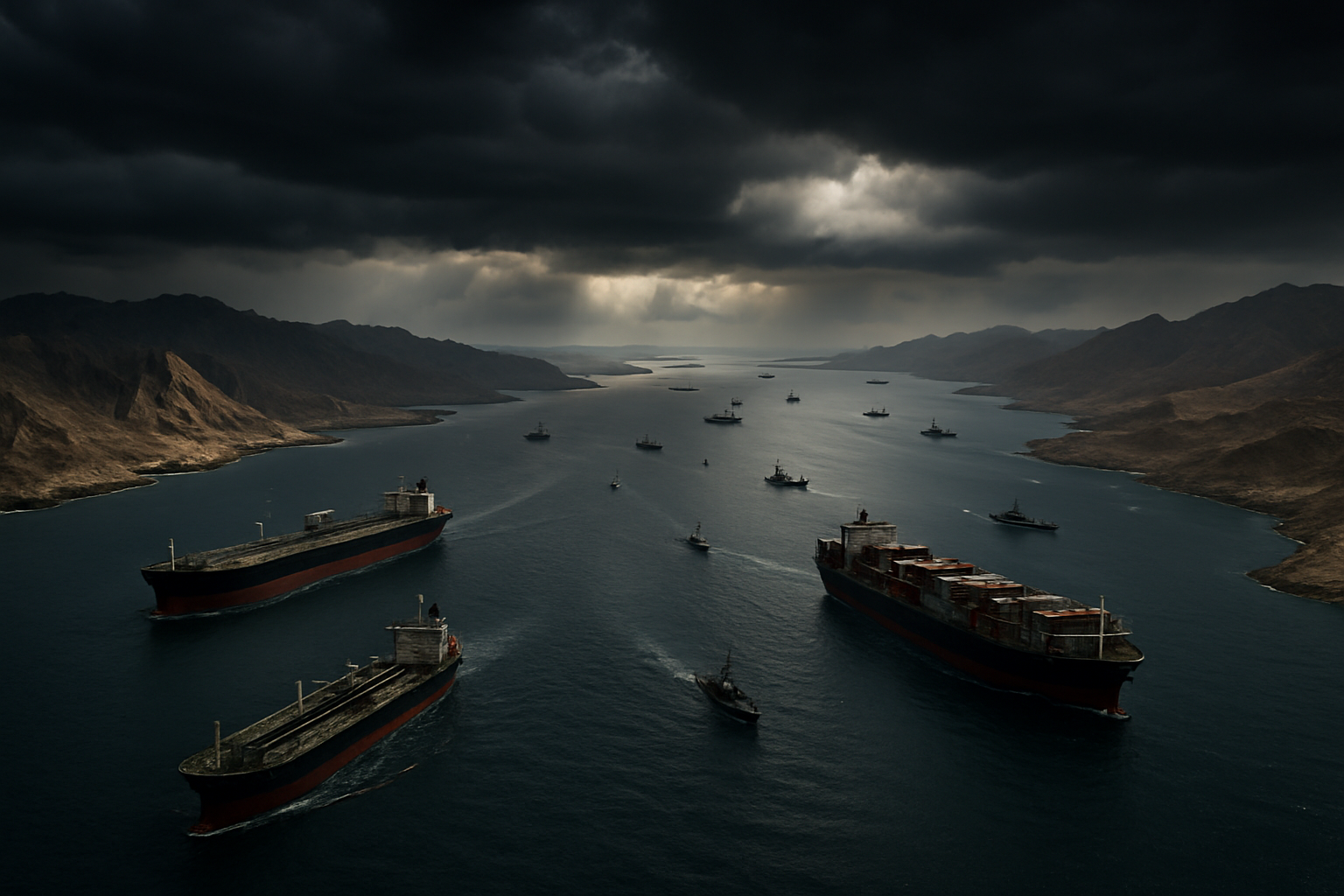
Iran's Revolutionary Guard has declared the Strait of Hormuz "unsafe for shipping," effectively closing the world's most critical energy chokepoint and triggering the most severe global energy crisis since the 1970s oil shocks, while President Trump issues increasingly aggressive ultimatums demanding the waterway's immediate reopening.
The crisis reached a critical juncture on April 6, 2026, when Trump issued his most explicit deadline yet, threatening to strike Iranian power plants and bridges unless the strait reopens by Tuesday evening. Oil prices have surged past $100 per barrel for the first time since 2022, with Brent crude peaking at $119.50 and West Texas Intermediate hitting a record 18.98% single-day jump to $108.15.
Strategic Waterway Under Siege
The Strait of Hormuz, a 21-mile-wide chokepoint between Iran and Oman, normally handles 40% of the world's seaborne oil transit—approximately 21 million barrels per day. Iran's deployment of an estimated 2,000 to 6,000 naval mines throughout the waterway has created what maritime officials describe as the most dangerous shipping environment in decades.
Over 150 oil and liquefied natural gas tankers worth billions of dollars remain stranded in the Persian Gulf, with major shipping companies Maersk and MSC suspending all operations in the region. The U.S. Navy has destroyed 28 Iranian mine-laying vessels in response, but the fundamental blockade remains intact.
"This is a complete closure of the most important shipping route for global energy supplies," said Samuel Ciszuk, energy security analyst at Global Energy Dialogue. "The vulnerability of this single chokepoint has been exposed in the most dramatic way possible."
— Samuel Ciszuk, Global Energy Dialogue
Global Energy Markets in Crisis
The International Energy Agency has responded with the largest strategic petroleum reserve release in its 50-year history, deploying 400 million barrels from 32 member countries—more than double the amount released during the 2022 Ukraine crisis. Japan alone is releasing 80 million barrels, marking the first such deployment since the 2011 Fukushima disaster.
Natural gas prices have exploded by 24% in Europe and 78% in the United States, reaching €47.32 per megawatt-hour—the highest level since February 2025. Qatar's decision to halt LNG production at its Ras Laffan and Mesaid facilities, which account for approximately 20% of global LNG exports, has intensified supply concerns across Europe and Asia.
Qatar Energy Minister Saad Al Kaabi has warned that Gulf states may be forced to declare force majeure "within weeks" if the situation continues, potentially driving oil prices toward $150 per barrel and threatening to "bring down the economies of the world."
Aviation Industry Paralyzed
The crisis has extended far beyond energy markets, creating the most severe aviation disruption since COVID-19. More than 18,000 flights have been cancelled worldwide as eight Middle Eastern countries maintain simultaneous airspace closures: Iran, Iraq, Israel, UAE, Qatar, Syria, Kuwait, and Bahrain.
Dubai International Airport, the world's busiest with 86 million passengers annually, remains completely shut down due to missile damage. Major carriers including Emirates, Air France-KLM, and Wizz Air have suspended operations indefinitely, affecting hundreds of thousands of passengers globally.
Jet fuel costs have soared from $85-90 per barrel to $150-200 per barrel—a 122% increase that has forced airlines to implement emergency surcharges. Australia's Qantas and Air New Zealand have announced fare increases, while Scandinavian airline SAS has implemented temporary fuel surcharges on all routes.
Trump's Escalating Ultimatums
President Trump has issued increasingly aggressive threats as the crisis enters its fifth week. His Tuesday 8 PM ET deadline represents the most explicit threat yet against civilian infrastructure, warning that the day would be "Power Plant Day, and Bridge Day" for Iran unless shipping resumes immediately.
Trump has also threatened to seize Iran's Kharg Island, which processes 90% of Iranian oil exports—approximately 1.6 million barrels per day. The president claimed U.S. forces "could take it very easily," representing a direct threat to Iran's economic lifeline and a significant escalation from previous military objectives.
The administration's approach has evolved from nuclear-focused diplomacy to comprehensive regime change demands. Trump has claimed the right to "personally choose" Iran's next Supreme Leader, rejecting the appointment of Mojtaba Khamenei following his father's death in March.
Congressional Opposition Mounts
Operation Epic Fury, the largest U.S.-Israeli military campaign since 2003, has cost $11.3 billion in its first week alone, with Pentagon officials acknowledging operations may continue through September—far beyond initial 4-6 week estimates. The conflict enjoys only 25% public support, representing "almost unprecedented" unpopularity for early-stage military operations.
Senator Richard Blumenthal has expressed being "more concerned than ever" about the deployment of ground troops, while bipartisan lawmakers are demanding detailed strategy briefings on costs and objectives. The USS Charlotte's sinking of an Iranian frigate—the first enemy vessel destroyed by a U.S. submarine since World War II—has only intensified congressional scrutiny.
European Territory Under Attack
The conflict reached European shores when Iranian drones struck RAF Akrotiri in Cyprus—the first attack on European territory since World War II. This unprecedented escalation prompted an immediate naval coalition response, with HMS Dragon leading British forces alongside Spanish, Italian, French, Dutch, and Greek vessels.
The European Union activated its ESTIA crisis evacuation mechanism for the first time in the bloc's history, while diplomatic efforts have focused on creating international coalitions to secure the strait. British Foreign Secretary Yvette Cooper has led talks with over 35 countries to forge a coordinated response.
Regional Alliances Fracture
The crisis has severely strained the previously unprecedented consensus among Saudi Arabia, UAE, Qatar, and Egypt in supporting diplomatic solutions. Iranian retaliation has directly targeted coalition member territories: one civilian was killed in Abu Dhabi, 32 were injured in Kuwait airport strikes, and eight were wounded in Qatar despite Patriot missile interceptions.
Egyptian President Abdel Fattah al-Sisi has condemned attacks on "sisterly Arab countries" while warning of "comprehensive chaos" if escalation continues. The fracturing of this regional coalition represents a fundamental shift in Middle Eastern geopolitics, with Gulf states caught between U.S. alliance obligations and Iranian pressure.
"We must prevent comprehensive chaos across the entire region," warned President Sisi during emergency consultations in Cairo. "The attacks on sisterly countries cannot be allowed to continue."
— President Abdel Fattah al-Sisi, Egypt
Diplomatic Breakdown and Nuclear Concerns
The current crisis emerged from the complete collapse of U.S.-Iran nuclear negotiations despite achieving what negotiators described as "broad agreement on guiding principles"—the most progress since the 2018 JCPOA collapse. The fundamental deadlock centered on scope: Iran insisted on nuclear-only talks excluding ballistic missiles and regional proxies as "red lines," while the U.S. demanded comprehensive agreements covering missiles, armed groups, and human rights.
Iran continues uranium enrichment at 60% purity with over 400 kilograms of near-weapons-grade material—sufficient for multiple nuclear weapons if weaponized. The crisis unfolds against the backdrop of nuclear governance breakdown, with New START Treaty expiring in February 2026, leaving the first 50+ year gap without U.S.-Russia nuclear constraints.
Consumer Impact Worldwide
The energy crisis has created immediate hardship for consumers globally. Bangladesh has implemented fuel rationing affecting 170 million people, while Pakistan has instituted wartime austerity measures including four-day government work weeks. Bosnia-Herzegovina is down to two days of gas reserves, and Malta faces prices 45% higher without government subsidies.
European consumers are experiencing dramatic price increases: Ireland's heating oil approaches €2 per liter amid accusations of "brazen rip-offs," while Sweden faces electricity increases of 10-20 öre and gasoline price rises of 1-2 kronor per liter. Austria has seen fuel costs increase 20%, prompting government intervention to prevent "war-driven price explosions."
Multiple governments have abandoned free-market principles to implement emergency measures. Hungary imposed immediate price caps, France deployed 500 fuel inspectors to prevent price manipulation, and New Zealand is considering "Muldoon-era" car-free days and petrol sale limits not seen since the 1970s.
Financial Markets in Turmoil
Global financial markets have experienced severe disruption, with Pakistan's KSE-100 recording its largest single-day decline in history at -8.97%. South Korea's KOSPI fell 12%, triggering circuit breakers as the Korean won hit a 17-year low. PayPal's $1.1 billion IPO has been postponed indefinitely due to market volatility.
Central banks including the European Central Bank and Bank of Japan are coordinating emergency liquidity measures, though traditional monetary policy has limited effectiveness against structural geopolitical disruptions affecting physical infrastructure and international trade routes.
Supply Chain Vulnerabilities Exposed
The crisis has revealed dangerous over-dependence on the Persian Gulf as a critical trade hub extending far beyond energy. The region serves as a vital link for consumer goods and industrial materials, with manufacturing in automotive, electronics, and textiles sectors experiencing severe disruptions.
China has suspended refined fuel exports, while Singapore reports 30% increases in logistics costs. The single-point failure of the 21-mile Strait of Hormuz has exposed fundamental vulnerabilities in modern global logistics, with no realistic alternative routes capable of handling the diverted volume.
International Mediation Efforts
Pakistan has emerged as a key mediator, with Foreign Minister Ishaq Dar confirming indirect talks between the U.S. and Iran through a "message relay system." The U.S. has shared a 15-point peace proposal, which Iran is reportedly deliberating while maintaining five counter-conditions including sovereignty over the Strait of Hormuz and war reparations.
Ukraine's President Volodymyr Zelensky has offered assistance in reopening the strait, stating that "only joint action by nations can yield results." However, fundamental disagreements persist over Iran's demand for nuclear-only negotiations versus comprehensive U.S. requirements.
Template-Setting Crisis for the 21st Century
UN Secretary-General António Guterres has characterized the situation as "the greatest test of multilateral cooperation in crisis management in the modern era." The rapid transition from diplomatic breakthrough to military confrontation demonstrates the fragility of crisis management mechanisms in the multipolar era.
The stakes extend far beyond the immediate conflict, affecting regional war prevention, global energy security, nuclear governance credibility, and international law enforcement principles established after World War II. Success in containing the crisis could provide a framework for future nuclear dispute resolution, while failure may accelerate military solutions, reshaping Middle Eastern geopolitics for decades while encouraging proliferation and undermining diplomatic credibility worldwide.
Uncertain Recovery Timeline
Unlike weather-related disruptions with predictable patterns, recovery from the current crisis depends entirely on military and diplomatic resolution. Aviation industries cannot schedule long-term operations while multiple airspaces remain closed, and energy markets remain volatile with critical transit routes blocked.
Energy architecture transformation has become imperative, requiring fundamental restructuring to reduce dependence on strategic chokepoints and volatile geopolitical regions. While strategic petroleum reserves provide temporary buffers, sustained disruptions demand years or decades of supply diversification and renewable energy transitions—though the current crisis has dramatically accelerated the urgency for such changes.
As the Tuesday deadline approaches, the world watches to see whether Trump's ultimatum will force Iranian concessions, trigger military escalation targeting civilian infrastructure, or potentially open diplomatic channels through international mediation. The outcome will establish precedents for 21st-century conflict resolution, energy security planning, and the effectiveness of multilateral cooperation in an increasingly interconnected yet fragmented world.