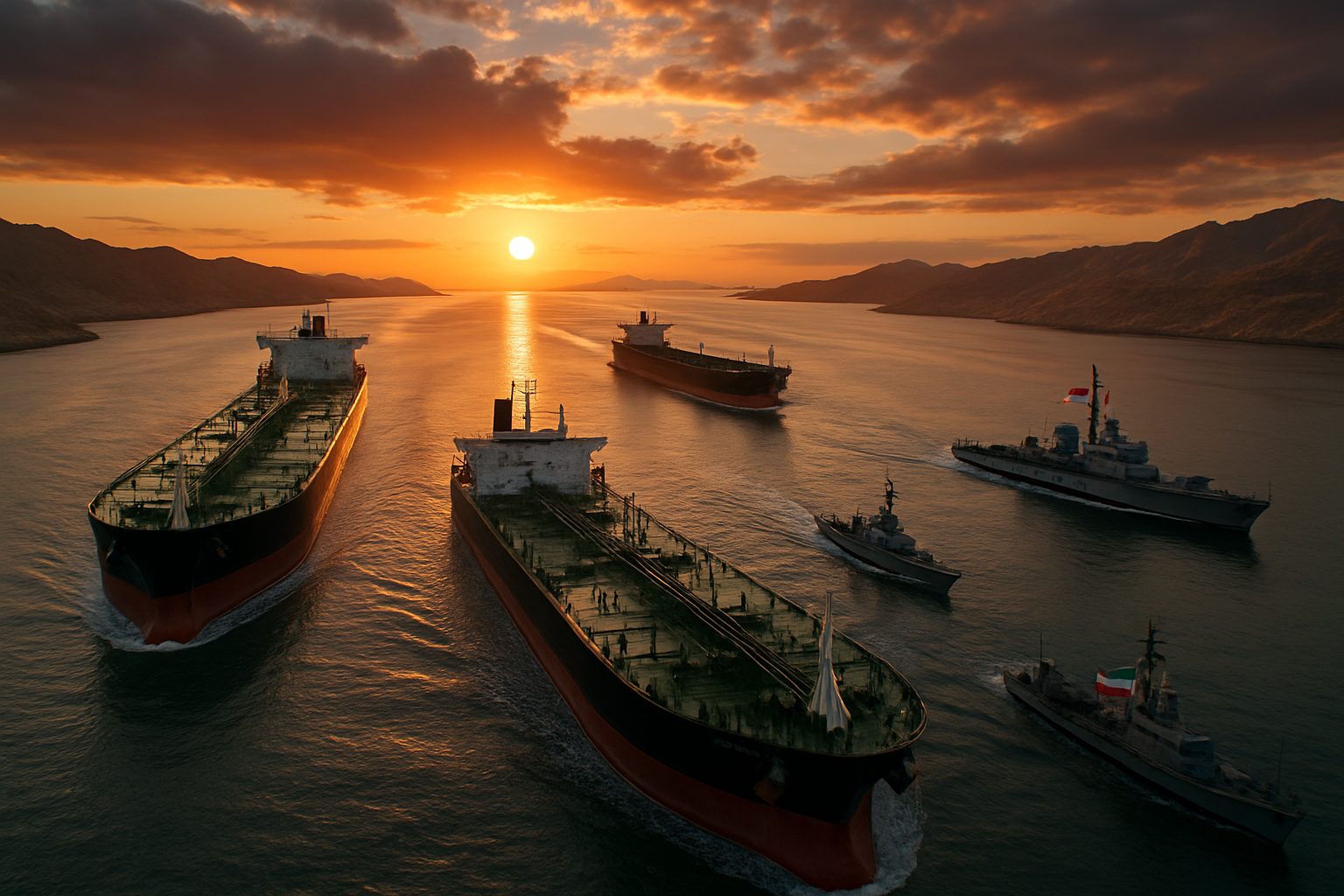
Commercial vessels are cautiously resuming transit through the Strait of Hormuz under Iranian oversight, marking a significant development in the maritime crisis that has gripped global shipping since March, with Iran maintaining control over the strategic waterway that handles 40% of the world's seaborne oil trade.
Iran's Foreign Minister Abbas Araghchi confirmed Saturday that Tehran is facilitating safe passage for ships carrying humanitarian and essential goods through the strait, stating "We have not closed the strait. It is open" but requiring "coordination with Iranian authorities with full respect for sovereignty and security."
First Western Ship Breaks Through Since March
The Malta-flagged container ship Kribi, owned by French maritime group CMA CGM, became the first known vessel with Western European ties to safely transit the strait since March 1, according to ship-tracking data analyzed by AFP. The vessel passed through the vital waterway Thursday afternoon, exiting the Gulf via a route approved by Iranian authorities.
The crossing represents a potential breakthrough in the shipping crisis that has stranded thousands of vessels and created the most severe global energy emergency since the 1970s oil shocks.
"The ship stayed close to the Iranian coastline, suggesting coordination mechanisms are possible"
— Maritime Industry Source
Multiple Nations Navigate Iranian Oversight
Several countries have successfully negotiated passage through the Iranian-controlled waterway. Turkish and Indian vessels have transited the strait, with officials from both Ankara and Delhi confirming safe passage of their flagged ships.
Japanese shipping company Mitsui O.S.K. reported that the Indian-flagged LPG tanker Green Sanvi, owned by an Indian affiliate, successfully completed transit as the second Japan-linked ship to pass through the strait during the crisis.
The developments suggest Iran's Revolutionary Guard has established a systematic vetting process for merchant vessels seeking passage through what officials describe as "safe corridors" once approved by Iranian authorities.
Historical Context and Crisis Origins
The current maritime crisis began in March 2026 when Iran's Revolutionary Guard declared the 21-mile Strait of Hormuz "unsafe for shipping" following the escalation of U.S.-Israeli military operations. The action effectively closed the world's most critical energy chokepoint, triggering unprecedented global consequences.
Oil prices surged to historic peaks of $119.50 per barrel (Brent crude) and $108.15 (WTI), representing the largest single-day jump on record. The crisis prompted the International Energy Agency to authorize its largest strategic petroleum reserve release in 50-year history—400 million barrels from 32 countries.
Global Economic Impact
The shipping disruption has had cascading effects across multiple sectors. Over 18,000 flights were cancelled worldwide as eight Middle Eastern countries simultaneously closed their airspace. Dubai International Airport, the world's busiest hub serving 86 million passengers annually, was shut down due to missile damage.
Financial markets experienced severe volatility, with Pakistan's KSE-100 index recording its largest single-day decline in history at -8.97%, while South Korea's KOSPI fell 12% triggering circuit breakers.
Consumer impacts have been felt globally, with Bangladesh implementing fuel rationing for 170 million people, Pakistan imposing wartime austerity measures including four-day work weeks, and Sweden facing electricity and gasoline price increases.
Nuclear Diplomacy Breakdown
The maritime crisis stems from the complete collapse of U.S.-Iran nuclear negotiations despite achieving what was described as "broad agreement on guiding principles"—the most progress since the 2018 JCPOA collapse. Iran excluded ballistic missiles and proxy forces as "red lines" while the U.S. demanded comprehensive agreements covering missiles, armed groups, and human rights.
The diplomatic breakdown led to Operation Epic Fury, described as the largest U.S.-Israeli coordinated military operation since 2003, followed by Iranian retaliation under Operation True Promise 4, during which Tehran declared "no red lines remain."
Regional Coalition Under Pressure
The crisis has severely strained the unprecedented consensus among Saudi Arabia, UAE, Qatar, and Egypt that had supported diplomatic solutions. Iranian attacks on coalition member territories—including one civilian killed in Abu Dhabi, 32 injured in Kuwait airport strikes, and eight wounded in Qatar despite Patriot missile interceptions—have threatened the regional alliance.
Egyptian President Sisi condemned the attacks on "sisterly countries," warning of "comprehensive chaos" if escalation continues.
Energy Architecture Implications
The crisis has exposed dangerous over-dependence on strategic chokepoints in global energy infrastructure. The 21-mile Strait of Hormuz represents a single-point failure in modern logistics with no realistic alternatives for the volume of transit it handles.
Qatar Energy Minister Saad Al Kaabi warned that Gulf states may declare force majeure "within weeks" if the situation persists, potentially driving oil prices to $150 per barrel, which could "bring down the economies of the world."
"This is the most severe energy security crisis in decades, exposing single-chokepoint vulnerabilities"
— Samuel Ciszuk, Energy Analyst
International Response and Coalition Formation
Over 40 countries have launched an unprecedented international coalition led by British Foreign Secretary Yvette Cooper to secure free passage through the Strait of Hormuz. The coalition is pursuing "collective mobilization of the full range of diplomatic and economic tools" to address the crisis.
Ukraine has offered assistance in reopening the strait, with President Zelensky stating that "only joint action by nations can yield results" during Middle East visits where he told regional representatives Ukraine could help with the waterway crisis.
Nuclear Governance Crisis
The maritime crisis unfolds against the backdrop of a broader nuclear governance breakdown. The New START Treaty between the U.S. and Russia expired in February 2026, marking the first time in over 50 years without nuclear constraints between the superpowers.
Iran continues uranium enrichment at 60% purity with over 400 kilograms of weapons-grade material—sufficient for multiple nuclear weapons. UN Secretary-General Guterres has described nuclear risks as at their "highest in decades," calling the situation "the greatest test of multilateral cooperation in the modern era."
Looking Forward
As ships begin cautiously transiting the strait under Iranian oversight, the international community faces a template-setting moment for 21st-century crisis management. The success or failure of diplomatic solutions will establish precedents for conflict resolution that could influence international relations for decades.
The crisis has accelerated discussions about fundamental energy architecture transformation to reduce dependence on volatile geopolitical regions and strategic chokepoints, though such transitions require years or decades to implement fully.
Recovery timelines remain uncertain, dependent on military and diplomatic resolution rather than predictable economic factors. The aviation industry cannot schedule long-term operations with closed airspace, while energy markets remain volatile with critical transit routes under restrictions.
The Strait of Hormuz crisis represents the most dangerous international situation since the Cold War's end, simultaneously affecting regional war prevention, global energy security, nuclear governance credibility, and international law enforcement mechanisms that have underpinned the post-World War II order.