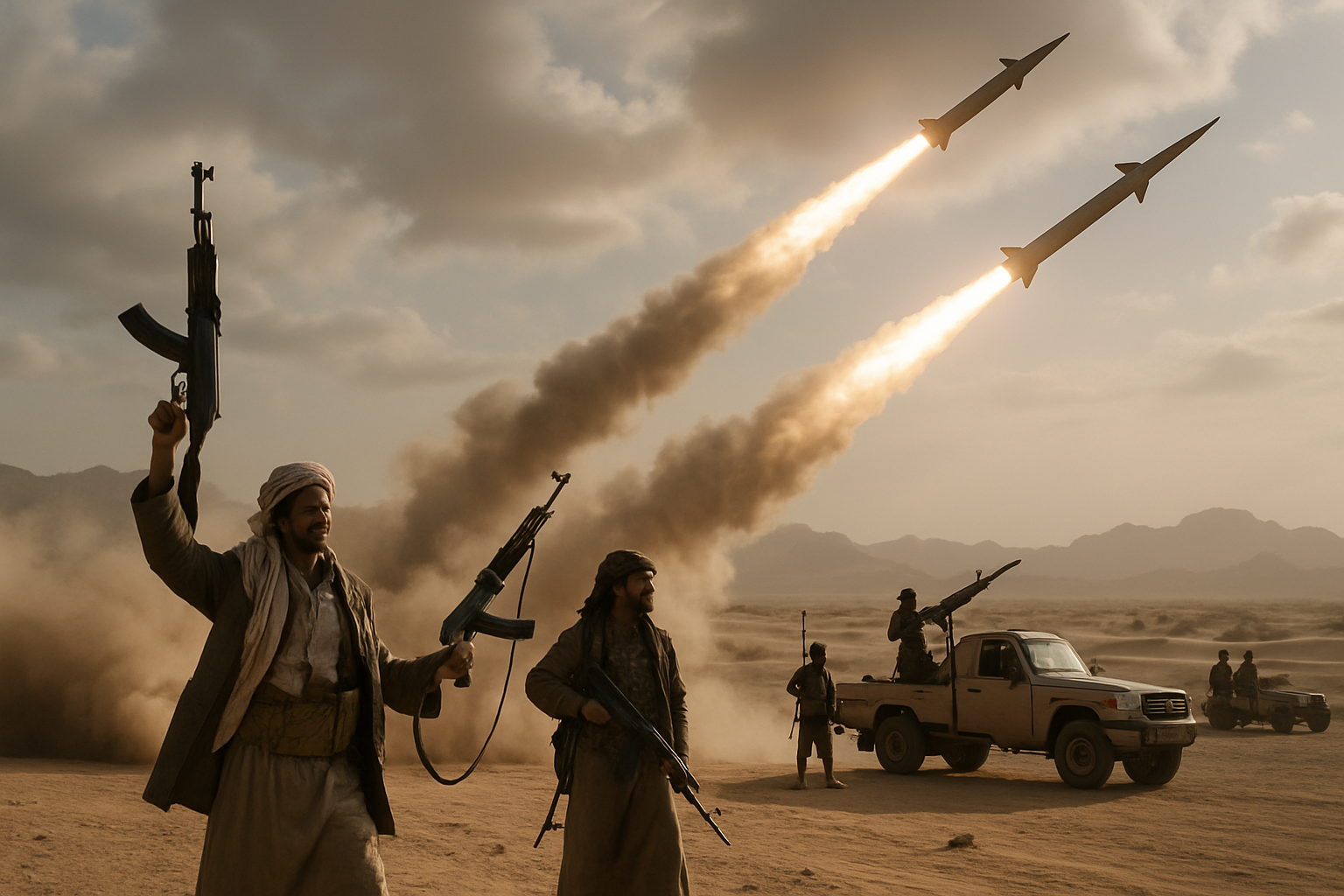
Yemen's Iran-aligned Houthis launched their first direct missile attacks on Israeli territory Saturday, dramatically expanding the month-old Middle East conflict to a dangerous third front that threatens global trade routes and energy security.
Houthi spokesperson Yahya Saree confirmed the group targeted "sensitive Israeli military sites" in southern Israel, marking the rebels' formal entry into the Iran-Israel war that began February 28 with Operation Epic Fury. The development creates an unprecedented three-front conflict involving Iran-Israel, Lebanon-Israel, and now Yemen-Israel theaters.
Strategic Escalation Creates Global Shipping Threat
The Houthi entry represents the most dangerous geographical expansion of the conflict since Iranian drones struck RAF Akrotiri in Cyprus—the first attack on European territory since World War II. The Yemen-based group's involvement opens critical vulnerabilities in global commerce, particularly threatening the Red Sea shipping corridor through the Bab al-Mandab strait, which handles 12% of global trade.
Combined with Iran's effective closure of the Strait of Hormuz through naval mining—affecting 40% of global oil transit—the dual maritime threat could create unprecedented disruption to international commerce. Intelligence assessments warn that sustained Houthi operations could force the division of Israeli military resources across multiple fronts, potentially overwhelming regional air defenses.
"The intervention of Iran's Yemeni allies in the US-Israel war on Iran will spark concern about disruptions to Red Sea shipping routes critical for Europe-Asia trade corridors."
— Regional Security Analyst
Regional Coalition Faces Unprecedented Strain
The Houthi escalation severely tests the unprecedented regional coalition of Saudi Arabia, UAE, Qatar, and Egypt that had backed diplomatic solutions to the Iran crisis. Egyptian President Abdel Fattah al-Sisi condemned attacks on "sisterly countries" while warning of "comprehensive chaos" spreading across the Middle East.
Saudi Arabia faces renewed threats from Yemeni missile attacks after successfully intercepting previous strikes, while the Kingdom has expressed concerns about the conflict's expansion threatening regional stability. The UAE, which has suffered civilian casualties from Iranian retaliation, now confronts additional threats from Tehran's proxy forces.
Global Crisis Reaches Peak Intensity
The Houthi entry occurs as the broader Middle East crisis reaches unprecedented global dimensions. Over 18,000 flights have been cancelled worldwide—the most extensive aviation disruption since COVID-19—as eight countries maintain simultaneous airspace closures. Dubai International Airport, the world's busiest, remains shut down due to missile damage.
Oil prices have surged past $100 per barrel and are heading toward $200, according to energy analysts. The International Energy Agency authorized its largest strategic petroleum reserve release in 50-year history—400 million barrels—to counter market disruption. Natural gas prices have increased 24% in Europe and 78% in the United States.
Nuclear Diplomacy Collapse Triggers Military Response
The current escalation followed the complete breakdown of nuclear negotiations despite achieving "broad agreement on guiding principles" in Geneva—the most significant diplomatic progress since the 2018 JCPOA collapse. Iran maintained ballistic missiles and regional proxies as "red lines" excluded from nuclear-only talks, while the US demanded comprehensive agreements including missiles, armed groups, and human rights issues.
Iran continues uranium enrichment at 60% purity with over 400 kilograms of weapons-grade material, approaching the threshold for multiple nuclear weapons capability. The February diplomatic collapse led to Operation Epic Fury, the largest coordinated US-Israeli military campaign since 2003, resulting in the confirmed death of Supreme Leader Ali Khamenei and the succession of his son, Mojtaba Khamenei—the first hereditary leadership transition in Islamic Republic history.
Congressional and International Concerns Mount
The expanding conflict faces growing opposition from the US Congress, with Senator Richard Blumenthal expressing being "more concerned than ever" about potential ground troop deployments. The conflict maintains only 25% public support in the United States—unprecedented unpopularity for military operations in their early stages.
Operation Epic Fury has cost $11.3 billion in its first week, with Pentagon operations now planned through September, far beyond the initial 4-6 week timeline. The deployment includes 150 US troops wounded, with 3 confirmed killed in the largest Middle East operation since the 2003 Iraq invasion.
Template-Setting Crisis for 21st Century
UN Secretary-General António Guterres described the situation as the "greatest test of multilateral cooperation in the modern era." The rapid transition from diplomatic framework to military confrontation demonstrates what experts call "multipolar era fragility" in crisis management.
The crisis unfolds amid broader nuclear governance breakdown, with the New START treaty expiring February 5—the first time in 50+ years without US-Russia nuclear constraints. China's nuclear expansion and Iran's weapons-grade uranium stockpile create what Guterres calls nuclear risks at their "highest level in decades."
"The Houthis' entry fundamentally alters the conflict scope, threatening further maritime disruption of critical international commerce routes between Europe and Asia."
— Maritime Security Expert
Humanitarian Impact and International Response
The Iran Red Crescent reports 787+ civilian casualties from US-Israeli strikes, including a devastating attack on a Minab school that killed between 53-85 students and staff. The humanitarian crisis has prompted international evacuations on the scale of the Arab Spring, with Australia reporting 115,000 nationals trapped and Germany 30,000 stranded.
European territory was attacked for the first time since World War II when Iranian drones struck RAF Akrotiri in Cyprus, prompting an unprecedented naval coalition response from HMS Dragon and Spanish, Italian, French, Dutch, and Greek vessels.
Energy Architecture Under Threat
The dual threat to both the Strait of Hormuz and Red Sea shipping lanes threatens to collapse the global energy architecture. Maersk and MSC have suspended Persian Gulf operations, with over 150 tankers stranded carrying billions in cargo. Qatar has halted LNG production, representing approximately 20% of global exports.
Airlines have implemented emergency fuel surcharges as jet fuel prices surge from $85-90 per barrel to $150-200 per barrel. The crisis exposes global supply chain vulnerabilities in manufacturing sectors dependent on Gulf logistics networks, affecting automotive, electronics, and textile production worldwide.
Looking Ahead: Containment or Regional War
The coming days will determine whether the three-front conflict can be contained through renewed diplomatic efforts or represents the beginning of a broader regional war with global implications. Pakistan has emerged as a potential mediator, with Foreign Minister Ishaq Dar facilitating "indirect talks" between the US and Iran through a "message relay system."
Trump administration officials predict military operations will conclude "within weeks, not months," while Iran has rejected demands for "unconditional surrender" as serving only US-Israeli interests. The success or failure of containment efforts will create precedents for 21st-century conflict resolution, affecting international approaches to territorial disputes, nuclear governance, and energy security for decades to come.
March 29, 2026 represents a watershed moment in international relations, testing whether diplomatic solutions can prevail over military escalation in an increasingly multipolar world order. The stakes extend far beyond the Middle East, encompassing global energy markets, nuclear proliferation mechanisms, and the credibility of international law enforcement in the post-WWII era.