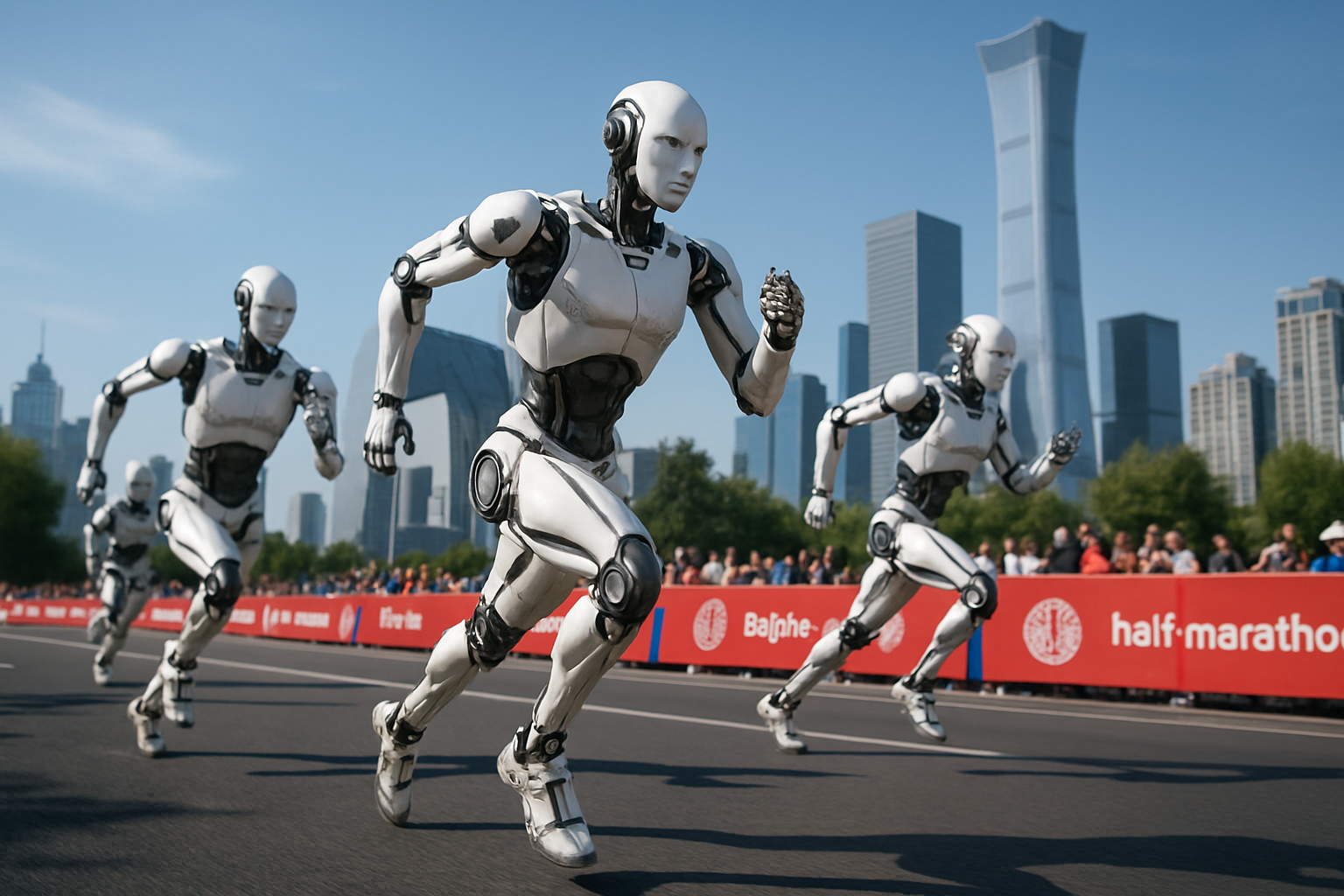
In a groundbreaking demonstration of technological advancement, humanoid robots achieved unprecedented success in Beijing's half-marathon on Sunday, with the winning robot completing the 21.1-kilometer course in 50 minutes and 26 seconds—significantly surpassing the human world record and marking a new era in AI-powered athletics.
The historic race featured over 300 humanoid robots competing alongside human participants, representing the largest deployment of bipedal robots in a competitive athletic setting to date. The victory margin was stunning: the winning robot finished approximately seven minutes faster than the current human half-marathon world record, showcasing the rapid advancement of Chinese robotics technology.
"This is a historic moment for the entire robotics and AI industry," said Dr. Wei Chen, lead engineer at Unitree Robotics, one of the companies whose robots participated in the race. "What we're witnessing is the transition from laboratory prototypes to real-world athletic performance that exceeds human capabilities."
Chinese Robotics Revolution Accelerates
The Beijing marathon success represents the culmination of China's aggressive push into humanoid robotics, driven by the nation's strategic response to its demographic crisis. As the country grapples with the "4-2-1 problem"—where single children must support four aging parents and grandparents due to previous population control policies—AI and robotics have emerged as critical solutions for maintaining productivity amid rapid aging.
Unitree Robotics, a key participant in Sunday's race, has scaled production from 5,500 humanoid units in 2025 to over 20,000 units in 2026, representing the fastest laboratory-to-commercial transition in robotics history. This dramatic scaling demonstrates China's commitment to transforming robotics from experimental technology to essential infrastructure.
The performance improvement from last year was remarkable. While many robots struggled to complete the course in 2025—with some falling and failing to finish—this year's race showcased dramatic technological advancement. The contrast highlighted the rapid evolution in balance, endurance, and AI-powered decision-making capabilities.
Technical Breakthroughs Enable Athletic Success
The robots demonstrated sophisticated capabilities beyond simple locomotion. Multiple sources reported that while there were some technical difficulties—with one robot falling at the start line and another bumping into a barrier—the majority of participants completed the challenging course successfully.
The race wasn't merely about speed. The robots navigated complex urban terrain, adjusted to varying weather conditions, and demonstrated the kind of adaptive intelligence required for real-world applications. Engineers noted that the robots' ability to maintain stability and optimal performance throughout the extended race duration represents a significant leap in robotics endurance capabilities.
Chinese companies have developed proprietary vision-language-action models and advanced AI integration systems that enable seamless human-robot collaboration. These same technologies that power manufacturing applications have now proven themselves capable of athletic competition at superhuman levels.
Global Infrastructure Advantages Drive Success
Alibaba Chairman Joe Tsai recently identified three key competitive advantages that have enabled China's robotics breakthrough: superior power grid infrastructure providing stable energy foundation for AI computational requirements, strategic commitment to open-source AI models enabling collaborative development, and complete domestic manufacturing supply chains reducing vulnerability to geopolitical disruptions.
These infrastructural advantages proved crucial for Sunday's success. China controls 60% of global critical mineral production and 90% of refining capacity, providing strategic supply chain leverage that has allowed continued innovation despite global semiconductor shortages affecting competitors worldwide.
The race occurred amid a global memory semiconductor crisis with sixfold price increases affecting Samsung, SK Hynix, and Micron until 2027. However, China's integrated approach and infrastructure-first strategy have enabled continued advancement while Western competitors face component shortages.
Demographic Strategy Drives Innovation
The Beijing marathon success exemplifies China's systematic approach to addressing its demographic challenges through technological advancement. As the world's most rapidly aging society, China faces unique pressures that have accelerated robotics development beyond traditional economic motivations.
Bank of America analysis reveals that China's AI and robotics development represents a strategic response to sustaining productivity despite demographic pressures. The Spring Festival 2026 demonstrations, where four Chinese companies (Unitree, Galbot, Noetix, MagicLab) showcased humanoid robots performing kung fu and lion dances for over 600 million global viewers, marked a cultural-technological milestone demonstrating public acceptance and integration.
This human-centered automation approach contrasts sharply with Western mass layoffs, emphasizing AI amplification tools versus replacement mechanisms while maintaining social stability during technological advancement. The success of robots in athletic competition provides a positive framework for broader societal integration.
International Competition and Response
The Beijing achievement highlights the growing technological gap between China's mass production capabilities and Western experimental approaches. While BMW recently deployed two "Aeon" humanoid robots at a German manufacturing facility—representing Europe's counter-response—the limited pilot scope underscores the scale difference.
International observers noted the significance extends far beyond athletics. "This demonstrates China's ability to rapidly scale from proof-of-concept to large-scale deployment," observed Dr. Sarah Mitchell from the European Robotics Institute. "The athletic performance is impressive, but the underlying production and coordination capabilities are what will reshape global competition."
The UN has established an Independent Scientific Panel of 40 experts for global AI assessment, while Spain has implemented criminal executive liability frameworks for tech platforms, representing sophisticated governance responses to rapid technological advancement. However, coordination challenges persist as China continues to advance at unprecedented speed.
Economic and Strategic Implications
China achieved a logistics automation efficiency record of 13.9% of GDP ratio through systematic AI implementation, demonstrating measurable productivity gains from robotics integration. The nation has simultaneously announced zero-tariff access for 53 African countries beginning May 2026, indicating confidence in using technological advancement for international engagement.
The success comes during China's historic transition to "high-quality development" with a GDP growth target of 4.5-5% for 2026—the first time below 5% since 1991. Despite conservative economic targets, defense spending increased 7% to 1.91 trillion yuan, demonstrating military modernization priority even amid economic constraints.
Industry experts identify this period as a critical "civilizational choice point" determining whether AI serves human flourishing versus exploitation. The positive demonstration of robotics in competitive athletics provides an optimistic template for human-AI collaboration that amplifies capabilities while preserving creativity and cultural understanding.
Global Template for Aging Societies
China's success in robotics development provides a template for aging societies worldwide facing similar demographic challenges. The ability to maintain productivity despite population decline could reshape global assumptions about demographics and development during 21st-century transitions.
The marathon results occur during what industry experts characterize as the transition from experimental AI to essential infrastructure. Success requires unprecedented coordination between governments, companies, institutions, and civil society to balance innovation with safety governance, commercial interests with human welfare, and national competitiveness with international cooperation.
The most promising path forward appears to be sophisticated human-AI collaboration that amplifies human capabilities while preserving the creativity, empathy, and wisdom that define human potential. Sunday's marathon success provides evidence that this collaborative future is achievable.
Looking Ahead: Future of AI-Powered Competition
The Beijing marathon represents a watershed moment in humanity's evolving relationship with artificial intelligence. As robots demonstrate capabilities that exceed human performance in specific domains, society faces fundamental questions about the future of competition, work, and human identity.
However, the positive reception of Sunday's race—with spectators cheering for both human and robot participants—suggests potential for inclusive frameworks where technological advancement enhances rather than replaces human achievement. The robots ran in dedicated lanes, competing alongside rather than directly against human athletes, providing a model for coexistence.
As China continues scaling humanoid robot production with targets reaching 50,000-100,000 units by 2027, the implications extend far beyond athletics. The same technologies enabling marathon success will drive manufacturing, healthcare, education, and infrastructure applications that could fundamentally reshape society.
The success of Beijing's humanoid marathon may be remembered not just as a technological milestone, but as the moment when humanity glimpsed a future where artificial intelligence amplifies human potential rather than threatening it—a future where robots run alongside us toward shared goals of progress, excellence, and human flourishing.