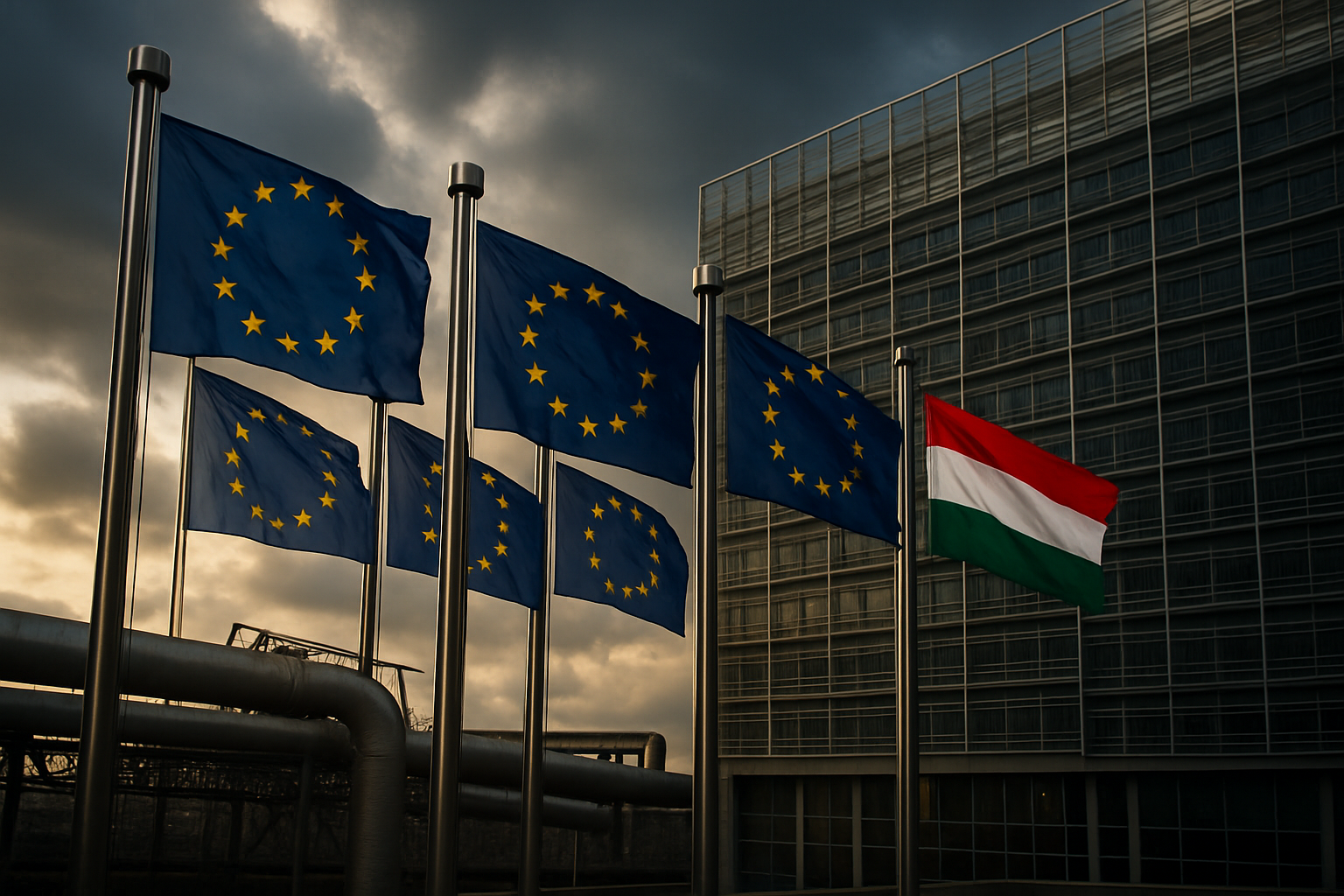
Hungary has moved to block the European Union's historic €90 billion loan package for Ukraine, creating the most significant obstacle yet to what would be the largest EU financial assistance package ever provided to a single nation. The blockade stems from an escalating dispute over the Druzhba oil pipeline, highlighting deepening divisions within the European Union over both energy security and continued support for Ukraine.
According to multiple European sources, including reports from Germany's Tagesschau and Financial Times, Hungarian Foreign Minister Péter Szijjártó announced that Budapest would not approve the crucial aid package until Ukraine restores Russian oil transit through the damaged Druzhba pipeline. The Hungarian position represents a dramatic escalation of tensions within the EU at a critical moment for Ukrainian financial stability.
The Pipeline at the Heart of the Crisis
The Druzhba pipeline dispute has become a flashpoint between Hungary and Ukraine, with both countries offering conflicting accounts of the pipeline's operational status. Hungarian officials claim that Ukraine deliberately halted oil transit as "blackmail," while Ukrainian authorities maintain that the pipeline was damaged in Russian missile attacks and requires significant repairs before operations can resume.
Slovakia has also been severely affected by the pipeline disruptions, with Prime Minister Robert Fico declaring a state of oil emergency and releasing 250,000 tons from strategic reserves to maintain operations at the Slovnaft Bratislava refinery. The crisis has forced Slovakia to suspend diesel exports to Ukraine while prioritizing domestic supply and negotiating alternative routes through Croatia for Mediterranean access.
The pipeline, which has historically carried Russian crude oil to Central European nations, represents a critical energy lifeline for landlocked countries like Hungary and Slovakia. Despite EU efforts to reduce dependence on Russian energy, these nations have maintained exemptions allowing continued oil imports through the Druzhba system.
EU Financial Package Under Threat
The €90 billion loan package represents the European Union's most ambitious financial commitment to Ukraine, designed to support both defense capabilities and reconstruction efforts through 2026-2027. The European Parliament previously approved the package with overwhelming support—458 votes in favor, 140 against, and 44 abstentions—making Hungary's blockade particularly significant given the broad European consensus.
The financial assistance comes at a crucial time for Ukraine, which faces mounting economic pressures amid ongoing conflict. President Volodymyr Zelensky has described the package as "precisely the signal that must be sent to the aggressor," emphasizing that Russia would ultimately be responsible for reimbursement.
However, the EU's unanimity requirements for major financial decisions mean that Hungary's opposition could effectively derail the entire package, despite support from the vast majority of member states. This situation mirrors previous instances where Budapest has used its veto power to influence EU policy, particularly on issues related to rule of law and migration.
Broader European Divisions
The Hungarian blockade exposes deeper divisions within the European Union over burden-sharing and strategic priorities. Slovakia, Czech Republic, and Hungary have all refused to participate in financing the Ukraine loan package, demonstrating persistent East-West tensions despite broad parliamentary support for Ukrainian assistance.
These divisions occur against a backdrop of unprecedented European unity on many Ukraine-related issues. Recent polling shows that 89% of Europeans demand greater EU unity, while 86% want a stronger global voice. However, the practical implementation of solidarity faces obstacles when national interests conflict with collective commitments.
The timing of Hungary's blockade is particularly sensitive, coming as diplomatic efforts intensify to resolve the Ukraine conflict. Recent breakthroughs in trilateral talks between Ukraine, Russia, and the United States—including a historic prisoner exchange of 314 individuals and the restoration of military communications—have created momentum for potential peace negotiations.
Energy Security Implications
The Druzhba pipeline dispute highlights ongoing European vulnerabilities in energy security, despite years of efforts to diversify away from Russian supplies. The crisis has forced affected countries to draw on strategic reserves and seek alternative supply routes, demonstrating the continued importance of energy infrastructure coordination.
Natural gas prices have surged 24% across Europe, adding to the economic pressures facing member states. The disruption comes at a time when European energy systems are already strained by winter demand and ongoing geopolitical tensions affecting global energy markets.
For Hungary specifically, the pipeline dispute represents both an economic and political challenge. Prime Minister Viktor Orbán faces increasing electoral pressure ahead of April 2026 parliamentary elections, with his Fidesz party trailing opposition coalitions in polls for the first time in over a decade. The energy crisis provides both a domestic political opportunity and a tool for influencing EU policy.
International Context and Stakes
The Hungarian blockade occurs amid a broader reassessment of European strategic autonomy and unity. The Munich Security Conference recently highlighted deep transatlantic strains, with European leaders increasingly emphasizing the need for independent defense and security capabilities.
The crisis also unfolds against the backdrop of historic changes in nuclear governance, with the New START treaty between the United States and Russia expiring in February 2026—the first time in over 50 years without bilateral nuclear constraints between the superpowers. This context adds urgency to European efforts to maintain unity and credible deterrence.
Meanwhile, ongoing diplomatic efforts to resolve the Ukraine conflict face a June 2026 deadline established by the Trump administration, with talks potentially moving to Washington for presidential-level engagement. The success or failure of European financial support could significantly influence these negotiations and Ukraine's bargaining position.
Political Calculations and Consequences
Hungary's blockade strategy reflects Viktor Orbán's long-standing approach of leveraging EU institutional rules to advance national interests and maintain relevance in European politics. The move comes as Orbán faces his most challenging electoral contest since returning to power in 2010, with opposition parties uniting around pro-EU platforms promising wealth taxes, euro adoption, and stronger NATO ties.
The timing may also reflect broader geopolitical calculations, as Hungary maintains closer relationships with Russia compared to other EU members. Despite international sanctions, Budapest has preserved economic relationships and opposed various EU measures targeting Moscow's energy revenues.
For the European Union, the crisis tests institutional mechanisms designed to prevent individual member states from blocking collective action. The bloc has increasingly explored "enhanced cooperation" procedures that allow subsets of countries to advance policies without unanimity, though such approaches carry risks for overall unity.
Path Forward and Resolution Prospects
Resolving the current impasse will likely require careful diplomatic coordination between Brussels, Budapest, Kyiv, and other affected capitals. Technical solutions to the pipeline dispute could potentially address Hungary's immediate concerns while preserving the broader EU support package for Ukraine.
Alternative financing mechanisms might also be explored, potentially allowing willing member states to proceed with Ukrainian assistance while accommodating Hungarian objections. Such approaches would test the limits of EU solidarity while preserving essential support for Ukraine's defense and reconstruction needs.
The resolution of this crisis could establish important precedents for future EU decision-making, particularly regarding the balance between national sovereignty and collective commitments. With major geopolitical negotiations on the horizon and European security architecture under review, the stakes extend far beyond the immediate financial package.
As European leaders work to bridge these divisions, the ultimate resolution will likely require compromises that address both Ukraine's urgent financial needs and legitimate concerns about energy security infrastructure. The success or failure of these efforts will significantly influence both European unity and Ukraine's capacity to sustain its defense against Russian aggression while pursuing diplomatic solutions to the conflict.