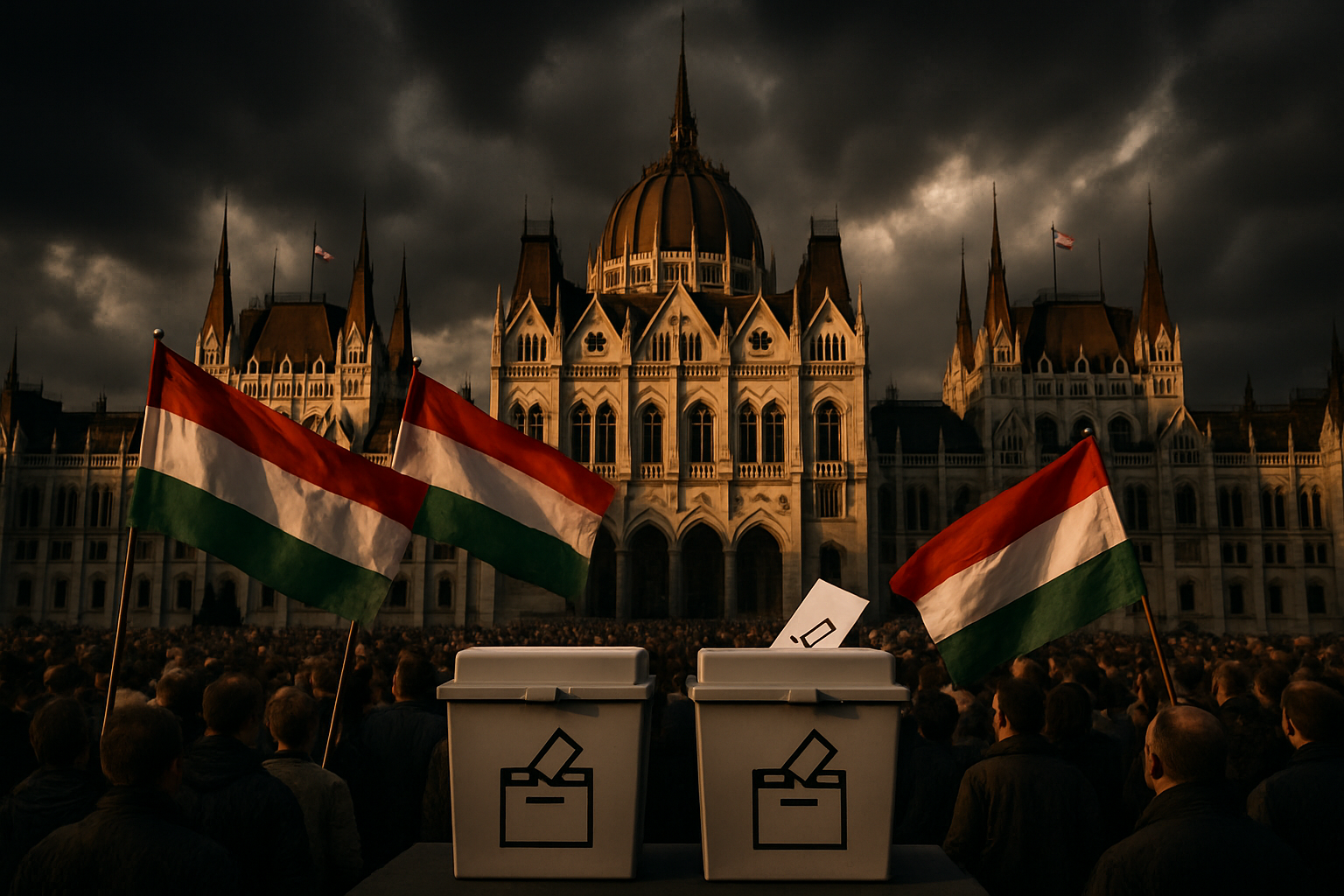
Hungary stands at a historic crossroads as Prime Minister Viktor Orbán faces the most serious electoral challenge of his 16-year rule, with opposition leader Péter Magyar's Tisza Party leading polls for the first time since 2010 ahead of crucial April 12, 2026 parliamentary elections.
The stakes could not be higher for both Hungary and the European Union, as documented foreign interference operations, energy crises, and unprecedented EU institutional tensions converge in what experts are calling the most consequential Central European election in decades.
Opposition Breakthrough After Years of Dominance
For the first time in over a decade, multiple polling organizations show opposition coalitions leading against Orbán's Fidesz party, creating genuine electoral uncertainty that has sent shockwaves through Hungary's political establishment. Péter Magyar, a 45-year-old former government insider who dramatically left Fidesz in 2024, has successfully consolidated opposition forces behind a pro-European platform promising wealth taxes, euro adoption, and stronger EU and NATO ties.
The transformation became visible during Magyar's "Greatest National March" on March 15, 2026, which drew an estimated 500,000 participants to Budapest – the largest opposition demonstration since 2010. The timing on Hungary's national holiday was deliberately symbolic, marking the anniversary of the 1848 revolution against Austrian rule.
"In 1848 and 1956, our revolutions continued in blood. The Russians came, but they could never defeat us. Orbán cannot do this either, who in his final desperation has called upon the KGB tsar."
— Péter Magyar, Tisza Party Leader
Magyar's credibility as a challenger stems from his insider knowledge of Fidesz operations and his public denunciations of corruption within Orbán's circle. His 240-page electoral program represents a stark departure from Orbán's nationalist sovereignty approach, advocating for deeper European integration and democratic reforms.
Unprecedented Foreign Interference
The election has been overshadowed by documented evidence of dual foreign interference – a phenomenon unprecedented in modern European politics. Investigative journalist Szabolcs Panyi's VSquare investigation revealed the first concrete evidence of Russian operative teams actively supporting Fidesz in Budapest, marking the first documented case of Kremlin agents directly participating in EU member state electoral campaigns.
Simultaneously, the Trump administration has provided explicit political backing through high-profile visits and endorsements. US Vice President J.D. Vance's Budapest visit on April 7 – just five days before the election – represented an extraordinary departure from traditional American diplomatic neutrality. Vance condemned EU "bureaucrats in Brussels" for "shameless election interference" while declaring Orbán a "model for Europe" and emphasizing that Trump "loves" the Hungarian leader.
Ukrainian officials have characterized recent incidents, including the discovery of explosive devices near the Balkan Stream pipeline in Serbia exactly one week before elections, as "false flag operations as part of Moscow's large-scale interference in Hungary's elections."
EU Relations at Breaking Point
Hungary's relationship with the European Union has deteriorated to crisis levels, with Budapest maintaining a blockade of a historic €90 billion Ukraine aid package over the Druzhba oil pipeline dispute. The pipeline has been offline since January 27, 2026, with Hungary claiming Ukraine deliberately manipulated oil supplies as "political blackmail," while Ukraine maintains the infrastructure was damaged in Russian attacks requiring repairs.
The crisis has prompted European Commission to freeze approximately €19 billion in Hungarian funding over rule of law concerns – one of the largest financial penalties ever imposed on an EU member state. Intelligence restrictions have also been placed on Hungary following allegations that Foreign Minister Péter Szijjártó systematically leaked EU Council details to Russian Foreign Minister Sergei Lavrov.
"The EU cannot become Budapest's hostage."
— Kestutis Budrys, Lithuanian Foreign Minister
Enhanced cooperation discussions have accelerated to bypass Hungarian obstruction, representing a fundamental departure from traditional EU consensus decision-making. This could allow 26 member states to proceed without Hungary on critical issues – a development that would fundamentally alter European institutional structures.
Energy Weaponization and Regional Security
The energy dimension has become central to the political crisis, with Hungary threatening to "gradually halt gas deliveries from Hungary to Ukraine" until oil transit resumes. This threat comes as over 1,170 Kyiv buildings lack adequate heating during sub-zero temperatures, affecting more than 17.8 million Ukrainians accessing winter support programs.
The discovery of sophisticated explosive devices near critical energy infrastructure in Serbia has heightened security concerns. The Balkan Stream/TurkStream pipeline carries 15.75 billion cubic meters of gas annually through the Turkey-Bulgaria-Serbia-Hungary route, making it crucial for Central European energy security.
Hungary and Slovakia remain the only EU countries still dependent on Russian oil under special sanctions exemptions, creating ongoing vulnerabilities in European energy architecture. Slovakia has already declared an oil emergency and deployed 250,000 tons from strategic reserves.
Democratic Media Breakthrough
Despite Fidesz's extensive control over traditional media, the Hungarian opposition has successfully escaped government information monopoly through digital platforms and international coverage. This represents a crucial shift undermining Orbán's messaging dominance, particularly among younger demographics who consume news primarily through online channels.
The media breakthrough has enabled alternative information channels that reach beyond government-controlled rural and traditional markets, providing voters with perspectives previously suppressed or marginalized in Hungarian public discourse.
International Implications and Global Stakes
The April 12 election outcome will have far-reaching consequences beyond Hungary's borders. An opposition victory would restore Hungarian EU alignment, lift the Ukraine aid blockade, and remove Brussels' most persistent internal critic. Orbán's survival with foreign backing could embolden similar interference operations across the continent and accelerate enhanced cooperation implementation, fundamentally altering European decision-making structures.
The election comes against the backdrop of the New START treaty's expiration on February 5, 2026 – the first time in over 50 years without US-Russia nuclear constraints. Both countries control 80% of global nuclear weapons, creating what UN Secretary-General António Guterres has called a "grave turning point" with nuclear risks at their "highest in decades."
Template for 21st Century Democracy
European officials have characterized the crisis as a template-setting moment for democratic governance under foreign interference and authoritarian pressure. A senior EU official noted that Europe is "writing the template for 21st-century crisis management, with the world watching whether democratic institutions can adapt while preserving European values."
The stakes encompass European security architecture, international law enforcement credibility, and the effectiveness of democratic institutions under sustained pressure. Success in channeling political tensions through electoral competition while preserving institutional integrity would strengthen the European democratic model globally.
"This is a historic moment that will determine not just Hungary's future, but the trajectory of European integration for decades to come."
— European Council Source
Campaign's Final Hours
As Hungarian voters prepare to cast their ballots, the convergence of domestic political transformation, foreign interference, energy weaponization, and EU institutional crisis has created the most complex electoral environment in the country's post-communist history. The election represents a fundamental choice between continued confrontation with European institutions or a return to mainstream EU integration.
With 89% of Europeans demanding greater EU unity according to recent Eurobarometer polling, yet facing increasing political fragmentation across the continent, Hungary's decision will serve as a critical test of democratic resilience in the face of authoritarian pressure and foreign manipulation.
The outcome on April 12 will determine whether Europe can strengthen through adaptive governance or will experience further fragmentation that undermines the foundational cooperation principles that have underpinned European success since 1945. For Hungary, it represents the most significant potential political transition since the end of the communist era.