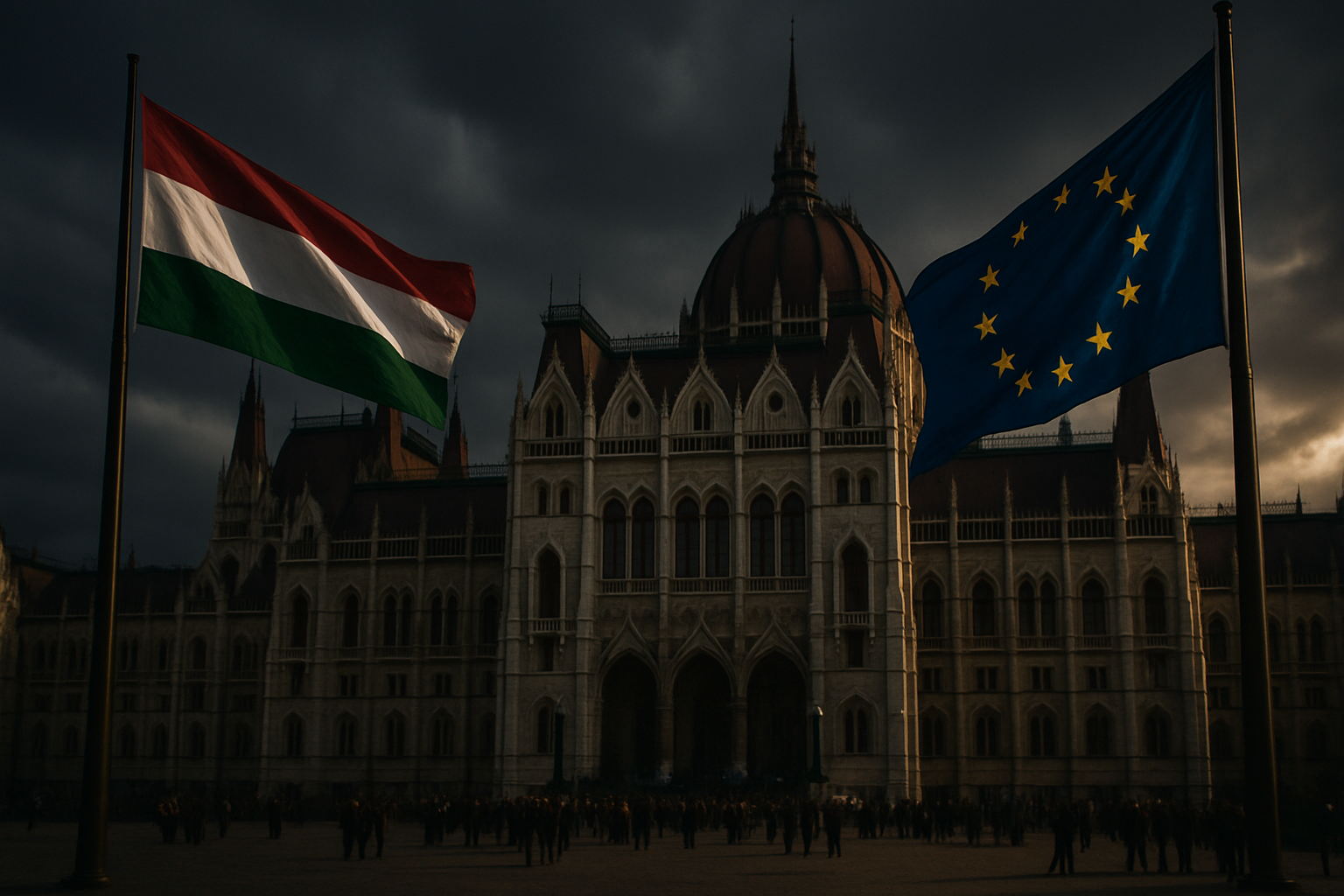
Hungarian Prime Minister Viktor Orban faces the most serious electoral challenge of his career as the April 12, 2026 parliamentary elections approach, with his Fidesz party trailing opposition coalitions in polls for the first time since 2010 amid mounting EU tensions and allegations of Russian interference.
After sixteen years of political dominance, Orban's grip on power appears increasingly precarious as opposition leader Péter Magyar's Tisza Party gains unprecedented momentum. The center-right opposition party has organized massive demonstrations, including the "Greatest National March" that drew an estimated 500,000 participants to Budapest in what observers described as the largest anti-government demonstration since 2010.
Unprecedented Electoral Vulnerability
For the first time since Orban returned to power in 2010, multiple polling organizations show Fidesz trailing opposition coalitions, creating genuine electoral uncertainty in a country that has experienced little meaningful political competition for over a decade. This dramatic shift comes as Hungary faces a perfect storm of domestic and international pressures.
Magyar, a former government insider who broke with Fidesz, has consolidated opposition forces behind a pro-European platform promising wealth taxes, euro adoption, and stronger EU and NATO ties – a stark contrast to Orban's nationalist sovereignty approach that has put Hungary at odds with Brussels on multiple fronts.
"The propaganda machine Orban has built has a massive impact before any election, but it cannot overcome the reality that Hungarians are tired of his divisive politics," an opposition analyst told French media.
— Election Observer, quoted by RFI
Documented Foreign Interference Operations
The electoral challenge comes amid explosive revelations of foreign interference. Investigative journalist Szabolcs Panyi, working with VSquare, has documented what appears to be the first concrete evidence of Russian operatives actively participating in European electoral campaigns. The investigation revealed Russian interference teams operating in Budapest specifically to support Fidesz's electoral efforts.
This Russian support coincides with unprecedented American intervention, as US Vice President JD Vance visited Budapest just five days before the election, condemning EU "bureaucrats in Brussels" for "shameless election interference" while declaring Orban a "model for Europe." The dual foreign intervention – Russian operational support combined with American political backing – represents an entirely new dimension in European electoral politics.
Ukrainian officials have characterized recent pipeline-related incidents as potential "false flag operations as part of Moscow's large-scale interference in Hungary's elections," adding an additional layer of international intrigue to an already complex electoral landscape.
Deepening EU Crisis
Hungary's relationship with the European Union has reached a crisis point, with Budapest maintaining a blockade of the historic €90 billion Ukraine aid package – the largest single-nation EU assistance ever proposed. The blockade centers on the Druzhba pipeline dispute, which has been offline since January 27, 2026, creating significant energy security concerns for both Hungary and Slovakia.
The EU has responded with unprecedented measures, freezing approximately €19 billion in Hungarian funding over rule of law concerns and restricting Hungary's access to classified intelligence following allegations that Foreign Minister Péter Szijjártó leaked EU Council details to Russian Foreign Minister Sergei Lavrov during official meetings.
Lithuanian Foreign Minister Kestutis Budrys captured European frustration when he declared that "the EU cannot become Budapest's hostage," while enhanced cooperation discussions have accelerated to potentially bypass Hungarian vetoes – representing a fundamental departure from consensus decision-making that could alter European institutional structures for decades.
Media Control and Democratic Erosion
Concerns about the fairness of the April 12 elections have mounted as international observers document Fidesz's extensive control over Hungarian media landscape. German analysis describes Hungary as an "illiberal democracy" – a term Orban himself has embraced – noting how the country has been systematically restructured to favor the ruling party, including modifications to the electoral system itself.
However, the opposition has successfully leveraged digital platforms and international media coverage to create alternative information channels, particularly reaching younger demographics who consume news primarily through online platforms. This represents a crucial shift that has begun to undermine Orban's information monopoly, especially in urban and traditionally pro-government rural markets.
Energy Weaponization and Security Threats
The electoral period has been marked by escalating tensions over energy infrastructure. Serbian authorities recently discovered sophisticated explosive devices near the Balkan Stream/TurkStream pipeline infrastructure close to the Hungarian border, prompting Orban to convene an extraordinary National Defense Council session.
Opposition leaders dismissed the incident as "election campaign tactical panic-making," suggesting Orban was exploiting security fears for political benefit during the most challenging electoral contest of his career. The timing of the discovery – exactly one week before the elections – has raised suspicions about potential manipulation.
Hungary has threatened to "gradually halt gas deliveries to Ukraine" until oil transit through the Druzhba pipeline resumes, representing a dramatic escalation in energy standoff that affects not only bilateral relations but European energy security during critical winter conditions.
International Stakes and Implications
The outcome of Hungary's April 12 elections carries implications far beyond the country's borders. An opposition victory would likely restore Hungary's alignment with mainstream EU policies, lift the aid blockade to Ukraine, and remove Brussels' most persistent internal critic. Conversely, Orban's survival with foreign backing could embolden similar interference operations across the continent and potentially force the implementation of enhanced cooperation mechanisms that would fundamentally alter European decision-making structures.
The elections are being closely watched as a template-setting moment for 21st-century democracy under foreign interference and institutional pressure. Senior EU officials have noted that Europe is "writing the template for 21st-century crisis management, with the world watching whether democratic institutions can adapt while preserving European values."
"This is not just about Hungary anymore. The outcome will determine whether European institutions can resist authoritarian capture or if we're witnessing the gradual transformation of liberal democracy while maintaining its forms but undermining its values."
— Senior EU Official, speaking anonymously
Opposition's Pro-European Platform
Magyar's Tisza Party has presented a comprehensive 240-page electoral program that promises to reverse many of Orban's signature policies. The opposition platform includes wealth taxes on the highest earners, adoption of the euro currency, and a commitment to strengthen Hungary's ties with both the EU and NATO.
This represents a stark ideological contrast to Orban's approach, which has emphasized national sovereignty, resistance to EU migration policies, and maintenance of economic relationships with Russia despite international sanctions. The opposition has successfully framed the election as a referendum on Hungary's European future versus continued institutional confrontation with Brussels.
Demographic and Social Shifts
Polling suggests that Magyar's movement has successfully reached across traditional party lines, appealing to voters frustrated with corruption allegations, economic stagnation concerns, and what many see as democratic governance fatigue after sixteen years of Fidesz rule. The opposition has particularly gained traction in urban areas and among younger voters who have access to alternative media sources.
The "Greatest National March" demonstrated the opposition's capacity to mobilize supporters on a scale not seen since Orban's return to power, suggesting a level of political engagement that could translate into electoral success if voters turn out in sufficient numbers.
Economic Pressures and EU Relations
Hungary's economic relationship with the EU has become increasingly strained, with Brussels freezing substantial funding over rule of law concerns. The opposition has argued that Orban's confrontational approach has cost the country billions in potential EU investment and has hindered economic development.
Meanwhile, Orban has maintained that his policies protect Hungarian sovereignty and that alternative international relationships, particularly with the Trump administration, provide sufficient legitimacy and support. The Trump administration's explicit backing, including recent high-level visits, has given Orban an alternative source of international legitimacy amid tensions with Brussels.
The Path Forward
As Hungary approaches what many observers consider the most consequential election since the end of communist rule, the stakes could not be higher. The election will determine not only Hungary's domestic trajectory but also the country's role within European institutions and the broader future of EU decision-making mechanisms.
The combination of domestic political pressure, international interference, and institutional tensions has created an electoral environment unlike any seen in modern European politics. Whether Hungarian democratic institutions can successfully navigate these challenges while maintaining electoral integrity will provide crucial lessons for democratic governance in the 21st century.
With just days remaining before the April 12 vote, Hungary stands at a crossroads that will determine its political direction for years to come, with implications extending far beyond its borders to the very foundations of European integration and democratic governance.