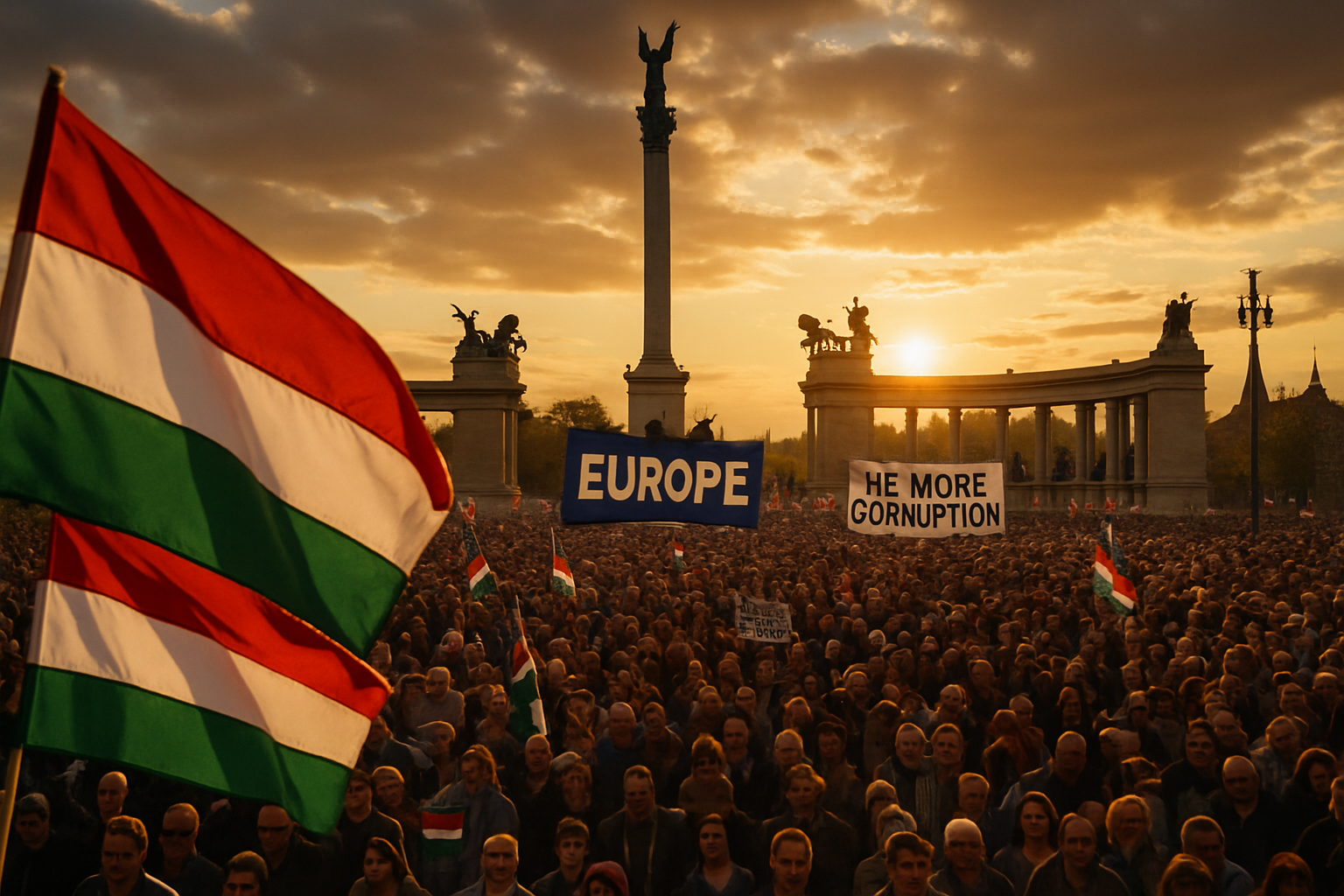
Hungary prepares for what could be its most consequential election since the fall of communism as Viktor Orbán faces unprecedented challenges to his 16-year rule, with opposition rallies drawing over 100,000 supporters demanding political change ahead of Sunday's crucial parliamentary vote.
The atmosphere in Budapest is electric as opposition leader Péter Magyar's Tisza Party has organized massive demonstrations that represent the largest anti-government gatherings since 2010. The sight of flag-waving crowds chanting "Russians go home!" and calling for democratic renewal has sent shockwaves through Hungary's political establishment, marking the first time in over a decade that Orbán's Fidesz party trails consistently in polling data.
Opposition Breakthrough Momentum
The 500,000-person "Greatest National March" organized by Magyar in March marked a watershed moment in Hungarian politics. The former government insider, who once worked within Orbán's system, has successfully consolidated disparate opposition forces behind a pro-European platform promising wealth taxes, euro adoption, and stronger EU/NATO ties.
Multiple international media outlets have documented the dramatic shift in public sentiment. French broadcaster RFI reported that "huge crowds of flag-waving supporters have cheered them on all week," while German news sources noted that Magyar's movement represents "the most credible challenger yet to Orban's 16-year grip on power."
"This could become Hungary's most important political moment since the fall of communism in 1989."
— International observers, RFI
The opposition's breakthrough has been particularly notable among younger demographics, who have grown up entirely under Orbán's rule. Austrian media highlighted this generational divide, asking "how do those who grew up under Orbán think?" Young Hungarians at rallies declared they want to be "free from hate propaganda," representing a stark rejection of the nationalist messaging that has defined Hungarian politics for over a decade.
Digital Resistance and Media Control
A crucial factor in the opposition's rise has been their successful escape from government media control through digital platforms and international coverage. This represents a fundamental shift undermining Orbán's information monopoly, particularly in rural and traditional markets where Fidesz previously held uncontested influence.
Swedish media reported on a documentary film released just two weeks before the election, exposing alleged vote-buying among Hungary's impoverished populations. The film, which has gone viral on YouTube, demonstrates how opposition forces have bypassed traditional media channels controlled by the government to reach voters directly.
Norwegian coverage from the rural town of Szekszárd revealed changing attitudes even in traditionally conservative areas, suggesting Orbán's rural stronghold may be weakening. This grassroots shift, combined with sophisticated digital campaigning, has created alternative information channels that challenge the government's narrative control.
International Stakes and Foreign Interference
The election has attracted unprecedented international attention due to its potential impact on European politics. France 24 emphasized that "Hungary's legislative elections on Sunday are being closely watched in Moscow," noting that Orbán has long been "Russian President Vladimir Putin's closest ally within the European Union."
Investigative reporting by Hungarian journalist Szabolcs Panyi revealed concrete evidence of Russian operative teams supporting Fidesz—the first documented case of Kremlin agents actively participating in European electoral campaigns. Simultaneously, the Trump administration has provided explicit political backing through high-profile visits and endorsements, creating an unprecedented dual foreign intervention scenario.
American involvement reached new heights when Vice President J.D. Vance visited Budapest days before the election, condemning EU "bureaucrats" for "shameless election interference" while declaring Orbán a "model for Europe." This represents a dramatic departure from traditional U.S. diplomatic neutrality in European elections.
Energy Crisis and EU Relations
The election occurs amid a deepening crisis in Hungary's relationship with the European Union. Orbán has maintained a blockade of a €90 billion Ukraine aid package over the Druzhba oil pipeline dispute, creating what observers call the deepest EU institutional crisis since the bloc's formation.
The crisis escalated when Serbian authorities discovered sophisticated explosive devices near the Balkan Stream/TurkStream pipeline infrastructure exactly one week before the election. While Hungarian officials suggested security threats, opposition leaders dismissed the incident as "tactical panic-making" designed to exploit security fears for electoral benefit.
Lithuanian Foreign Minister Kestutis Budrys captured European frustration, declaring that "the EU cannot become Budapest's hostage." Enhanced cooperation discussions are underway to potentially bypass Hungary's veto powers, representing a fundamental departure from consensus decision-making that could reshape European governance.
Economic Pressures and Social Change
Beyond geopolitical considerations, domestic economic pressures have contributed to Orbán's vulnerability. The European Commission has frozen approximately €19 billion in funding over rule of law concerns, representing one of the largest financial penalties ever imposed on an EU member state.
Magyar's opposition platform directly addresses these economic challenges with proposals for wealth taxation and accelerated European integration. The promise of euro adoption and stronger economic ties with Western Europe contrasts sharply with Orbán's nationalist economic approach, which has increasingly isolated Hungary from European financial mechanisms.
Italian sources noted how opposition movements have successfully escaped government control, creating "alternative information channels particularly reaching younger demographics." This demographic shift is crucial, as Generation Z voters—those who have known only Orbán's rule—are increasingly rejecting the system they inherited.
Electoral Dynamics and Polling
German analysis reveals that for the first time since 2010, challenger Magyar holds a clear lead over the incumbent prime minister in polling data. This represents a dramatic reversal of political fortunes for a leader who has dominated Hungarian politics for over a decade.
The electoral mathematics have been complicated by changes to Hungary's voting system since 2010, which Swedish media reports have been "rigged to favor Orbán." Despite these structural advantages, opposition momentum has proved sufficient to overcome institutional barriers.
Cyprus media noted that "despite Peter Magyar's lead, the outcome and the next day remain uncertain," highlighting the complex factors that could still influence the final result. The combination of voter mobilization, international pressure, and domestic discontent creates an unprecedented electoral environment.
Concert for Change
The opposition's cultural mobilization reached its peak with a massive protest concert in Budapest featuring dozens of bands performing for systemic change. German sources reported that "more than 100,000 people came" to hear musicians advocate for political transformation.
Israeli media coverage emphasized that the crowd was "largely made up of young people" who chanted "Russians go home!"—a direct challenge to Orbán's pro-Moscow foreign policy orientation. The event, which drew an additional 100,000 viewers via livestream, demonstrated the opposition's ability to mobilize across different media platforms and age groups.
Constitutional and Democratic Implications
Portuguese analysis frames the election as testing "the resilience of European democracy and whether popular vote can still dismantle a state captured by authoritarianism." This perspective reflects broader concerns about democratic backsliding in Central and Eastern Europe.
Slovak media highlighted cross-border political influences, with polling showing that "Smer supporters favor Orbán, while Progressive Slovakia voters support Magyar." This regional dimension underscores how Hungarian election results could influence neighboring countries' political trajectories.
Romanian coverage emphasized that this represents "the most tense, polarized campaign with the most violent and serious accusations in two decades," reflecting the high stakes involved for Hungary's democratic future.
The Path Forward
As voting begins Sunday morning with polling stations open from 6 AM to 7 PM, over 8.1 million eligible voters will determine not just Hungary's political direction but potentially the future of European integration. An additional 500,000 Hungarians living abroad add another dimension to electoral calculations.
The election has been characterized as a choice between continued isolation from European institutions under Orbán's nationalist approach, or reintegration with the European mainstream under Magyar's pro-EU platform. This fundamental choice will reverberate far beyond Hungary's borders.
Senior EU officials describe the situation as "writing the template for 21st-century crisis management," with "the world watching whether democratic institutions can adapt while preserving European values." The stakes encompass not just Hungarian domestic politics but the broader credibility of democratic governance under authoritarian pressure.
Whether Viktor Orbán can overcome the strongest challenge of his political career or whether Péter Magyar can achieve a historic opposition breakthrough will be determined by voters who face a choice between continuity and change, between nationalism and European integration, between the politics of division and the promise of democratic renewal.