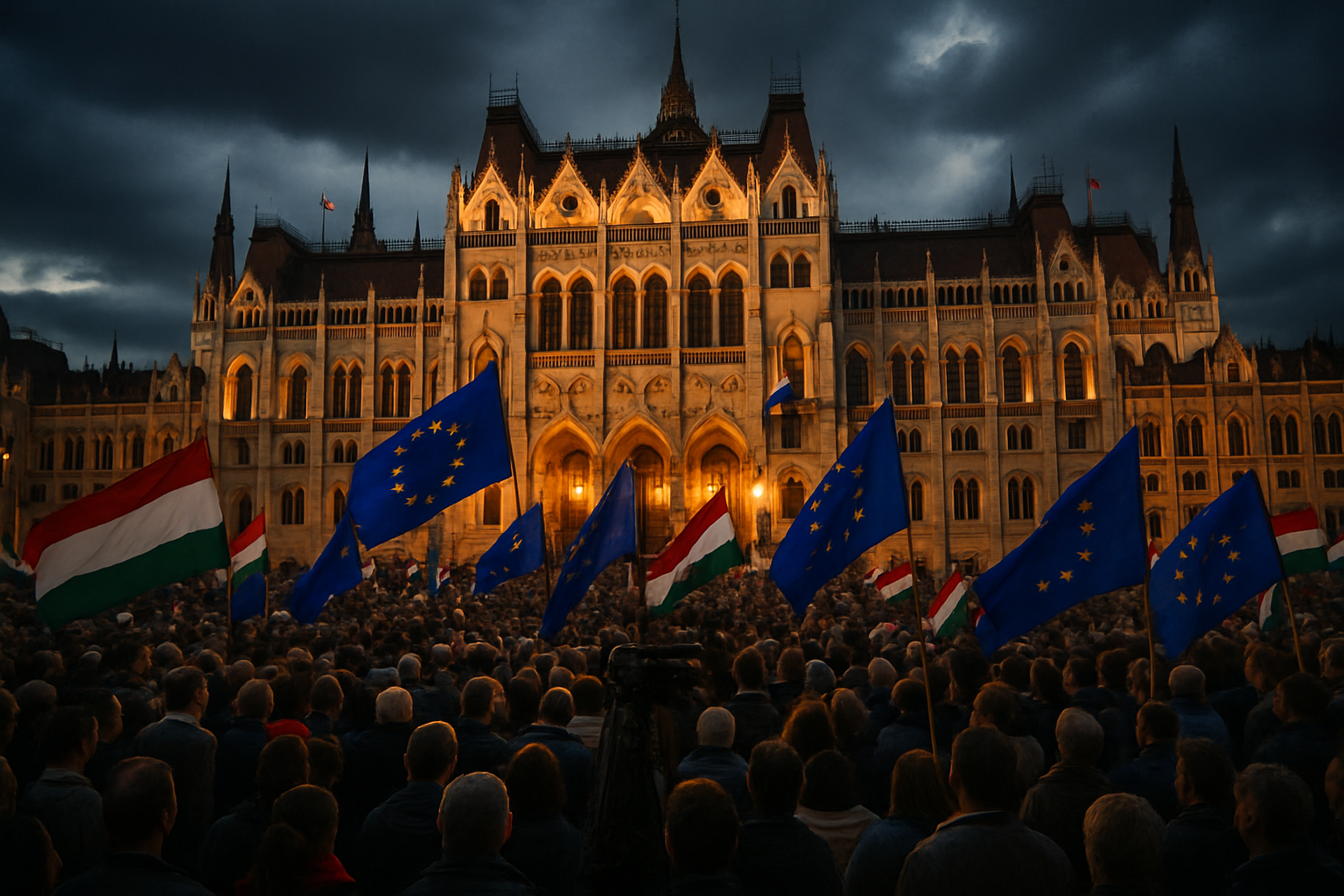
Hungary stands at a democratic crossroads as Prime Minister Viktor Orbán faces his most formidable electoral challenge in over a decade, with opposition leader Péter Magyar's Tisza Party leading in polls ahead of Sunday's parliamentary elections that could reshape the country's relationship with the European Union.
For the first time since Orbán's Fidesz party returned to power in 2010, multiple polling organizations show the opposition coalitions consistently ahead, creating genuine electoral uncertainty in what many observers describe as the most consequential Hungarian election since the end of communist rule.
The 62-year-old prime minister, who has dominated Hungarian politics for sixteen years, finds himself trailing in surveys to Magyar, a former government insider whose pro-European platform promises wealth taxes, euro adoption, and stronger EU and NATO ties – a stark contrast to Orbán's nationalist sovereignty approach.
Opposition Mobilization Reaches Historic Levels
The scale of opposition momentum became dramatically evident in March when Magyar organized the "Greatest National March" in Budapest, drawing an estimated 500,000 participants on Hungary's national holiday. The demonstration, timed symbolically on the anniversary of the 1848 revolution, represented the largest anti-government gathering since 2010.
"In 1848 and 1956, our revolutions continued in blood. The Russians came, but they could never defeat us. Orbán cannot do this either, who in his final desperation has called upon the KGB tsar."
— Péter Magyar, Tisza Party Leader
Magyar's rise has been meteoric. A former member of Orbán's inner circle, he broke with the system he once served, positioning himself as a credible conservative alternative who understands the machinery of power from the inside. His 240-page electoral program offers a comprehensive vision for Hungary's European future, emphasizing democratic governance, rule of law, and integration with Western institutions.
International Dimensions and Foreign Interference
The elections have taken on unprecedented international dimensions, with documented evidence of dual foreign interference. Investigative journalist Szabolcs Panyi revealed through VSquare reporting the first concrete evidence of Russian operative teams actively supporting Fidesz – marking the first documented case of Kremlin agents participating directly in European electoral campaigns.
Simultaneously, the Trump administration has provided explicit political backing for Orbán. US Vice President JD Vance's Budapest visit just five days before the election saw him condemning EU "shameless interference" while declaring Orbán a "model for Europe" – representing an extraordinary departure from traditional American diplomatic neutrality in European elections.
The convergence of Russian operational support and American political endorsement creates an unprecedented situation where two global superpowers are directly intervening in an EU member state's domestic politics, raising fundamental questions about electoral sovereignty and democratic integrity.
EU Relations at Breaking Point
Hungary's relationship with Brussels has reached its lowest point in the country's EU membership history. The European Commission has frozen €19 billion in funding over rule of law concerns, while Hungary maintains a blockade of a historic €90 billion Ukraine aid package over the Druzhba pipeline dispute.
The crisis has prompted unprecedented institutional responses. Lithuanian Foreign Minister Kestutis Budrys warned that "the EU cannot become Budapest's hostage," while enhanced cooperation discussions have accelerated to bypass Hungary's systematic use of veto powers. Such mechanisms would represent a fundamental departure from consensus decision-making, potentially altering the EU's institutional architecture for decades to come.
"Europe is writing the template for 21st-century crisis management, with the world watching whether democratic institutions can adapt while preserving European values."
— Senior EU Official
Energy Politics and Pipeline Disputes
Central to the current crisis is the Druzhba oil pipeline, which has been offline since January 27, 2026. Hungary and Slovakia claim Ukraine deliberately halted Russian oil transit as "political blackmail," while Ukraine maintains that Russian drone attacks damaged the infrastructure, requiring extensive repairs.
The dispute has real humanitarian consequences. Slovakia declared an oil emergency and released 250,000 tons from strategic reserves, while Orbán has threatened to "gradually halt gas deliveries to Ukraine" until oil transit resumes. This energy weaponization occurs as over 1,170 buildings in Kyiv lack adequate heating during sub-zero temperatures, affecting millions of Ukrainian civilians.
Adding to tensions, Serbian authorities discovered sophisticated explosive devices near the Balkan Stream/TurkStream pipeline infrastructure exactly one week before the Hungarian elections. While opposition leaders dismissed this as "election campaign tactical panic-making," Ukrainian officials characterized it as a "false flag operation" designed to influence the vote.
Media Breakthrough and Digital Resistance
A crucial factor in the opposition's success has been breaking through Fidesz's extensive media control. Hungarian opposition forces have successfully escaped government dominance through digital platforms and international coverage, creating alternative information channels that particularly resonate with younger demographics.
This represents a fundamental shift in the Hungarian information landscape. Márton Gulyás's "Partizán" platform has built a counter-narrative reaching millions, challenging the government's monopoly on traditional media. The evolution demonstrates how digital resistance can undermine authoritarian information control, even in systems with extensive state media apparatus.
Campaign Dynamics and Final Push
As the campaign entered its final weekend, both major parties held massive rallies in Budapest. Orbán, addressing supporters at a concert near Parliament, declared that "with 3 million votes, not even hell will stop us," calling on voters to bring friends and family to the polls. His campaign has emphasized sovereignty themes and warned of external threats to Hungarian independence.
Magyar, speaking from Debrecen in eastern Hungary, promised that "from April 13, Hungary will return to being a democracy." His campaign has focused on corruption allegations, economic stagnation, and the promise of European integration, offering a stark alternative to sixteen years of Fidesz rule.
Over 100,000 people attended an opposition concert in Budapest on Saturday evening, demonstrating the sustained enthusiasm for change among government critics. The gathering featured prominent Hungarian artists and cultural figures who have largely been marginalized during the Orbán era.
Stakes for European Democracy
The implications of Sunday's vote extend far beyond Hungary's borders. An opposition victory would restore Hungary's alignment with mainstream European positions, lift the Ukraine aid blockade, and remove Brussels' most persistent internal critic. It would demonstrate that democratic renewal remains possible even after years of institutional capture and authoritarian drift.
Conversely, Orbán's survival despite unprecedented challenges and documented foreign interference could embolden similar operations across the continent, potentially accelerating the implementation of enhanced cooperation mechanisms that fundamentally alter European decision-making structures.
Template for 21st Century Democracy
The election serves as a crucial test case for democratic resilience under modern pressures. With 89% of Europeans demanding greater EU unity according to Eurobarometer polling, yet political reality showing increasing fragmentation, Hungary's experience provides lessons for maintaining institutional integrity while addressing legitimate political competition.
The success or failure of channeling political tensions through electoral rather than extra-legal means will influence democratic development across Europe and beyond. It represents a template-setting moment for how democratic institutions adapt to 21st-century challenges while preserving the values and frameworks that have underpinned European success since 1945.
Nuclear Context and Security Implications
The elections unfold against a backdrop of unprecedented security concerns. The expiration of the New START treaty in February 2026 marked the first time in over 50 years without US-Russia nuclear constraints, with both countries controlling 80% of global weapons. UN Secretary-General António Guterres has described current nuclear risks as the "highest in decades."
This context adds urgency to resolving European divisions and maintaining alliance cohesion. The ability to preserve institutional integrity while managing political change becomes not just a democratic imperative but a security necessity in an era of great power competition.
Economic Dimensions and Voter Concerns
Beyond high politics, voters face real economic pressures that have contributed to Fidesz's declining support. Once the economic leader among former Eastern Bloc states, Hungary has fallen behind under Orbán's economic policies, particularly affecting the automotive industry that forms a crucial part of the economy.
The opposition's platform of wealth taxes and euro adoption appeals to voters frustrated with corruption and economic stagnation. Magyar's background as a former government insider lends credibility to his claims of systemic corruption and his promises of technocratic competence in economic management.
Natural gas prices have surged 24% across Europe, reaching €47.32 per MWh, while oil prices remain above $100 per barrel. These energy costs directly impact Hungarian households and businesses, creating additional pressure on the incumbent government.
Looking Toward Sunday
As Hungarians prepare to vote on Sunday, April 12, the stakes could hardly be higher. This election will determine not only Hungary's domestic trajectory but its role within European institutions, its relationship with both East and West, and its contribution to democratic governance in an increasingly challenging international environment.
The outcome will be closely watched from Washington to Moscow, from Brussels to Beijing. It represents perhaps the most significant Central European election in decades, with implications for NATO cohesion, EU integration, transatlantic relations, and the broader question of whether democratic institutions can successfully adapt to the pressures of the 21st century while maintaining their essential character.
In a region where democratic backsliding has become a persistent concern, Hungary's election offers both a test of institutional resilience and an opportunity for democratic renewal. The choices made by Hungarian voters on Sunday will reverberate far beyond the country's borders, shaping the trajectory of European democracy for years to come.