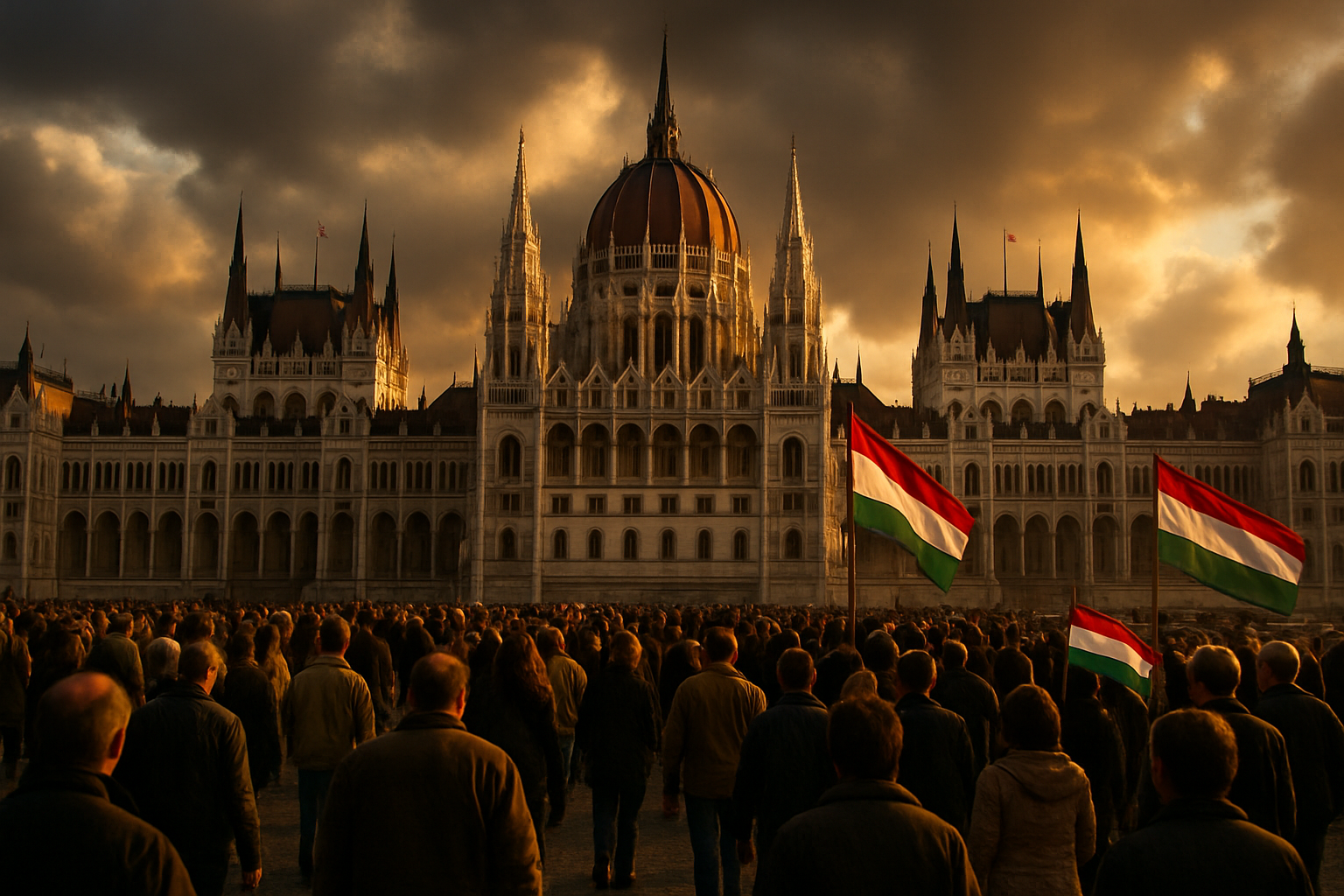
Hungarian Prime Minister Viktor Orbán faces the most serious electoral challenge of his career as voters head to the polls Sunday, with opposition forces gaining unprecedented momentum after sixteen years of his increasingly authoritarian rule.
For the first time since Orbán returned to power in 2010, his ruling Fidesz party trails opposition coalitions in multiple polling organizations, creating genuine electoral uncertainty that could reshape Hungary's role in the European Union and fundamentally alter Central European politics.
Opposition Breakthrough Unprecedented
Leading the charge against Orbán is Péter Magyar, a former government insider whose Tisza Party has consolidated opposition forces behind a pro-European platform promising wealth taxes, euro adoption, and stronger EU and NATO ties. Magyar organized the historic "Greatest National March" on March 15, drawing an estimated 500,000 participants to Budapest in the largest anti-government demonstration since 2010.
"In 1848 and 1956, our revolutions continued in blood. The Russians came, but they could never defeat us. Orbán cannot do this either, who in his final desperation has called upon the KGB tsar."
— Péter Magyar, Opposition Leader
Magyar's candidacy represents a dramatic shift in Hungarian politics. As a former government insider with credible alternative leadership credentials, he has successfully escaped the government's extensive media control through digital platforms and international coverage, creating alternative information channels that particularly resonate with younger demographics.
The opposition's breakthrough comes as Hungarian voters express growing frustration with corruption allegations, economic stagnation, and what critics call "democratic fatigue" after years of increasingly centralized power under Orbán's system.
Unprecedented Foreign Interference
Adding an extraordinary international dimension to the domestic election, multiple forms of foreign interference have been documented. Investigative journalist Szabolcs Panyi's reporting through VSquare revealed concrete evidence of Russian operative teams actively supporting Fidesz – marking the first documented case of Kremlin agents participating directly in European electoral campaigns.
Simultaneously, the Trump administration has provided unprecedented American political backing. Vice President J.D. Vance visited Budapest just five days before the election, condemning what he called EU "shameless interference" while declaring Orbán "a model for Europe." This represents the most direct American intervention in an EU member state election in modern history.
The dual foreign interference – Russian operational support combined with American political legitimacy – creates a historic precedent that could influence democratic processes across Europe.
EU Relations at Breaking Point
Hungary's relationship with the European Union has reached a crisis point under Orbán's leadership. Budapest maintains a blockade of the EU's historic €90 billion Ukraine aid package over the Druzhba pipeline dispute, while the European Commission has frozen €19 billion in Hungarian funding over rule of law concerns.
Intelligence restrictions have been imposed following allegations that Foreign Minister Péter Szijjártó systematically leaked EU Council details to Russian Foreign Minister Sergei Lavrov during official meetings. Lithuanian Foreign Minister Kestutis Budrys warned that "the EU cannot become Budapest's hostage."
The crisis has accelerated discussions about enhanced cooperation mechanisms that would allow 26 EU member states to proceed with decisions without Hungary – a fundamental departure from traditional consensus-based decision-making that could permanently alter European institutional structures.
Energy Politics as Electoral Weapon
Energy security has become a central campaign issue, with Hungary and Slovakia remaining the only EU countries dependent on Russian oil under special exemptions. The Druzhba pipeline has been offline since January 27, 2026, with Hungary claiming Ukraine deliberately manipulated supplies as "political blackmail," while Ukraine maintains the pipeline was damaged in Russian attacks requiring repairs.
The timing of a pipeline sabotage discovery – Serbian authorities found sophisticated explosive devices near the Balkan Stream infrastructure exactly one week before the election – has been dismissed by the opposition as "tactical panic-making" designed to exploit security fears for electoral benefit.
Democratic Stakes and International Implications
The April 12 election outcome will determine Hungary's European integration trajectory for decades. An opposition victory would restore Hungarian EU alignment, lift the aid blockade, and remove Brussels' most persistent internal critic. Orbán's survival with foreign backing could embolden similar interference operations continent-wide and fundamentally alter European decision-making structures.
Senior EU officials describe Europe as "writing a template for 21st-century crisis management" with the world watching whether democratic institutions can adapt while preserving European values. The success of channeling political tensions through electoral competition while maintaining institutional integrity would strengthen the European democratic model globally.
Campaign Dynamics and Voter Sentiment
From Hungarian citizens across Europe to voters at home, the election has generated intense engagement. A Melbourne woman named Ildi, featured in Australian media coverage, exemplifies the diaspora's investment in change, wanting to see "the end of Viktor Orbán's time ruling over Hungary."
At a concert in Budapest, musicians and concertgoers openly expressed criticism of Orbán's leadership, reflecting a cultural shift where opposition to the government has become more visible and vocal. The digital resistance has successfully undermined Orbán's information monopoly despite his extensive control over traditional media outlets.
The Broader European Context
Hungary's election occurs during what experts describe as "the most challenging period for continental democracy since World War II." With 89% of Europeans demanding greater EU unity according to Eurobarometer polling, yet political reality showing increasing fragmentation, the Hungarian vote represents a critical test of democratic resilience under authoritarian pressure.
The election serves as a template-setting moment for democratic governance in an era of foreign interference, energy weaponization, and institutional manipulation. Success would demonstrate that sophisticated authoritarian systems can be reversed through democratic means, while failure could accelerate fragmentation undermining the cooperation principles that have underpinned European success since 1945.
Looking Forward: A Continental Crossroads
As Hungarians prepare to vote, the stakes extend far beyond national borders. The outcome will influence EU decision-making capacity, NATO cohesion, and transatlantic relationships for years to come. It represents the most consequential Hungarian election since the end of communist rule, with implications for European security architecture, international law enforcement credibility, and democratic governance under authoritarian pressure.
Whether Europe strengthens through adaptive governance or experiences fragmentation will largely depend on the choices Hungarian voters make. In an interconnected world where domestic politics increasingly shapes international relations, this election serves as a crucial test of whether democratic institutions can adapt to 21st-century challenges while maintaining the frameworks that enable effective governance in an increasingly complex global environment.
The results will not only determine Hungary's path forward but could establish precedents for democratic innovation and resilience that will influence governance models worldwide for decades to come.