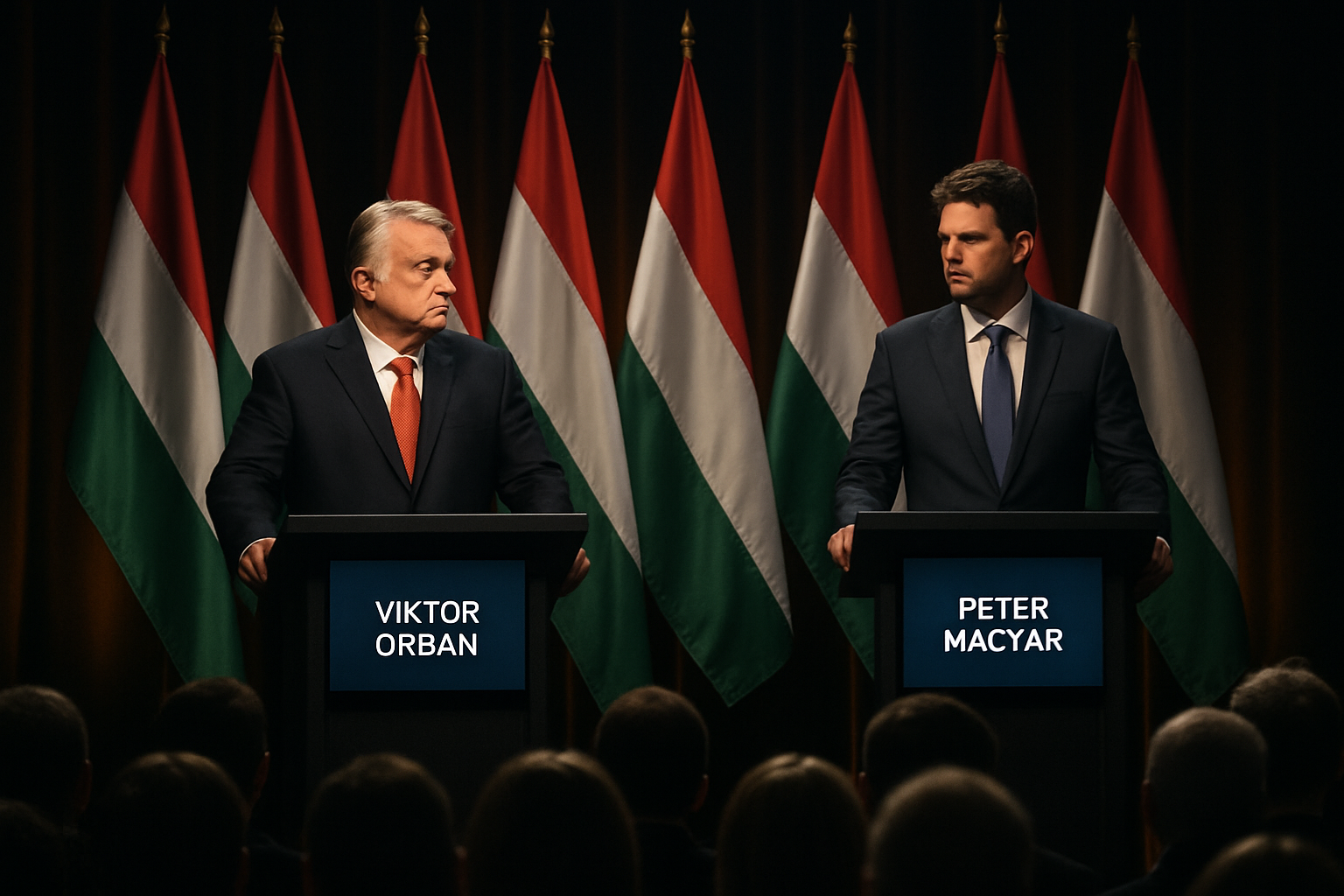
Hungary's April 12, 2026 parliamentary elections represent the most consequential political showdown in over a decade, as Prime Minister Viktor Orbán faces his gravest electoral challenge since returning to power in 2010. For the first time in 16 years, his ruling Fidesz party trails in the polls, threatened by opposition leader Péter Magyar's surging Tisza Party.
A Historic Political Earthquake
The political landscape has shifted dramatically in recent months, with multiple polling organizations confirming that Orbán's Fidesz party trails opposition coalitions for the first time since 2010. This represents a seismic change in Hungarian politics, where Orbán has maintained seemingly unshakeable dominance through a combination of media control, economic populism, and nationalist rhetoric.
Péter Magyar, a former government insider who broke with the Orbán system, has emerged as the most credible opposition leader in over a decade. His Tisza Party has consolidated opposition forces behind a distinctly pro-European platform, promising wealth taxes, euro adoption, and stronger EU and NATO ties – a stark contrast to Orbán's sovereignty-first approach.
"In 1848 and 1956, our revolutions continued in blood. The Russians came, but they could never defeat us. Orbán cannot do this either, who in his final desperation has called upon the KGB tsar."
— Péter Magyar, Tisza Party Leader
The opposition's momentum crystallized in March 2026 with the "Greatest National March" in Budapest, drawing an estimated 500,000 participants – the largest anti-government demonstration since 2010. Timed symbolically on Hungary's national holiday commemorating the 1848 revolution, the march demonstrated unprecedented unity among opposition forces.
Unprecedented International Interference
What makes these elections truly historic is the unprecedented level of foreign interference documented by investigative journalists. Szabolcs Panyi's VSquare investigation revealed concrete evidence of Russian operative teams working in Budapest to support Fidesz – the first documented case of Kremlin agents actively participating in European electoral campaigns.
Simultaneously, the Trump administration has provided explicit political backing through diplomatic visits and public endorsements. US Vice President J.D. Vance's Budapest visit just five days before the election condemned EU "shameless interference" while declaring Orbán a "model for Europe." This dual foreign intervention – Russian operational support combined with American political legitimacy – creates an unprecedented international dimension to domestic Hungarian politics.
The timing of various incidents has raised suspicions among opposition leaders and European observers. Just one week before the election, Serbian authorities discovered sophisticated explosive devices near the Balkan Stream/TurkStream pipeline infrastructure. While Orbán immediately convened the National Defense Council, opposition leaders dismissed it as "tactical panic-making" designed to exploit security fears for electoral benefit.
EU Relations in Crisis
Hungary's relationship with the European Union has reached a breaking point, with Orbán maintaining a blockade of the €90 billion Ukraine aid package – the largest single-nation EU assistance ever approved. The crisis centers on the Druzhba oil pipeline, which has been offline since January 27, 2026, with Hungary claiming Ukraine deliberately manipulated oil supplies as "political blackmail."
The European Commission has frozen €19 billion in Hungarian funding over rule of law concerns, while intelligence restrictions have been imposed following allegations that Foreign Minister Péter Szijjártó leaked EU Council details to Russian Foreign Minister Sergei Lavrov. Lithuanian Foreign Minister Kestutis Budrys warned that "the EU cannot become Budapest's hostage."
These tensions have accelerated discussions about enhanced cooperation mechanisms that would allow willing member states to proceed without Hungarian participation, representing a fundamental departure from the EU's traditional consensus decision-making approach.
Media Control vs. Digital Resistance
Despite Orbán's extensive control over traditional media outlets, the opposition has successfully escaped government information dominance through digital platforms and international coverage. This shift has been particularly effective in reaching younger demographics who consume news primarily through online channels, representing a crucial evolution in the Hungarian media landscape.
The government has responded with disinformation campaigns, including AI-generated videos targeting Magyar and his Tisza party. A vast campaign orchestrated by fake accounts has emerged on TikTok and Facebook, demonstrating the increasingly sophisticated nature of modern electoral interference.
Economic Pressures and Policy Alternatives
Economic concerns have played a crucial role in Orbán's declining popularity. EU funding suspensions over rule of law issues have created financial constraints, while inflation and economic stagnation have frustrated voters. Magyar's opposition platform offers concrete alternatives: wealth taxation, euro adoption, and renewed EU integration to unlock suspended funding.
The crisis over Chinese battery manufacturing facilities in eastern Hungary – traditionally Fidesz strongholds – has demonstrated how economic policy can become a political liability. Local opposition to these projects has contributed to the broader narrative of Orbán's disconnect from voter concerns.
Nuclear Governance and Regional Security
The elections occur against the backdrop of a broader nuclear governance crisis. The New START treaty expired on February 5, 2026, leaving the world without US-Russia nuclear constraints for the first time in over 50 years. Both countries control 80% of global nuclear weapons, with UN Secretary-General António Guterres warning of "the highest nuclear risks in decades."
Hungary's position as the EU's most persistent internal critic has implications far beyond domestic politics. The country's blocking of Ukraine aid and sanctions packages affects European security architecture, international law enforcement credibility, and the EU's capacity for collective action during wartime conditions.
Stakes Beyond Hungary's Borders
The April 12 election outcome will determine Hungary's trajectory for decades. An opposition victory would restore Hungary to mainstream EU alignment, lift the aid blockade, and remove Brussels' most persistent internal critic. Such an outcome would demonstrate that electoral democracy can reverse authoritarian capture and encourage similar movements across Europe.
Conversely, Orbán's survival with documented foreign backing could embolden similar interference operations continent-wide and force the implementation of enhanced cooperation mechanisms that would fundamentally alter European decision-making structures.
"Europe is writing the template for 21st-century crisis management, with the world watching whether democratic institutions can adapt while preserving European values."
— Senior EU Official
A Template for Democratic Resilience
These elections represent a template-setting moment for democratic governance under foreign interference and institutional pressure. Success in channeling political tensions through electoral competition while preserving institutional integrity would strengthen the European model globally. Failure could accelerate fragmentation and undermine the cooperation principles that have underpinned European success since 1945.
The stakes encompass European security architecture, international law enforcement effectiveness, and democratic institutions' capacity to function under authoritarian pressure. With 89% of Europeans demanding greater unity according to recent Eurobarometer polling, the contrast between public sentiment and institutional reality has never been starker.
As voters prepare to cast their ballots on April 12, they face a choice that extends far beyond Hungary's borders. The outcome will influence EU decision-making capacity, NATO cohesion, transatlantic relationships, and the broader question of whether democratic governance can adapt to 21st-century challenges while maintaining its fundamental principles.
This election will determine not just Hungary's future, but provide crucial insights into the resilience of democratic institutions when tested by sophisticated authoritarian pressure, foreign interference, and the complex realities of an interconnected but increasingly fragmented world.