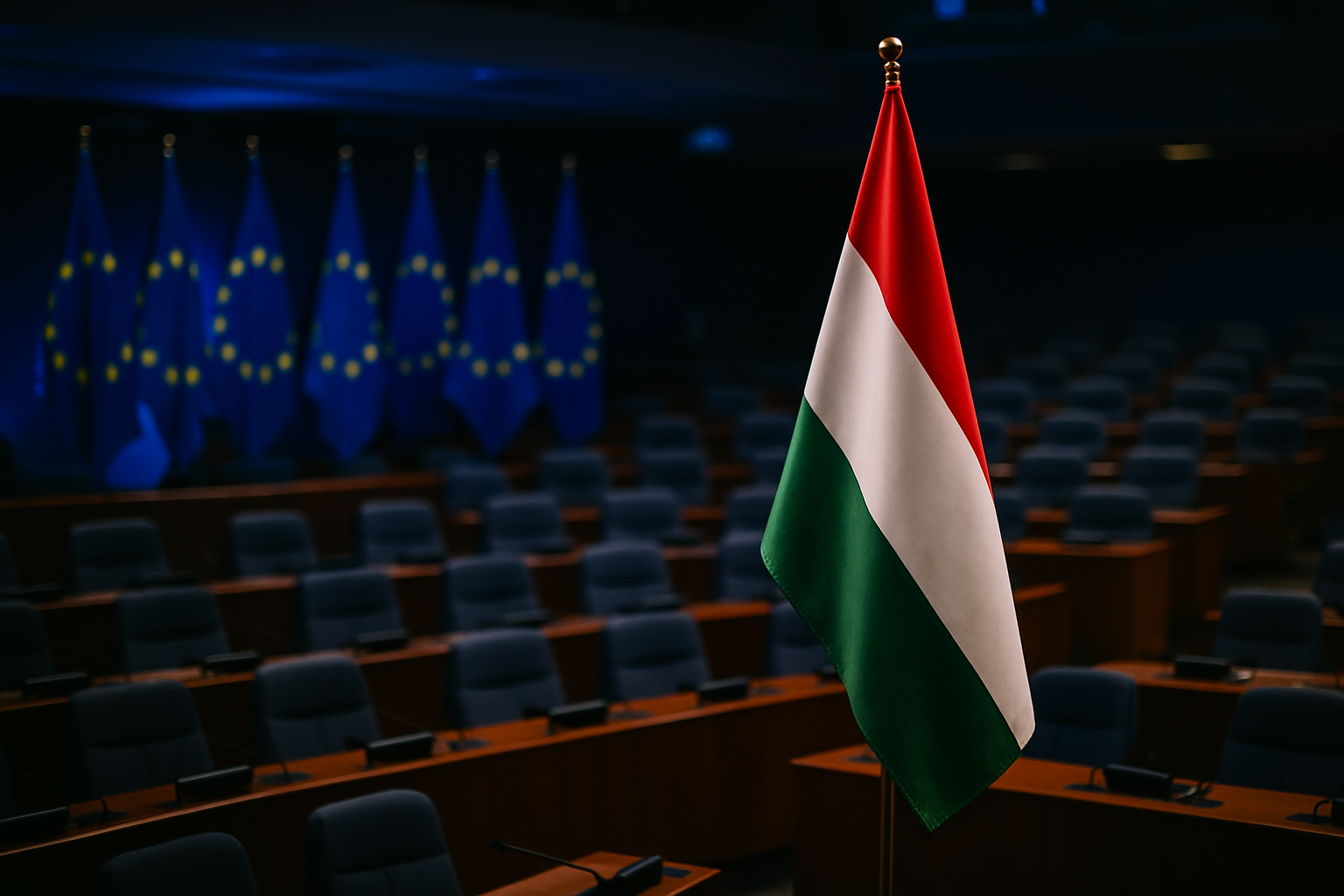
European Union leaders faced their gravest institutional crisis since the Russian invasion began as Hungarian Prime Minister Viktor Orbán maintained his blockade of the €90 billion Ukraine aid package during heated Brussels summit proceedings on March 19, 2026, defying 90 minutes of unprecedented pressure from European Council President António Costa and fellow heads of state.
The Hungarian leader's defiant stance threatens to derail the largest EU financial assistance package in history, approved by the European Parliament with 458 votes in favor, 140 against, and 44 abstentions. Despite broad European support, Hungary's veto power under EU unanimity requirements has effectively paralyzed the aid mechanism designed to support Ukraine's defense and reconstruction efforts through 2027.
Dramatic Walkout Highlights EU Divisions
In an unprecedented display of diplomatic discord, Orbán walked out of the European Council chamber when Ukrainian President Volodymyr Zelensky appeared via video link to address EU leaders. The symbolic gesture, witnessed by 27 heads of state and government, underscored the depth of Hungary's opposition to continued Ukraine support.
European Council President António Costa issued what diplomatic sources described as an "unprecedented direct letter" to Budapest, demanding Hungary honor its previous commitments to European solidarity. The confrontation represents the most severe institutional challenge to EU decision-making since the bloc's formation.
"The EU cannot become Budapest's hostage. We will help Ukraine when we have our oil."
— Viktor Orbán, Hungarian Prime Minister
Druzhba Pipeline Crisis at Heart of Dispute
The aid blockade centers on the ongoing Druzhba pipeline crisis that has persisted since late January 2026. Hungary and Slovakia claim Ukraine deliberately halted Russian oil transit as "political blackmail," while Ukrainian authorities maintain that Russian drone attacks damaged critical infrastructure requiring extensive repairs.
The pipeline dispute has created cascading effects across Central Europe. Slovakia declared an oil emergency in February, releasing 250,000 tons of strategic reserves to maintain operations at the Slovnaft refinery. Both Hungary and Slovakia remain the only EU member states still dependent on Russian oil under special sanctions exemptions granted during the initial sanctions packages.
Hungarian Foreign Minister Péter Szijjártó has explicitly linked the aid package to pipeline restoration, stating Hungary will maintain its veto until Russian oil transit resumes through Ukrainian territory. This position has drawn sharp criticism from Baltic and Nordic states, with Lithuanian Foreign Minister Kestutis Budrys warning that "the EU cannot become Budapest's hostage."
European Leaders Express Frustration
Swedish Prime Minister Ulf Kristersson delivered perhaps the harshest criticism, declaring that Orbán "is blackmailing Ukraine and the entire European Council." The comments reflect growing frustration among EU leaders who view Hungary's position as undermining European solidarity during a critical phase of the Ukraine conflict.
Italian Prime Minister Giorgia Meloni surprised fellow leaders by expressing understanding for Hungary's position, according to Politico reporting, creating additional complexity within EU ranks. However, Meloni simultaneously supported the €90 billion allocation, highlighting the intricate political dynamics surrounding the crisis.
German officials have been particularly vocal in their criticism of Hungary's institutional manipulation, with former Foreign Minister Johann Wadephul condemning the use of unanimity requirements to block collective European action during wartime conditions.
Enhanced Cooperation Mechanisms Under Discussion
The crisis has accelerated discussions about enhanced cooperation procedures that would allow willing member states to proceed with policies without requiring unanimous approval. Such mechanisms, requiring support from at least nine member states, would represent a fundamental departure from traditional EU consensus decision-making.
The enhanced cooperation option could allow the remaining 26 member states to deliver the aid package despite Hungarian opposition, though it would set a significant precedent for bypassing national vetoes on major foreign policy initiatives. EU officials indicate these discussions have gained momentum as traditional diplomatic pressure has proven ineffective.
France and Germany have emerged as key proponents of exploring alternative mechanisms, arguing that European security cannot be held hostage to individual member state domestic political calculations.
Electoral Context and International Support
Orbán's hardline stance occurs against the backdrop of Hungary's most challenging electoral period since 2010. For the first time since his return to power, Fidesz trails opposition coalitions in multiple polling organizations ahead of April 12, 2026 elections. The crisis provides domestic political benefits by demonstrating independence from Brussels while appealing to sovereignty concerns among Hungarian voters.
The Hungarian leader enjoys explicit support from the Trump administration, with Secretary of State Marco Rubio's recent Budapest visit including declarations that America is "profoundly attached to your success." This alternative source of international legitimacy allows Orbán to maintain his confrontational stance with EU institutions.
Opposition leader Péter Magyar's Tisza Party has capitalized on the crisis, organizing massive demonstrations including the "Greatest National March" that drew an estimated 500,000 participants to Budapest streets. The opposition has framed the election as a referendum on Hungary's European future versus continued institutional confrontation.
Military and Humanitarian Stakes
The aid blockade occurs as Ukraine faces intensifying military pressure from Russian forces. Intelligence reports indicate Russian territorial gains accelerated to 481 square kilometers in January 2026 compared to 260 square kilometers in December 2025, representing an 85% increase in the fastest months of territorial acquisition.
The humanitarian situation has deteriorated significantly, with over 1,170 Kyiv buildings lacking adequate heating during extreme winter conditions. Ukrainian officials report that 17.8 million citizens are accessing winter support programs, while systematic attacks on energy infrastructure have forced nuclear plants to halt electricity production for the first time since the conflict began.
Ukrainian casualties continue mounting, with President Zelensky disclosing that 55,000 soldiers have been officially killed, with a "large number" listed as missing. International intelligence estimates suggest actual casualty figures may be two to three times higher than official disclosures.
Diplomatic Breakthrough Paradox
The EU crisis unfolds against the backdrop of significant diplomatic progress in peace negotiations. February's Abu Dhabi talks achieved a historic 314-prisoner exchange, the first in five months, while restoring US-Russia military communications after a four-year suspension.
Geneva talks in February showed "significant progress" on ceasefire monitoring mechanisms, with European "Big Five" observers (Germany, France, Italy, UK, Poland) participating for the first time. The Trump administration has established a June 2026 deadline for Washington venue talks with potential presidential-level engagement.
However, Hungarian divisions may signal weakening European resolve to Moscow, potentially undermining Ukraine's negotiating position when talks resume. The fundamental territorial dispute over eastern Ukrainian regions under Russian control remains unchanged, with Russia demanding recognition while Ukraine maintains its territorial integrity position.
Nuclear Governance Crisis Context
The aid crisis occurs during an unprecedented nuclear governance vacuum following the New START treaty's expiration on February 5, 2026. For the first time in over 50 years, no formal nuclear constraints exist between the United States and Russia, both of which control 80% of global nuclear weapons.
UN Secretary-General António Guterres has warned of a "grave turning point" with nuclear risks at their highest levels in decades. The restored US-Russia military communications represent the only remaining formal diplomatic channel between the superpowers, making European unity even more crucial for maintaining international stability.
European strategic autonomy discussions have accelerated in response to these developments, with French President Emmanuel Macron and German Chancellor Friedrich Merz confirming nuclear deterrent expansion talks beyond France's national scope for the first time since the Cold War's end.
Economic and Energy Implications
The pipeline crisis has exposed continued European vulnerabilities despite diversification efforts since the 2022 invasion. Natural gas prices have surged 24% across Europe, while Hungary and Slovakia's dependence on Russian oil creates ongoing leverage points for both Moscow and domestic political exploitation.
Croatia has offered alternative Mediterranean routes for oil supplies, but these would accommodate only non-Russian crude and require months or years for full implementation. Ukraine has proposed the Odessa-Brody pipeline as a replacement mechanism, though this would also require significant infrastructure investment and time.
The €90 billion aid package represents approximately 0.6% of EU GDP over the two-year period, making the economic impact manageable for the bloc's overall fiscal capacity. However, the institutional precedent of allowing individual member states to block collective security initiatives raises fundamental questions about EU decision-making effectiveness during crisis conditions.
International Law and Precedent Concerns
Legal experts have raised concerns about the precedent set by using energy interdependence as diplomatic leverage during active conflict conditions. The systematic targeting of civilian infrastructure during extreme winter conditions has been documented as violations of Geneva Conventions provisions protecting non-combatants.
The success or failure of resolving the EU aid crisis will influence future conflict management mechanisms and the credibility of democratic institutions under extraordinary pressure. The case represents a critical test of whether European integration can adapt to 21st-century security challenges while preserving both democratic legitimacy and member state sovereignty principles.
Enhanced cooperation mechanisms, if implemented, would fundamentally alter EU decision-making precedents established over decades of integration. The implications extend beyond Ukraine support to broader questions of collective action capabilities and democratic governance effectiveness during authoritarian pressure campaigns.
Looking Forward: April Elections and Beyond
The resolution of Hungary's aid blockade may ultimately depend on the outcome of April 12 elections, which represent Orbán's most significant electoral challenge since returning to power in 2010. Opposition parties have promised immediate EU integration restoration, euro adoption, and wealth taxation policies that contrast sharply with current nationalist approaches.
If Fidesz loses power, a new Hungarian government would likely lift the aid blockade immediately, allowing the €90 billion package to proceed and restoring EU unity on Ukraine support. However, an Orbán victory would entrench the crisis, potentially forcing enhanced cooperation implementation and fundamentally altering European decision-making structures.
The stakes extend far beyond Hungarian domestic politics to encompass European security architecture, international law enforcement credibility, and territorial sovereignty principles that will shape power competition frameworks for decades to come. Success in maintaining democratic solidarity against authoritarian pressure has never been more critical for European institutional resilience and global stability.