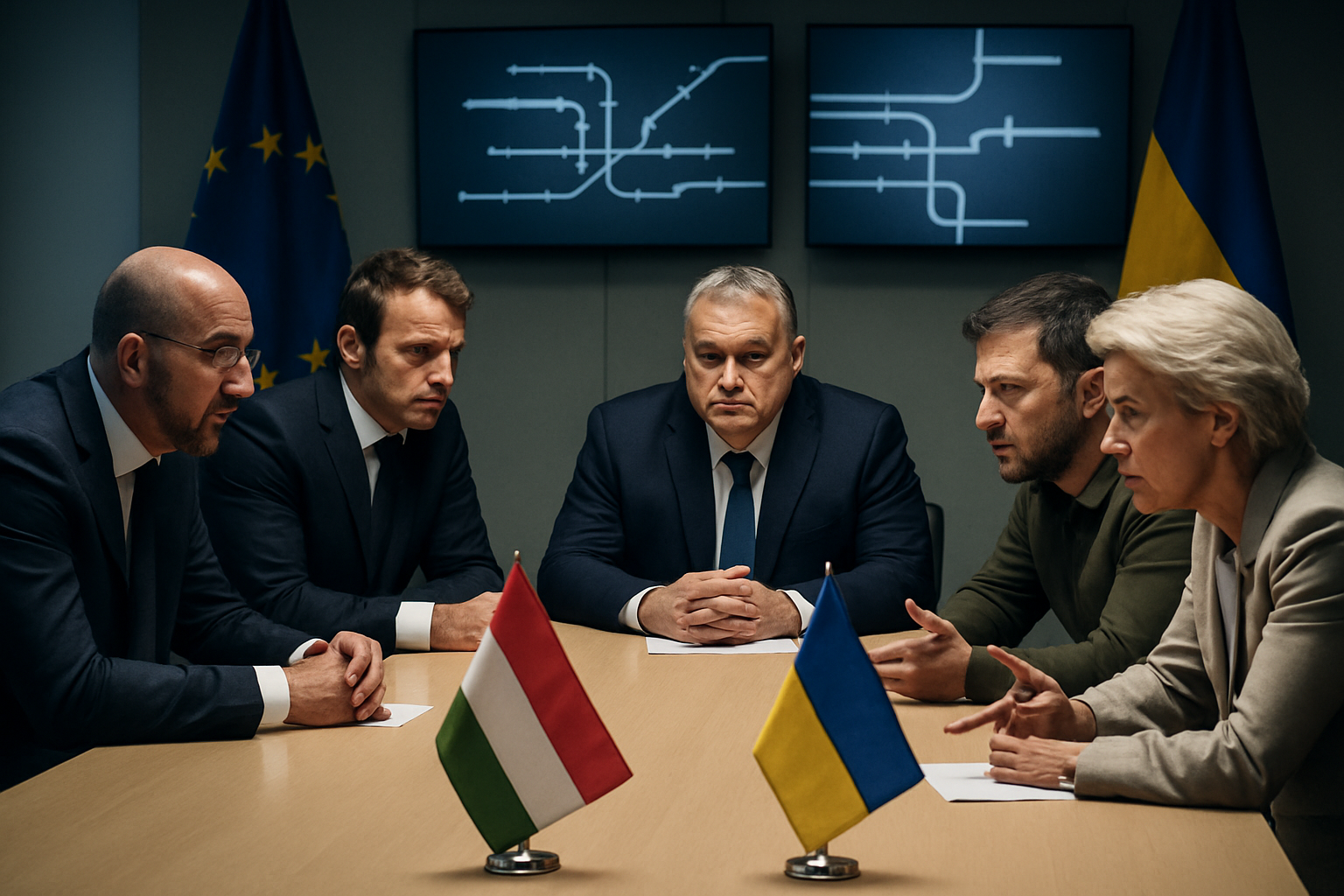
Hungarian Prime Minister Viktor Orbán announced on Wednesday that Budapest would gradually halt natural gas deliveries to Ukraine until oil transit through the Druzhba pipeline resumes, marking a dramatic escalation in the energy standoff that has become the centerpiece of Europe's most severe institutional crisis since the bloc's formation.
"We are gradually halting gas deliveries from Hungary to Ukraine, and will store the gas that remains with us in Hungary," Orbán declared in a video posted on Facebook, directly linking Hungary's gas supply decisions to the ongoing dispute over the Druzhba oil pipeline that has been offline since late January 2026.
The Core of the Crisis: Druzhba Pipeline Disruption
The Hungarian ultimatum centers on the critical Druzhba pipeline, which has remained offline since January 27, 2026. This infrastructure carries Russian crude oil through Ukrainian territory to refineries in Hungary and Slovakia, making these two countries the only EU members still dependent on Russian oil under special sanctions exemptions granted during the implementation of EU energy restrictions.
The dispute has created a fundamental deadlock between Budapest and Kyiv over the cause of the disruption. Hungary and Slovakia maintain that Ukraine deliberately manipulated oil supplies as "political blackmail," while Ukraine insists the pipeline was damaged by Russian drone attacks and is being repaired as quickly as possible.
Slovakia has already taken decisive action, declaring an oil emergency in February 2026 and releasing 250,000 tons from strategic reserves to supply the Slovnaft Bratislava refinery for approximately one month of operations. The country also suspended diesel exports to Ukraine to prioritize domestic supply security.
European Unity Under Maximum Stress
The Hungarian gas threat represents the culmination of months of escalating tensions that have exposed deep fractures within European solidarity during wartime. Hungary's Foreign Minister Péter Szijjártó has maintained a systematic blockade of the EU's historic €90 billion loan package to Ukraine—the largest single-nation financial assistance package in EU history—until oil transit resumes.
"EU cannot become Budapest's hostage," Lithuanian Foreign Minister Kestutis Budrys warned in previous statements, highlighting the unprecedented nature of Hungary's use of unanimity requirements as leverage against collective European action.
— Kestutis Budrys, Lithuanian Foreign Minister
The crisis has accelerated discussions about enhanced cooperation mechanisms that would allow 26 EU member states to proceed without Hungarian participation, representing a fundamental departure from consensus decision-making that has defined European integration for decades.
Humanitarian Stakes During Winter Crisis
The timing of Hungary's gas supply threat carries devastating humanitarian implications. Ukraine faces one of its most severe winter challenges since the conflict began, with over 1,170 Kyiv buildings lacking adequate heating during sub-zero temperatures. More than 17.8 million Ukrainians are currently accessing winter support programs as Russian attacks on energy infrastructure have created what officials describe as an "energy terrorism" campaign.
Ukrainian nuclear plants have been forced to halt electricity production for the first time in the conflict, making external energy supplies from neighboring countries like Slovakia and Hungary crucial for civilian survival. The threat to cut gas supplies directly impacts Ukraine's ability to maintain essential services during life-threatening weather conditions.
Electoral Politics and Strategic Calculations
Orbán's escalating confrontation with the EU occurs against the backdrop of unprecedented domestic political vulnerability. The Hungarian Prime Minister faces elections on April 12, 2026, with his Fidesz party trailing opposition coalitions for the first time since 2010.
Opposition leader Péter Magyar's Tisza Party organized the "Greatest National March" that drew 500,000 participants to Budapest, while polling consistently shows Fidesz losing ground. The opposition has framed the election as a referendum on Hungary's European future versus continued institutional confrontation with Brussels.
However, Orbán has cultivated alternative international legitimacy through explicit support from the Trump administration. Secretary of State Marco Rubio's visit to Budapest included declarations that Trump was "profoundly attached to your success," providing diplomatic cover for Hungary's EU confrontation.
Global Energy Context: From Crisis to Crisis
Hungary's gas threat occurs amid the aftermath of the most severe global energy crisis since the 1970s oil shocks. In March 2026, Iran's Revolutionary Guard closure of the Strait of Hormuz blocked 40% of global seaborne oil transit, sending oil prices to $119.50 per barrel for Brent crude and triggering the largest strategic petroleum reserve release in history.
That crisis exposed dangerous over-dependencies on strategic chokepoints and accelerated discussions about energy architecture transformation. The Hungarian-Ukrainian dispute now demonstrates how energy interdependence can be weaponized even among allies, creating additional vulnerabilities in an already fragile global energy system.
Institutional Precedent and Democratic Governance
European Council President António Costa issued an unprecedented direct letter to Budapest demanding Hungary honor its commitments—the most severe institutional challenge to EU decision-making structures since the bloc's formation. Swedish Prime Minister Ulf Kristersson accused Orbán of "blackmailing Ukraine and the entire European Council."
The crisis tests whether democratic governance mechanisms can adapt to 21st-century security challenges while preserving member state sovereignty principles. Enhanced cooperation procedures, if implemented, would represent a fundamental alteration of European decision-making precedents with implications extending decades beyond the current crisis.
Nuclear Governance and Diplomatic Context
The Hungarian-Ukrainian energy standoff unfolds against the backdrop of unprecedented nuclear governance challenges. The New START treaty expired on February 5, 2026, marking the first time in over 50 years that the United States and Russia operate without bilateral nuclear constraints. Both superpowers control approximately 80% of global nuclear weapons, prompting UN Secretary-General António Guterres to warn that nuclear risks have reached their "highest levels in decades."
Recent diplomatic breakthroughs, including a 314-prisoner exchange and the restoration of US-Russia military communications after a four-year suspension, had created momentum toward potential peace negotiations. However, the deepening divisions within Europe over energy policy may undermine Ukraine's negotiating position in future talks.
Alternative Solutions and Regional Cooperation
As the crisis deepens, alternative solutions are being explored. Croatia has offered Mediterranean route assistance for non-Russian crude oil, though implementation would require months or years of infrastructure development. Ukraine has proposed the Odessa-Brody pipeline as a replacement route, while Slovakia and Hungary are discussing direct pipeline connections between their refineries to reduce dependence on Ukrainian transit.
These longer-term solutions, however, provide little immediate relief for the current crisis. Hungary and Slovakia remain vulnerable to supply disruptions until alternative infrastructure is operational, creating ongoing leverage for disputes over energy transit.
Stakes for European Integration
The resolution of this crisis will determine the trajectory of European integration for decades to come. Success in maintaining unity while delivering promised aid to Ukraine would strengthen the EU's credibility as a global security actor. Failure would signal broader fragmentation under external pressure, undermining the democratic solidarity principles that have defined the European project.
The crisis demonstrates the vulnerability of unanimity requirements during extraordinary circumstances. Whether the EU can adapt its institutional mechanisms while preserving democratic legitimacy will influence its capacity for collective action in future security challenges.
"This is a historic moment that tests whether European integration can survive the pressures of the 21st century while maintaining its core values."
— Senior EU Official
Looking Ahead: April Elections as Decisive Moment
The outcome of Hungary's April 12, 2026 elections may prove decisive for resolving the crisis. An opposition victory would likely result in the immediate lifting of Hungary's blockade and restoration of EU unity on Ukraine support. However, an Orbán victory would entrench the crisis and force the implementation of enhanced cooperation mechanisms, fundamentally altering European decision-making structures.
The broader implications extend beyond immediate energy concerns to encompass European security architecture, international law enforcement credibility, and the effectiveness of democratic institutions under authoritarian pressure. The crisis serves as a template for understanding how energy interdependence, electoral politics, and institutional vulnerabilities intersect in an increasingly complex geopolitical environment.
As natural gas continues to flow from Hungary to Ukraine for now, according to Hungarian pipeline operator FGSZ's data, the threat of gradual cessation represents a sword of Damocles over European energy security. The coming weeks will test whether diplomatic solutions can be found or whether Europe must fundamentally restructure its decision-making processes to address 21st-century security challenges while preserving democratic governance principles.