Viktor Orbán's unprecedented 16-year rule in Hungary came to a dramatic end on April 12, 2026, as Péter Magyar's Tisza Party achieved a stunning constitutional supermajority with 138 of 199 parliamentary seats, marking the most significant Central European political transformation since the fall of communism.
The election results, confirmed with a record 80% voter turnout—the highest since Hungary's 1989 democratic transition—represent a complete repudiation of Orbán's nationalist-authoritarian model. Fidesz collapsed to just 55 seats, its worst performance since 2010, in what international observers are calling a template for 21st-century democratic resilience.
Immediate Democratic Transformation
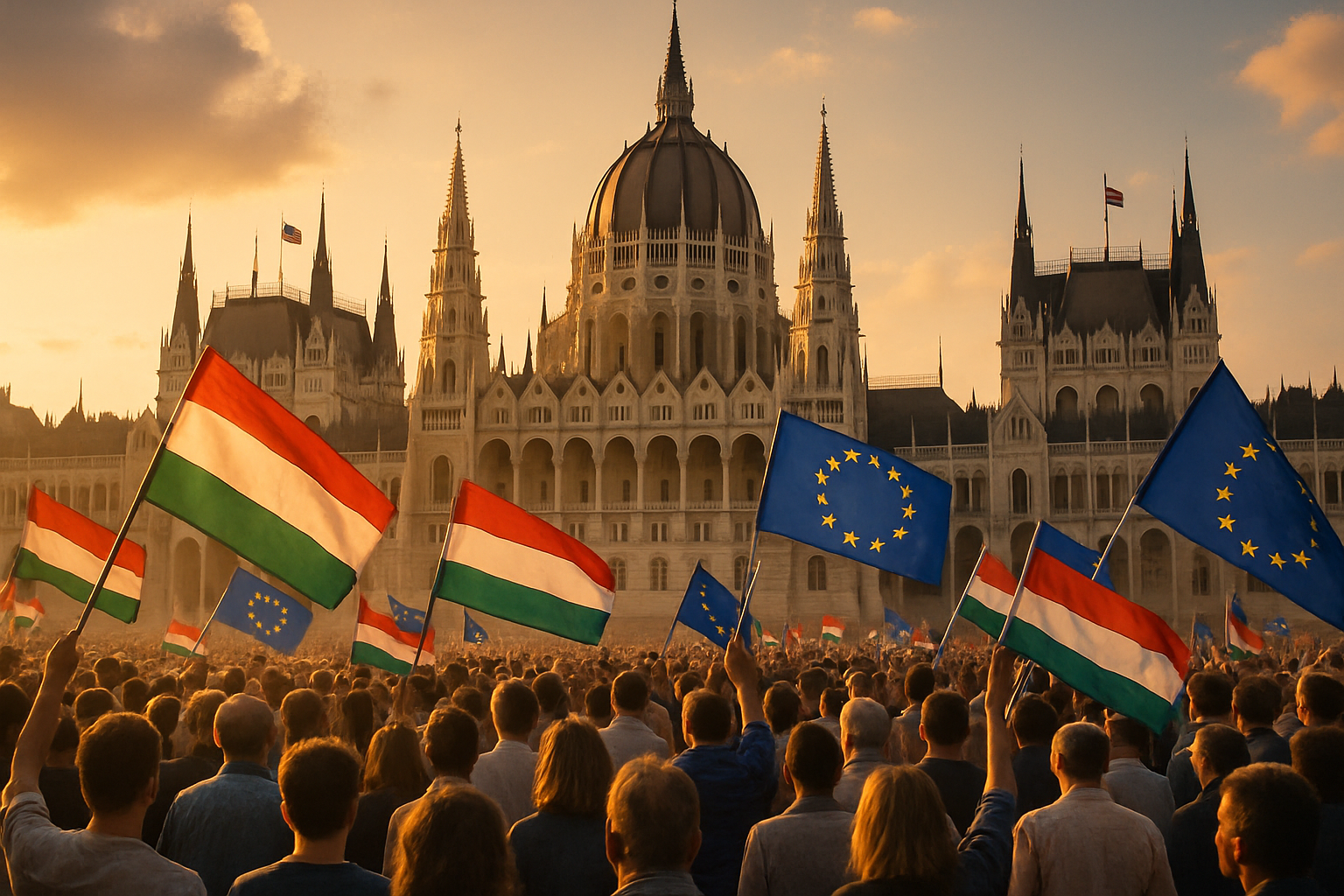
Magyar declared "We have liberated Hungary" as tens of thousands celebrated in Budapest's streets, displaying both Hungarian and EU flags in scenes reminiscent of the 1989 velvet revolution. The constitutional supermajority enables comprehensive democratic reforms including judicial independence restoration, media oligarchy dismantling, wealth tax implementation, and euro adoption process initiation.
The most immediate impact was Hungary's lifting of its €90 billion Ukraine aid blockade, which had created the deepest EU institutional crisis in the bloc's history. The frozen €19 billion in EU funding is expected to be restored within days, while enhanced cooperation discussions that would have bypassed Hungarian vetoes are now unnecessary.
"Hungary has chosen Europe. Our country has found its European path again."
— Ursula von der Leyen, European Commission President
The Fall of Foreign Interference
The election marked an unprecedented failure of dual foreign interference campaigns. Investigative journalist Szabolcs Panyi's VSquare investigation had documented Russian operative teams actively supporting Fidesz—the first concrete evidence of Kremlin agents participating in European electoral campaigns. Simultaneously, the Trump administration provided explicit political backing through JD Vance's Budapest visit five days before the election, where he condemned EU "shameless interference."
This foreign intervention ultimately backfired spectacularly, with voters decisively rejecting external manipulation. The failure provides a crucial template for democratic resistance against authoritarian interference operations worldwide.
Generation Orbán's Transformation
Perhaps most remarkably, voters aged 18-30 who came of age entirely under Orbán's rule—dubbed "Generation Orbán"—decisively rejected his nationalist messaging. Over 70% supported Magyar's pro-European vision, demonstrating the failure of authoritarian indoctrination efforts targeting Hungarian youth.
The opposition's digital resistance proved crucial in this generational shift. Platforms like Márton Gulyás's "Partizán" successfully escaped government media control, reaching millions with alternative narratives that undermined Orbán's information monopoly. This breakthrough occurred despite the regime's extensive control over traditional media outlets.
From Crisis to Unity: EU Relations Restored
The Hungarian crisis had brought the EU to the brink of institutional breakdown. Orbán's maintenance of the €90 billion Ukraine aid blockade over the Druzhba pipeline dispute had forced Brussels to accelerate enhanced cooperation mechanisms—a fundamental departure from consensus decision-making that would have allowed 26 states to proceed without Hungary.
European leaders celebrated the electoral outcome with relief and euphoria. French President Emmanuel Macron called it "a victory for democratic participation," while Ukrainian President Volodymyr Zelensky welcomed Hungary's "constructive approach." The Hungarian forint appreciated 1.9% to a four-year high, reflecting market optimism about restored EU relations.
Geopolitical Implications
The electoral transformation carries massive geopolitical consequences. Vladimir Putin loses his most reliable EU ally, while right-wing populist movements across Europe lose their most successful governmental model. The peaceful democratic defeat of an established authoritarian system provides hope for similar movements worldwide facing comparable pressure.
Magyar announced his first official visit would be to Poland, symbolically reconnecting Hungary with Central Europe and the broader EU project. This contrasts sharply with Orbán's isolation within European institutions and his cultivation of relationships with autocratic leaders globally.
The Path Forward
The peaceful power transfer proceeded smoothly, with Orbán conceding defeat and acknowledging that "the Hungarian people have spoken." This ends an era characterized by systematic attacks on press freedom, judicial independence erosion, and civil society restrictions.
Magyar's victory platform promises comprehensive reform: implementing wealth taxes on Hungary's oligarch class, beginning euro adoption procedures, restoring judicial independence, and dismantling the media oligarchy that enabled Fidesz's information control. The constitutional supermajority provides the legislative tools to implement these changes immediately.
A Template for Global Democracy
Senior EU officials described the election as Europe "writing the template for 21st-century crisis management," with the world watching whether democratic institutions could adapt while preserving European values. The successful channeling of political tensions through electoral competition rather than extra-legal means strengthens the European democratic model globally.
The Hungarian transformation demonstrates that authoritarian drift can be reversed democratically through united opposition, credible leadership, and clear policy alternatives. Record participation shows that electoral competition remains effective against authoritarianism when citizens can access alternative information sources.
"This represents the beginning of a new chapter of democratic renewal, European integration, and a return to our founding values."
— Péter Magyar, Hungary's Prime Minister-elect
April 12, 2026, will be remembered as a watershed moment when Hungarian voters chose democracy over authoritarianism, Europe over isolation, and hope over fear. The peaceful revolution achieved through ballot boxes rather than barricades provides a powerful example that even well-established authoritarian systems can be defeated when democratic forces unite behind a compelling vision for the future.
For Europe, Hungary's transformation removes the bloc's most persistent internal critic and enables accelerated integration to address continental challenges. For the global democratic community, it proves that electoral competition remains the most powerful tool for defending freedom against authoritarian encroachment in the 21st century.