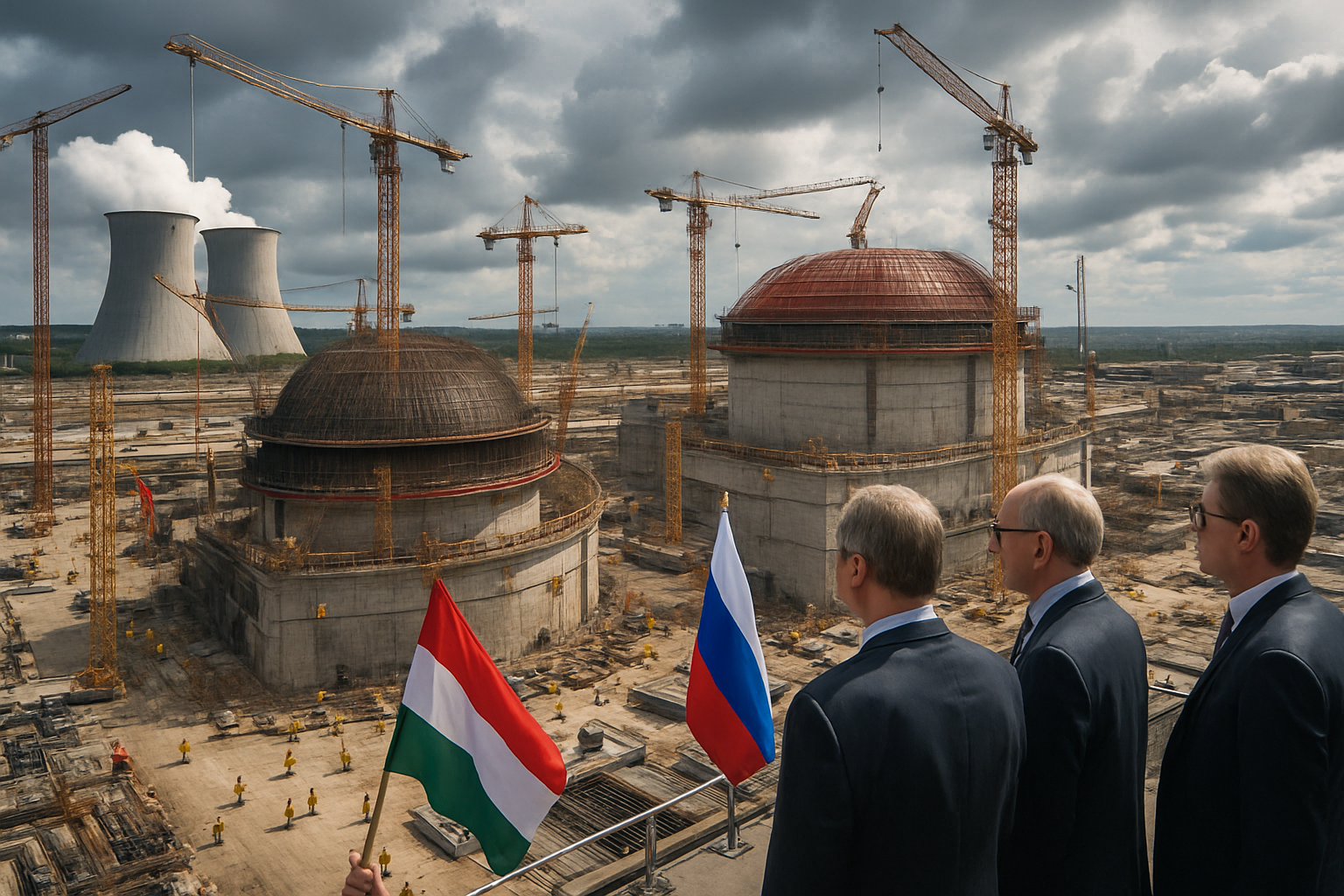
Construction of Hungary's second nuclear power plant at Paks officially commenced this week, marking the beginning of what will become Europe's largest nuclear construction project and Russia's most significant energy infrastructure investment in the continent, with an estimated value exceeding $39 billion over its operational lifetime.
The groundbreaking ceremony for the Paks-2 nuclear power plant was celebrated by Rafael Mariano Grossi, Director General of the International Atomic Energy Agency (IAEA), who declared it "a great day for Hungary, what a great day for Russia!" The project has secured complete IAEA backing after extensive safety and regulatory reviews, representing a major milestone in Central European energy independence.
Unprecedented Scale and Economic Impact
Rosatom Director General Alexey Likhachev revealed that the Paks-2 project is projected to generate over $39.1 billion in orders for Russian companies throughout its entire operational stage, which extends through the start of the 22nd century. This massive undertaking will now rank as both the largest nuclear construction project and the largest Russian project currently active in Europe.
The economic implications extend far beyond construction costs. According to Rosatom estimates, the project will provide stable employment for thousands of workers over multiple decades, while positioning Hungary as a regional energy hub with significant export potential to neighboring European Union countries facing their own energy security challenges.
Strategic Energy Partnership
The Paks-2 initiative represents a deepening of Hungarian-Russian energy cooperation despite ongoing geopolitical tensions across the continent. Hungary's decision to proceed with Russian nuclear technology comes at a time when the European Union faces severe warnings about critical materials shortages, with China controlling 60% of global production and 90% of refining capacity for lithium, cobalt, and rare earth elements essential for renewable energy infrastructure.
"This project demonstrates Hungary's commitment to energy diversification and security while maintaining technological partnerships that ensure reliable baseload power for decades to come."
— Government energy policy source
The timing proves particularly significant as the EU grapples with energy transition challenges amid what auditors describe as "dangerous dependence" on Chinese supply chains for critical materials needed for renewable energy scaling. Nuclear power offers Hungary a pathway to carbon-neutral electricity generation that doesn't rely on weather-dependent renewables or Chinese-controlled supply chains.
International Nuclear Renaissance
The Hungarian project launches during a global resurgence in nuclear power development, as countries seek reliable, carbon-free baseload electricity to meet climate commitments while ensuring energy security. This trend reflects growing recognition that renewable energy sources alone cannot provide the grid stability required for modern industrial economies.
Recent developments across multiple continents demonstrate this nuclear renaissance. Estonia opened continental Europe's largest battery storage facility to support renewable integration, while Austria achieved 88% renewable electricity production in 2024. However, these achievements highlight the complementary role nuclear power plays in providing consistent energy supply when wind and solar generation fluctuates.
Technical Innovation and Safety Standards
The Paks-2 project incorporates Russia's latest VVER reactor technology, representing significant advances in nuclear safety and efficiency compared to previous generations. The IAEA's comprehensive endorsement followed extensive technical reviews of reactor design, safety systems, emergency procedures, and waste management protocols.
Construction will employ cutting-edge digital monitoring systems, robotics for precision assembly, and advanced materials designed to withstand extreme conditions over the facility's projected century-plus operational lifetime. These technological innovations position the plant among the most advanced nuclear facilities globally.
Regional Energy Security Implications
Hungary's nuclear expansion occurs within a broader context of European energy vulnerability highlighted by recent geopolitical tensions. The country's strategic location in Central Europe positions it to potentially export excess nuclear-generated electricity to neighboring EU members facing energy shortages or seeking to reduce carbon emissions.
This capability proves particularly valuable given recent energy infrastructure attacks in neighboring Ukraine, where over 1,170 buildings in Kyiv lost heating amid minus-30°C temperatures during February's extreme weather conditions. Such vulnerabilities underscore the importance of diversified, resilient energy infrastructure.
Economic and Employment Benefits
Beyond the immediate $39 billion economic impact, the Paks-2 project promises substantial employment creation across multiple skill levels. Construction phases will require thousands of specialized workers, while operations will provide stable, high-paying jobs for nuclear engineers, technicians, security personnel, and support staff over the facility's operational lifetime.
The project also stimulates related industries including specialized manufacturing, transportation, security services, and research and development. Hungarian universities are already expanding nuclear engineering programs to train the next generation of nuclear professionals, creating long-term educational and research benefits.
Environmental and Climate Considerations
Nuclear power generation produces virtually no greenhouse gas emissions during operation, making the Paks-2 project a significant contribution to Hungary's climate commitments. Over its operational lifetime, the facility will prevent millions of tons of carbon dioxide emissions compared to fossil fuel alternatives.
The project addresses growing environmental concerns about renewable energy infrastructure, which requires extensive mining of rare earth elements and creates substantial waste streams from solar panel and wind turbine manufacturing. Nuclear power's minimal land requirements and decades-long operational lifespan offer environmental advantages that complement renewable energy sources.
Future Prospects and Regional Impact
The successful launch of Paks-2 construction establishes Hungary as a regional leader in nuclear energy development and positions the country advantageously for future energy export opportunities. As European nations struggle with energy transition costs and supply chain vulnerabilities, Hungary's investment in reliable nuclear capacity could prove strategically valuable.
The project's completion timeline, extending through the remainder of this decade, will coincide with critical periods in European energy policy as the continent seeks to achieve carbon neutrality while maintaining industrial competitiveness. Hungary's nuclear expansion provides a template other European countries may follow as they balance environmental goals with energy security requirements.
With full IAEA backing and Russia's substantial financial commitment, the Paks-2 project represents one of the most significant energy infrastructure developments in contemporary Europe, promising to reshape regional energy dynamics for the remainder of the 21st century and beyond.