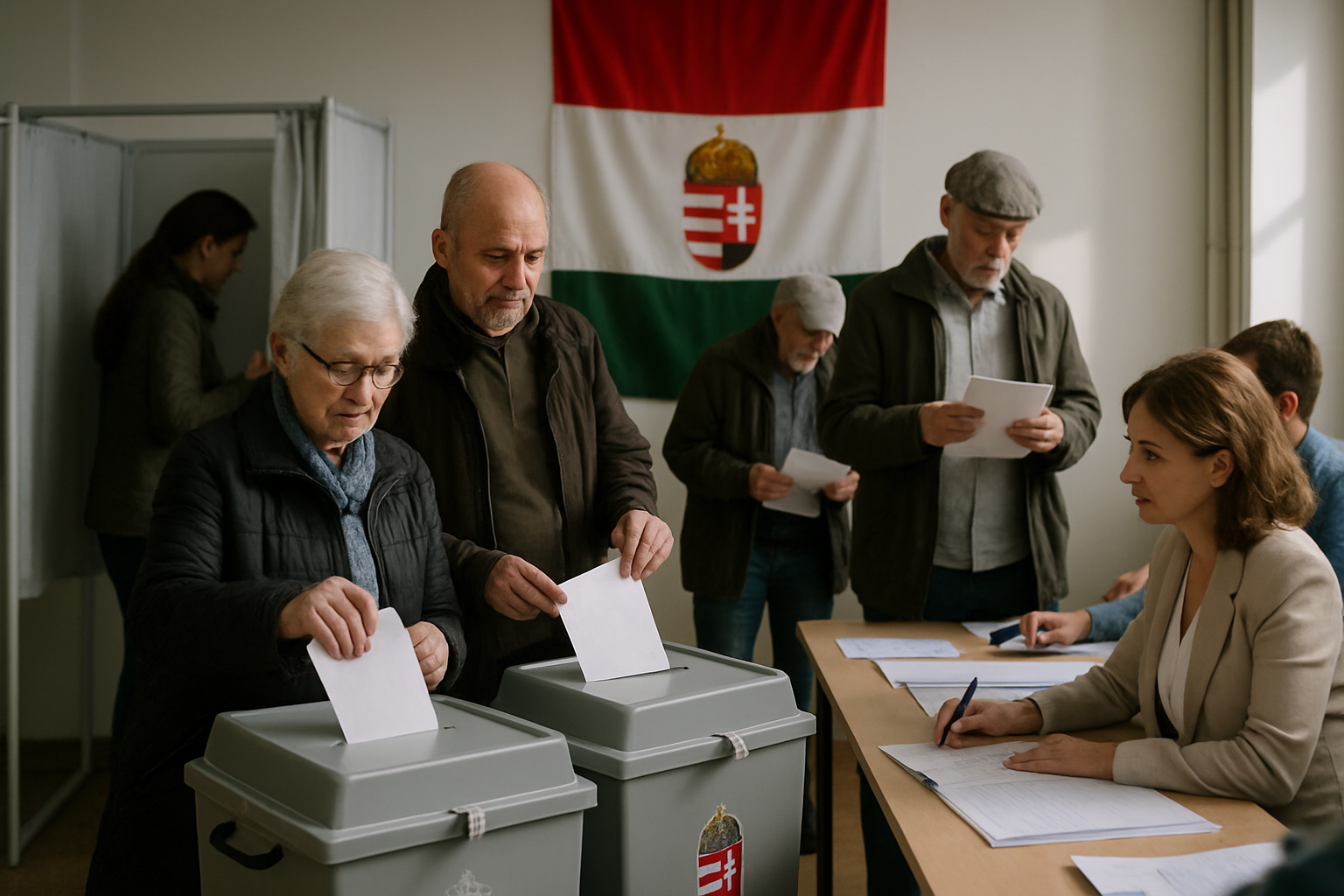
Hungarians headed to polling stations across the country on Sunday for parliamentary elections that could mark the end of Viktor Orbán's 16-year dominance of Hungarian politics, as the incumbent prime minister faces his most serious electoral challenge since returning to power in 2010.
Voting commenced at 6:00 AM local time, with polling stations opening across Hungary's 199 electoral districts. For the first time in over a decade, multiple opinion polls show Orbán's ruling Fidesz party trailing opposition coalitions led by Péter Magyar's upstart Tisza Party, creating genuine electoral uncertainty in what has become the most closely watched Hungarian election since the end of communist rule.
The Magyar Factor: Opposition Unity Behind Pro-European Platform
The election's defining narrative centers on Péter Magyar, a former government insider turned opposition leader who has managed to consolidate Hungary's fractured opposition behind a coherent pro-European platform. Magyar, who once worked within Orbán's system, now presents himself as the credible alternative to what he characterizes as 16 years of authoritarian drift and economic stagnation.
Magyar's Tisza Party has organized what opposition supporters call the "Greatest National March," drawing an estimated 500,000 participants in Budapest in March – the largest anti-government demonstration since 2010. The movement's 240-page electoral program promises transformative changes including wealth taxes, euro adoption, and stronger EU and NATO ties, representing a stark departure from Orbán's nationalist sovereignty approach.
"This is our chance to choose between isolation and integration, between corruption and transparency, between the past and the future."
— Péter Magyar, Tisza Party leader
Polling data consistently shows the opposition leading for the first time since Orbán's return to power, with Tisza Party garnering between 38-41% support compared to Fidesz's 32-34%. The shift represents a dramatic transformation in Hungarian political dynamics, driven largely by voter fatigue with economic stagnation, rising living costs, and reports of oligarchs close to the government amassing wealth while ordinary Hungarians struggle.
International Dimensions: Unprecedented Foreign Interference
These elections have attracted extraordinary international attention, marked by what experts describe as unprecedented dual foreign interference. Investigative journalist Szabolcs Panyi's VSquare investigation revealed concrete evidence of Russian operative teams operating in Budapest to support Fidesz – the first documented case of Kremlin agents actively participating in European Union electoral campaigns.
Simultaneously, the Trump administration has provided explicit political backing for Orbán, culminating in US Vice President JD Vance's visit to Budapest just five days before the election. During his controversial trip, Vance condemned EU "bureaucrats in Brussels" for "shameless election interference" while declaring Orbán a "model for Europe" and emphasizing that Trump "loves" the Hungarian leader.
This dual intervention – Russian operational support combined with American political endorsement – creates an historic precedent for foreign powers directly participating in EU member state elections. Ukrainian Foreign Ministry officials have characterized pipeline-related incidents as "false flag operations as part of Moscow's large-scale interference in Hungary's elections."
EU Relations Crisis: The Brussels Confrontation
The electoral backdrop includes Hungary's deepest crisis with European Union institutions since joining the bloc in 2004. Orbán has maintained an unprecedented blockade of a €90 billion Ukraine aid package over disputes regarding the Druzhba oil pipeline, which has remained offline since January 27, 2026.
The European Commission has responded by freezing approximately €19 billion in Hungarian funding over rule of law concerns, representing one of the largest financial penalties ever imposed on an EU member state. Intelligence restrictions have also been imposed following allegations that Foreign Minister Péter Szijjártó leaked EU Council details to Russian Foreign Minister Sergei Lavrov.
Lithuanian Foreign Minister Kestutis Budrys warned that "the EU cannot become Budapest's hostage," while enhanced cooperation discussions have accelerated to bypass Hungarian obstruction through mechanisms that would allow 26 member states to proceed without Hungary – a fundamental departure from consensus decision-making.
Energy Security and Pipeline Politics
Energy politics have become central to both the EU crisis and domestic electoral dynamics. The Druzhba pipeline dispute has created vulnerabilities for Hungary and Slovakia, the only EU countries still dependent on Russian oil under special sanctions exemptions. Slovakia has declared an oil emergency and deployed 250,000 tons of strategic reserves to maintain supply.
Adding to tensions, Serbian authorities discovered sophisticated explosive devices near the Balkan Stream/TurkStream pipeline infrastructure exactly one week before the Hungarian elections. While Hungarian officials suggested potential sabotage, opposition leaders dismissed the incident as "tactical panic-making" designed to exploit security fears for electoral benefit.
The pipeline carries 15.75 billion cubic meters of gas annually through the Turkey-Bulgaria-Serbia-Hungary route, making it critical for Central European energy security. Enhanced security protocols have been implemented along the entire pipeline route with increased military patrols and surveillance.
Media Breakthrough and Digital Resistance
One of the most significant developments in this electoral campaign has been the Hungarian opposition's successful escape from government media control through digital platforms and international coverage. Despite Fidesz's extensive dominance over traditional media outlets, alternative information channels have emerged that particularly reach younger demographics.
Márton Gulyás's "Partizán" platform and other independent media outlets have built counter-narratives reaching millions of Hungarians, representing a crucial shift that has undermined Orbán's information monopoly in rural and traditional markets. This media breakthrough has been instrumental in Magyar's ability to communicate his pro-European message directly to voters.
Economic Pressures and Campaign Dynamics
Economic concerns have driven much of the opposition momentum. After three years of economic stagnation and soaring living costs, many Hungarians have grown weary of Orbán's economic management. The EU funding freezes over rule of law concerns have created additional financial constraints, while opposition policies promising wealth taxation and euro adoption offer alternative economic approaches.
Magyar's background as a former government insider has provided credibility to his critiques of systemic corruption and oligarchic wealth concentration. His campaign has successfully framed the election as a choice between continued economic isolation under Orbán or integration with European prosperity under opposition leadership.
Democratic Stakes and Global Implications
Beyond Hungary's borders, this election represents a critical test of democratic resilience in 21st-century Europe. Senior EU officials describe the situation as Europe "writing the template for 21st-century crisis management" with the world watching whether democratic institutions can adapt while preserving European values.
An opposition victory would restore Hungarian EU alignment, lift the Ukraine aid blockade, and remove Brussels' most persistent internal critic. Conversely, Orbán's survival with foreign backing could embolden similar interference operations continent-wide and accelerate enhanced cooperation implementation that would fundamentally alter European decision-making structures.
The election occurs during what experts characterize as the most challenging period for continental democracy since World War II, with technological disruption, economic pressures, climate challenges, and international tensions creating unprecedented complexity for democratic governance.
Polling Day Dynamics and Expectations
As voting proceeded throughout Sunday, international observers monitored the electoral process for signs of irregularities or external interference. The election is being conducted under Hungary's electoral system that combines single-member constituencies with party lists, requiring careful vote counting and potential coalition negotiations.
Turnout figures will be closely watched, as higher participation typically favors opposition parties in Hungarian politics. Young voters, in particular, represent a demographic where Magyar's Tisza Party has shown strong support, potentially offsetting Fidesz's traditional advantages in rural constituencies.
Results are expected to begin emerging after polling stations close at 7:00 PM local time, though final tallies may not be available until late Sunday or early Monday given the complexity of Hungary's electoral system and the anticipated closeness of the contest.
Regional and International Consequences
The outcome will reverberate far beyond Hungary's borders. A Magyar victory would likely restore normal relations with EU institutions, end the Ukraine aid blockade, and remove intelligence-sharing restrictions. It could also provide a template for opposition movements across Central and Eastern Europe facing similar challenges from authoritarian-leaning governments.
For Russia, an Orbán defeat would eliminate a key ally within the European Union who has consistently opposed sanctions and maintained diplomatic channels with Moscow. For the United States, the result will be seen as a referendum on Trump administration support for European nationalist leaders over traditional democratic allies.
The election also carries implications for NATO cohesion, EU decision-making capacity, and the broader question of whether democratic institutions can effectively counter foreign interference while maintaining openness and legitimacy.
A Historic Turning Point
As Hungarians cast their votes, they face what many consider the most consequential political choice since the end of communist rule. The election represents not just a contest between political parties, but a fundamental decision about Hungary's place in Europe and the world.
The convergence of domestic political pressures, international interference, economic challenges, and institutional crises has created a perfect storm that will test both Hungarian democracy and European resilience. Whatever the outcome, Sunday's vote will establish precedents for democratic governance under pressure that will influence political developments across Europe for years to come.
The stakes could hardly be higher: not just for Hungary's political future, but for the credibility of democratic institutions, the strength of European integration, and the effectiveness of international cooperation in an era of growing authoritarianism and great power competition.