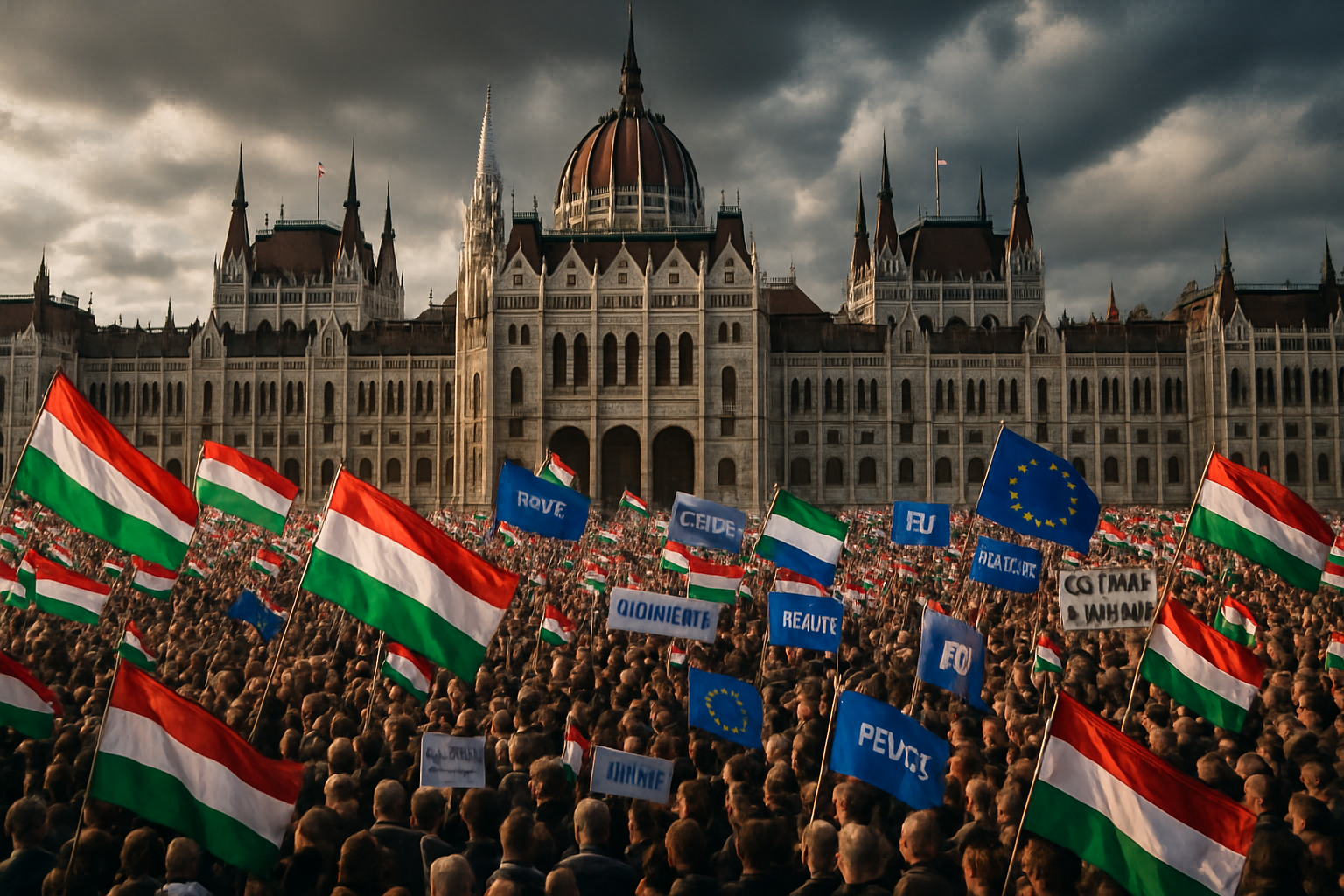
Hungary is experiencing unprecedented political upheaval as massive demonstrations rock Budapest, marking the most serious challenge to Prime Minister Viktor Orbán's rule since his return to power in 2010, with opposition forces mobilizing hundreds of thousands of supporters ahead of the critical April 12, 2026 parliamentary elections.
The political crisis reached a new crescendo on March 15, 2026, when opposition leader Péter Magyar's Tisza Party organized what they called the "Greatest National March" in Budapest, drawing an estimated 500,000 participants according to organizers. The demonstration, deliberately scheduled on Hungary's national holiday commemorating the 1848 revolution, carried profound symbolic weight as protesters called for democratic renewal and European integration.
Electoral Earthquake in the Making
For the first time since Orbán's Fidesz party returned to power in 2010, multiple polling organizations show opposition coalitions leading in electoral preferences, creating genuine uncertainty about the outcome of the April 12 elections. This dramatic shift in Hungary's political landscape has sent shockwaves through both domestic and international political circles.
Péter Magyar, a former government insider who broke with the Fidesz establishment, has emerged as the most credible opposition leader in over a decade. His Tisza Party has presented a comprehensive 240-page electoral program promising wealth taxes, euro adoption, and stronger ties with both the European Union and NATO - positions that stand in stark contrast to Orbán's nationalist sovereignty approach.
"In 1848 and 1956, our revolutions continued in blood. The Russians came, but they could never defeat us. Orbán cannot do this either, who in his final desperation has called upon the KGB tsar."
— Péter Magyar, Opposition Leader
International Dimensions and Foreign Interference
The Hungarian elections have taken on significant international dimensions, with concerns mounting about foreign interference in the democratic process. Investigative journalist Szabolcs Panyi, through VSquare reporting, has revealed concrete evidence of Russian interference teams operating in Budapest to support Orbán's Fidesz party. This represents the first documented case of Kremlin operatives actively participating in European electoral campaigns.
The international stakes are heightened by explicit American support for Orbán. President Trump has provided unprecedented electoral endorsements, calling Orbán "a truly strong and powerful leader" and declaring "complete and unconditional support." Secretary of State Marco Rubio's recent diplomatic visits to Budapest have further emphasized the Trump administration's preference for conservative nationalist leaders over traditional EU establishment figures.
Hungarian Culture Minister Balázs Hankó's controversial two-day tour of Romanian counties with ethnic Hungarian populations has raised additional concerns about cross-border electoral activities. When confronted by a student about reports of paid Transylvanian youth campaigning for Orbán, questions arose about appropriate boundaries for electoral influence and regional sovereignty.
Economic Pressures and EU Relations Crisis
The political crisis is occurring against a backdrop of severe economic pressures and deteriorating relations with the European Union. Hungary's blocking of the EU's historic €90 billion loan package to Ukraine over the Druzhba pipeline dispute has created the deepest European divisions since the conflict began.
European Council President Antonio Costa issued an unprecedented letter demanding Budapest honor previous commitments as the crisis threatens European unity. Lithuanian Foreign Minister Kestutis Budrys declared that the "EU cannot become Budapest's hostage," highlighting the frustration of other member states with Hungary's obstructionist tactics.
The economic context adds urgency to the political competition. EU funding suspensions over rule of law concerns have created financial constraints, while inflation pressures and growing opposition unity have contributed to Orbán's declining popularity. Magyar's opposition coalition proposes EU integration, euro adoption, and wealth taxation, contrasting sharply with Orbán's nationalist economic approach.
Democratic Institutions Under Strain
The intensity of political competition has placed unprecedented strain on Hungary's democratic institutions. The March 15 demonstrations represented a test of institutional resilience, with both government and opposition forces carefully managing the massive crowds to prevent violence while making powerful political statements.
Media environment evolution has challenged traditional Fidesz advantages, with social media platforms and international coverage creating alternative information channels. The opposition has demonstrated improved capacity to reach voters beyond traditional media control mechanisms developed over Orbán's decade-plus governance period.

Regional and European Implications
The outcome of Hungary's April 12 elections will have far-reaching implications beyond Hungarian borders. As the EU's most persistent internal critic, Orbán's potential defeat would remove a major obstacle to Brussels' decision-making processes and could restore Hungary to mainstream EU alignment on rule of law and foreign policy coordination.
The elections are being closely watched as a template for democratic resilience across Central and Eastern Europe. Success for the opposition could demonstrate that populist nationalism can be reversed through democratic means, potentially encouraging similar movements across the continent.
NATO cohesion and transatlantic relationships also hang in the balance. Hungary's position as a bridge between Western allies and Eastern partners creates complex electoral dynamics, particularly given ongoing tensions over Ukraine support and sanctions policies against Russia.
Campaign Dynamics and Security Concerns
The campaign has been marked by increasingly sophisticated political messaging and mobilization techniques. Both sides have demonstrated remarkable organizational capacity, with the March 15 opposition rally rivaling government-sponsored events in scale and impact.
Security concerns have mounted as political tensions escalate. The convergence of international interests - including Russian operational support and American political backing for Orbán - creates an unprecedented international dimension to a domestic Hungarian election.
The opposition faces the challenge of translating polling advantages into actual electoral success through voter mobilization and institutional processes. Democratic governance questions become central to competing political narratives, with sovereignty and European integration representing fundamental choices for Hungarian voters.
Historical Context and Democratic Stakes
The current political crisis represents the most significant potential transition in Hungarian politics since the end of the communist era. After sixteen years of Fidesz dominance, the possibility of democratic alternation of power carries profound implications for institutional governance and European integration.
Hungarian political experts emphasize that the April 12 elections will determine whether the opposition achieves a historic electoral breakthrough or whether the Orbán system demonstrates renewed capacity for political survival amid mounting domestic and international pressures.
The stakes extend beyond immediate political outcomes to broader questions about democratic governance and institutional resilience in 21st-century Europe. The elections serve as a crucial test of whether traditional democratic mechanisms can effectively manage political transitions while maintaining international partnerships and domestic stability.
International Reactions and Monitoring
International observers across Europe and beyond are monitoring the Hungarian elections for their precedent-setting potential. The convergence of domestic political dynamics with international pressure creates a complex environment that could influence democratic movements throughout the region.
European institutions face growing pressure from member states with far-right influence or control. Hungary's experience under Orbán has demonstrated how systematic undermining of rule of law, press freedom, and judicial independence can occur while maintaining a democratic facade.
The success or failure of Hungarian democratic renewal could provide templates for other established democracies facing similar challenges. Whether the current crisis strengthens democratic resilience through institutional adaptation or accelerates democratic backsliding remains a critical question with implications far beyond Hungary's borders.
As Hungary approaches its most consequential election in decades, the outcome will reverberate throughout European capitals and beyond. The April 12 vote represents not just a choice between political parties, but a fundamental decision about Hungary's future direction in an increasingly complex and interconnected world.