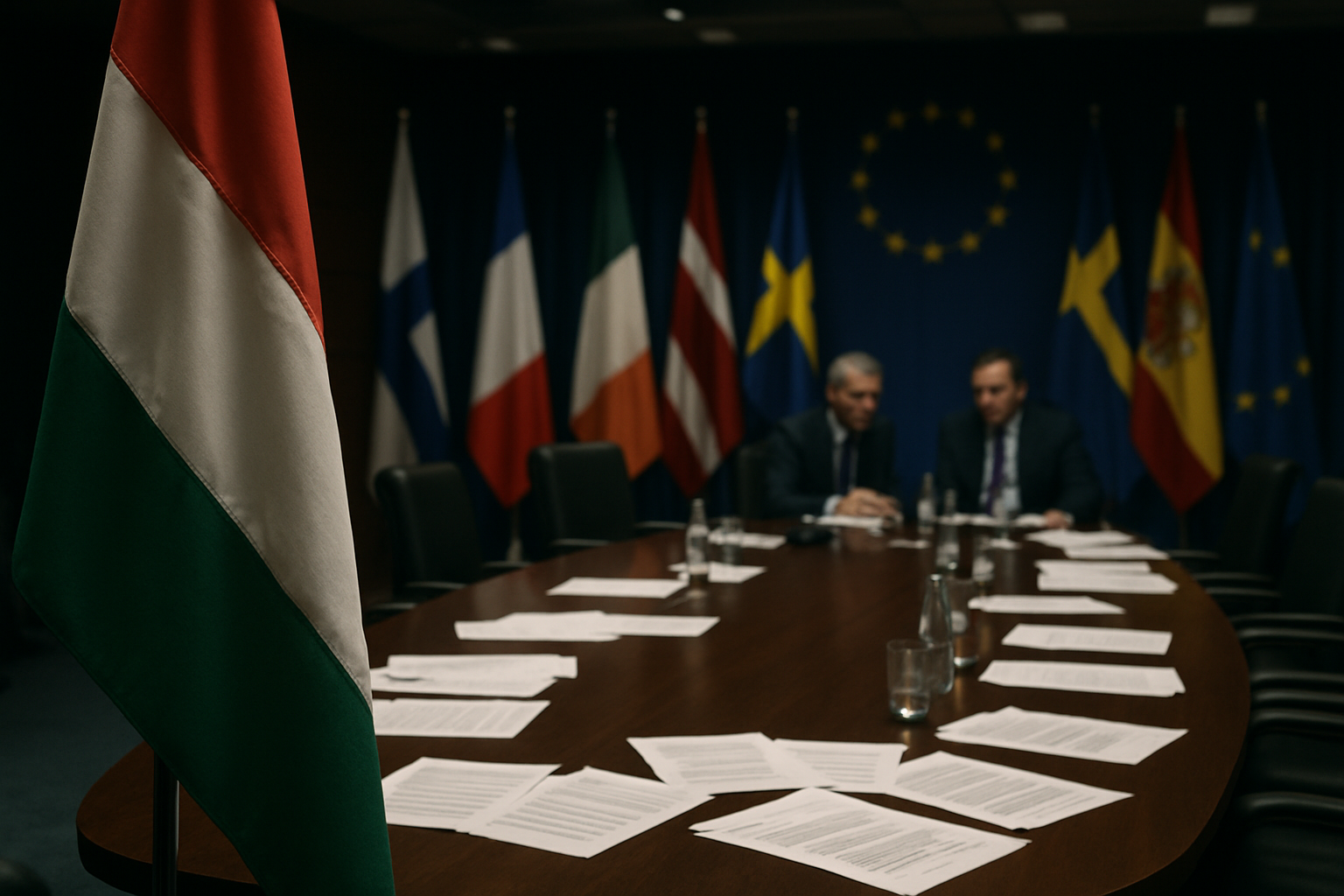
Hungary has issued a stark ultimatum to the European Union, threatening to block the bloc's landmark 20th sanctions package against Russia unless oil shipments through the Ukraine-controlled Druzhba pipeline resume immediately, creating a dramatic test of European unity just days before the fourth anniversary of Russia's invasion.
Hungarian Foreign Minister Péter Szijjártó announced Sunday that Budapest would exercise its veto power over the sanctions package, scheduled for adoption by EU foreign ministers on Monday, while simultaneously blocking efforts to provide additional aid to Ukraine. The dramatic escalation comes as oil transit through the critical Druzhba pipeline has been halted since late January, with Slovakia and Hungary—the only two EU countries still dependent on Russian oil under special sanctions exemptions—scrambling to manage their energy security crisis.
The Druzhba Pipeline Dispute
At the center of the crisis lies the Druzhba pipeline, a Soviet-era energy artery that has become a flashpoint in European energy politics. Ukraine maintains that Russian drone attacks in late January damaged critical infrastructure, necessitating repairs that have disrupted oil flow to both Hungary and Slovakia. However, Budapest and Bratislava have rejected this explanation, with Hungarian officials accusing Ukraine of deliberately manipulating oil supplies as "political blackmail."
The dispute has forced Slovakia to declare a state of oil emergency, releasing 250,000 tons from strategic reserves to supply the Slovnaft refinery—representing roughly one month of operational capacity. Slovakia has suspended diesel exports to Ukraine, prioritizing domestic supply while pursuing alternative routes through Croatia for Mediterranean crude access.
"We will not support any sanctions package against Russia, nor will we support any aid to Ukraine until Ukraine restarts oil deliveries through the Druzhba pipeline,"
— Péter Szijjártó, Hungarian Foreign Minister
European Unity Under Strain
The Hungarian blockade threatens to derail what would be the EU's most comprehensive sanctions package to date, coinciding strategically with the fourth anniversary of Russia's February 24, 2022 invasion. The 20th package introduces sweeping maritime services bans on Russian crude oil exports, including insurance, maintenance, port access, and technical support—measures designed to cripple Moscow's shadow fleet of over 600 vessels worldwide.
The timing reveals deeper fractures within the European project. Hungary's threat comes amid an already complex geopolitical landscape, where the EU has approved a historic €90 billion loan package for Ukraine—the largest financial assistance package ever provided to a single nation. Yet Slovakia, the Czech Republic, and Hungary have refused to participate in financing this unprecedented support mechanism, highlighting persistent East-West divisions within the bloc.
European Commission sources confirm that the sanctions package would add 43 additional vessels to the shadow fleet blacklist while activating anti-circumvention mechanisms targeting digital control machinery exports to countries suspected of re-exporting to Russia. The comprehensive approach reflects growing frustration with sophisticated Russian evasion methods that have undermined previous sanctions regimes.
Energy Weaponization in Wartime
The crisis demonstrates how energy interdependence has become weaponized during the conflict, with critical infrastructure serving as leverage in diplomatic negotiations. Ukraine faces desperate energy shortages following systematic Russian attacks on civilian infrastructure—part of Moscow's "winter weapon" strategy that has left over 1,170 Kyiv buildings without heating during sub-zero temperatures.
Slovakia's Prime Minister Robert Fico has issued his own ultimatum, threatening to cut emergency electricity supplies to Ukraine by February 23 unless oil transit resumes. The electricity supplies represent a critical lifeline for Ukrainian civilians enduring extreme winter conditions, with over 17.8 million Ukrainians accessing emergency winter support programs.
Viktor Orbán's Strategic Calculation
Hungarian Prime Minister Viktor Orbán's escalation occurs at a politically sensitive moment, as he faces unprecedented electoral vulnerability ahead of April 12, 2026 parliamentary elections. For the first time since 2010, Orbán's Fidesz party trails opposition coalitions in polling, creating anxiety within his political circle and potentially influencing his confrontational stance with Brussels.
The dispute also unfolds against the backdrop of strengthened Hungary-US relations under the Trump administration. President Trump has explicitly endorsed Orbán for re-election, calling him "a truly strong and powerful leader" and emphasizing their personal relationship. US Secretary of State Marco Rubio recently visited Budapest, declaring Trump "profoundly attached to your success"—representing unprecedented American intervention in EU member state elections.
This bilateral warming provides Orbán with alternative international legitimacy as he clashes with EU institutions over rule of law concerns, judicial reforms, and now sanctions policy. The Hungarian leader has consistently opposed EU sanctions on Russia while maintaining economic relationships with Moscow despite international pressure.
Diplomatic Momentum at Risk
The Hungarian blockade threatens to undermine significant diplomatic progress achieved through recent Ukraine-Russia-US trilateral talks. The Abu Dhabi negotiations produced concrete breakthroughs, including a historic 314-prisoner exchange—the first in five months—and restored US-Russia military communications after a four-year suspension.
With the Trump administration establishing a June 2026 deadline for comprehensive peace talks potentially in Washington, the sanctions dispute could complicate Ukraine's negotiating position. European divisions over support mechanisms may signal weakening Western resolve to Moscow, potentially affecting territorial compromise discussions.
"The EU must speak with one voice, especially at this critical juncture in the conflict. Internal divisions only serve to embolden those who seek to undermine our collective security."
— Kaja Kallas, EU High Representative for Foreign Affairs
Alternative Solutions Under Discussion
Despite the crisis, European officials continue pursuing technical solutions. Croatia has offered to assist with alternative Mediterranean routes, though implementation would require months or years of infrastructure development and would provide only non-Russian crude. Ukraine has proposed utilizing the Odessa-Brody pipeline as an alternative through European Commission coordination mechanisms.
The dispute highlights broader European energy transition challenges. While the EU has achieved remarkable diversification from Russian energy dependence since 2022, Hungary and Slovakia's continued reliance on Russian oil under special exemptions creates ongoing vulnerabilities that Moscow and its allies can exploit.
Fourth Anniversary Implications
As Europe approaches the fourth anniversary of Russia's invasion, the Hungarian sanctions blockade represents more than an energy dispute—it embodies fundamental questions about European integration, burden-sharing, and collective defense principles under extreme pressure. The crisis occurs amid accelerating Russian territorial gains, with Moscow capturing 481 square kilometers in January 2026 alone, nearly double December's advances.
The sanctions package's comprehensive maritime focus reflects recognition that previous measures have proven insufficient to deny Russia the resources needed to sustain military operations. Intelligence estimates suggest Russian shadow fleet operations generate billions in revenue that directly fund the war effort through sophisticated financial networks.
European unity has become essential not only for sanctions effectiveness but for maintaining credible deterrence against further Russian territorial expansion. Hungary's veto threat tests whether EU institutional mechanisms can preserve collective action when individual member states prioritize national interests over shared security concerns.
Stakes for European Security Architecture
The resolution of this crisis will establish precedents for European decision-making under wartime conditions and may determine the EU's capacity to respond coherently to future security challenges. Success in overcoming Hungarian opposition would demonstrate institutional resilience and commitment to international law enforcement. Failure could signal to adversaries that European unity can be fractured through targeted pressure on vulnerable member states.
With nuclear tensions at their highest levels in decades following the February 5 expiration of the New START treaty—eliminating bilateral US-Russia nuclear constraints for the first time in over 50 years—the stakes extend far beyond European borders. The international community closely watches whether democratic institutions can maintain effectiveness under extreme geopolitical pressure while adapting to 21st-century challenges that transcend traditional diplomatic frameworks.
As EU foreign ministers prepare for Monday's crucial vote, the Hungarian ultimatum forces a fundamental reckoning with the balance between national sovereignty and collective security in an interconnected world where energy infrastructure, economic sanctions, and military aid have become inseparable elements of modern statecraft.