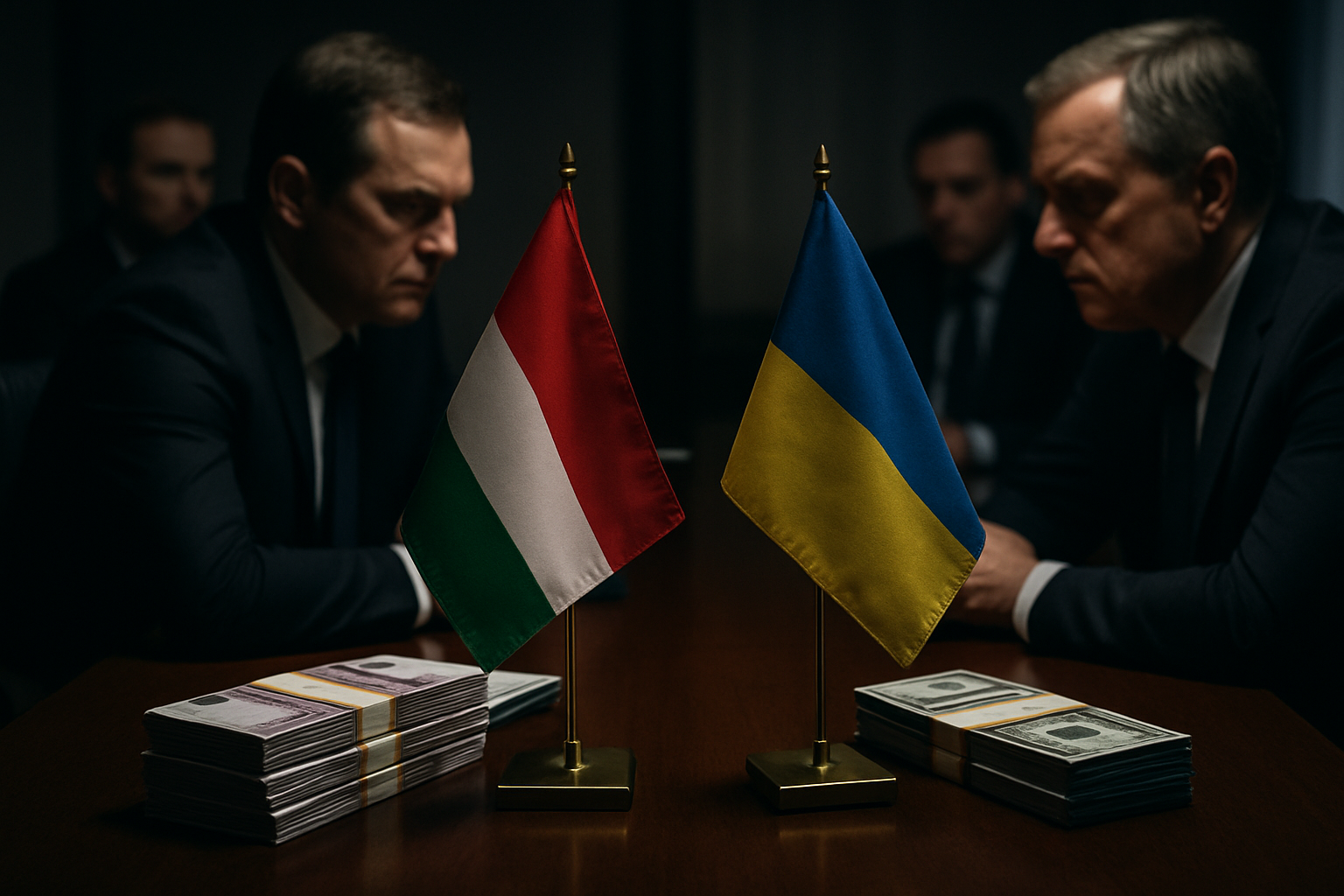
Hungarian law enforcement authorities detained seven employees of Ukraine's state-owned Oschadbank along with two armored vehicles transporting approximately $82 million in cash and gold from Austria to Ukraine, triggering a major diplomatic crisis between the two EU neighbors and prompting Ukraine to warn its citizens against traveling to Hungary.
The incident, which occurred on March 5, 2026, involved Ukrainian bank officials conducting what they described as a routine international currency transfer operation between Raiffeisen Bank Austria and Oschadbank under existing banking agreements. The detention has escalated tensions already strained by ongoing disputes over energy supplies and EU financial support.
Details of the Banking Operation
According to Oschadbank officials, the seven employees were transporting approximately $40 million in U.S. dollars, €35 million in euros, and roughly 9 kilograms of gold as part of a legitimate banking operation. The transfer was being conducted under formal agreements between Ukraine's second-largest state bank and Austria's Raiffeisen Bank.
GPS tracking data shows the detained vehicles are located in central Budapest near a Hungarian law enforcement facility. Hungarian authorities have launched a criminal investigation on suspicion of money laundering, though Ukrainian officials vehemently dispute these charges.
"We hope that one person in the EU will not block the €90 billion or the first tranche, and Ukrainian warriors will have weapons. Otherwise, we will give the address of this person to our Armed Forces."
— President Volodymyr Zelensky, addressing EU aid blockages
Ukrainian Government Response
Ukraine's Ministry of Foreign Affairs has issued an unprecedented travel advisory recommending Ukrainian citizens avoid travel to Hungary, including transit, citing "the inability to guarantee security due to arbitrary actions by Hungarian authorities." The ministry also warned Ukrainian and European businesses about potential "threats of arbitrariness" when conducting business activities in Hungary.
Ukrainian officials characterized the detention as "hostage-taking and theft," with Foreign Minister Andrii Sybiha calling it part of Hungarian Prime Minister Viktor Orbán's "blackmail and election campaign." The Ukrainian National Bank has demanded the immediate release of both the personnel and the seized assets.
Hungary's Position and Investigation
Hungarian Foreign Minister Péter Szijjártó confirmed that law enforcement agencies had detained the armored vehicles and launched an investigation into the Ukrainian citizens on suspicion of money laundering. Budapest has requested clarifications from Ukraine regarding the money transfer operation.
Hungary claims the detention is part of a legitimate criminal investigation, though they have provided limited details about the specific suspicions underlying the money laundering charges. Hungarian authorities say the detained personnel will be "expelled from Hungary" following the investigation.
Broader Context of Hungarian-Ukrainian Relations
This banking dispute occurs against a backdrop of severely strained relations between Hungary and Ukraine, centered primarily on energy and financial disagreements that have divided the European Union.
The Druzhba Pipeline Crisis
The detention comes amid an ongoing dispute over the Druzhba oil pipeline, which has been offline since late January 2026. Hungary and Slovakia claim Ukraine deliberately halted Russian oil transit as "political blackmail," while Ukraine maintains the pipeline was damaged in Russian attacks requiring repairs.
Slovakia declared an oil emergency in February, releasing 250,000 tons of strategic reserves, and Prime Minister Robert Fico even threatened to cut emergency electricity supplies to Ukraine unless oil transit resumed.
EU Financial Package Blockade
Hungary has blocked the EU's historic €90 billion loan package to Ukraine - the largest single-nation financial assistance package in EU history - over this pipeline dispute. The package was approved by the European Parliament with a 458-140-44 vote, but requires unanimity in the EU Council for implementation.
Lithuania's Foreign Minister Kestutis Budrys warned that "the EU cannot become Budapest's hostage," while European Council President António Costa issued an unprecedented letter demanding Hungary honor its previous commitments.
Nuclear and Security Implications
The banking crisis unfolds as Ukraine faces severe challenges on multiple fronts. The country continues to deal with systematic Russian attacks on civilian infrastructure, with over 1,170 Kyiv buildings remaining without heating during harsh winter conditions. Ukrainian nuclear plants have been forced to halt electricity production for the first time in the conflict.
This crisis also coincides with the February 5, 2026 expiration of the New START treaty between the United States and Russia - the first time in over 50 years without nuclear constraints between the superpowers, adding urgency to ongoing diplomatic efforts.
International Banking Security Concerns
The detention raises serious questions about the security of international banking operations during wartime conditions and could set a concerning precedent for how financial transfers are handled between EU member states during crisis periods.
The incident involves what Ukrainian officials describe as a routine operation under international banking agreements, suggesting that even established financial protocols may be vulnerable to political manipulation during times of heightened tensions.
Electoral Politics and Timing
The crisis comes as Hungarian Prime Minister Viktor Orbán faces elections on April 12, 2026, with his Fidesz party trailing opposition coalitions for the first time since 2010. The confrontation with Ukraine may serve domestic political purposes while demonstrating Hungary's ability to leverage EU decision-making processes.
Orbán has increasingly positioned himself as a critic of EU support for Ukraine while maintaining relationships with both Russia and the Trump administration, which has provided explicit support for his government.
European Union Response
The incident has exposed fundamental tensions within the EU about how to balance member state sovereignty with collective action during wartime. Enhanced cooperation discussions are underway to potentially bypass unanimity requirements for future Ukraine support measures.
The crisis tests European institutional mechanisms and raises questions about whether traditional EU decision-making processes are adequate for managing internal disputes while maintaining external solidarity during major security crises.
Impact on Peace Negotiations
The banking dispute comes as Ukraine and Russia have been engaged in U.S.-mediated peace talks, with significant progress reported on ceasefire monitoring mechanisms in recent Geneva negotiations. However, fundamental disagreements over territorial control in eastern Ukrainian regions remain unresolved.
European divisions demonstrated by this crisis could potentially weaken Ukraine's negotiating position in upcoming Washington venue talks scheduled for June 2026, which may involve presidential-level engagement.
International Law and Precedent
Legal experts note that the detention of banking personnel and seizure of assets during routine international financial operations could establish problematic precedents for international economic cooperation during crisis periods.
The incident raises questions about the application of money laundering laws to legitimate banking operations and whether such measures can be used as tools of diplomatic pressure between EU member states.
Economic and Financial Implications
The seizure of approximately $82 million in assets represents a significant financial impact on Ukraine's banking sector at a time when the country desperately needs access to international financial markets for reconstruction efforts.
The incident could potentially affect other international banking relationships and operations involving Ukrainian financial institutions, particularly in Central Europe where political tensions remain high.
Looking Forward
The resolution of this crisis will likely require high-level diplomatic intervention and could serve as a test case for how the EU manages internal disputes during wartime conditions. The outcome may influence future financial cooperation mechanisms and the security protocols for international banking operations.
As Ukraine continues to face military pressure from Russia while seeking to maintain access to European financial systems, incidents like this detention highlight the complex challenges of conducting international business during periods of heightened geopolitical tension.
The crisis also demonstrates how energy interdependence and financial cooperation can become weapons in diplomatic disputes, potentially affecting broader European unity and Ukraine's ability to access critical financial resources during its ongoing conflict with Russia.