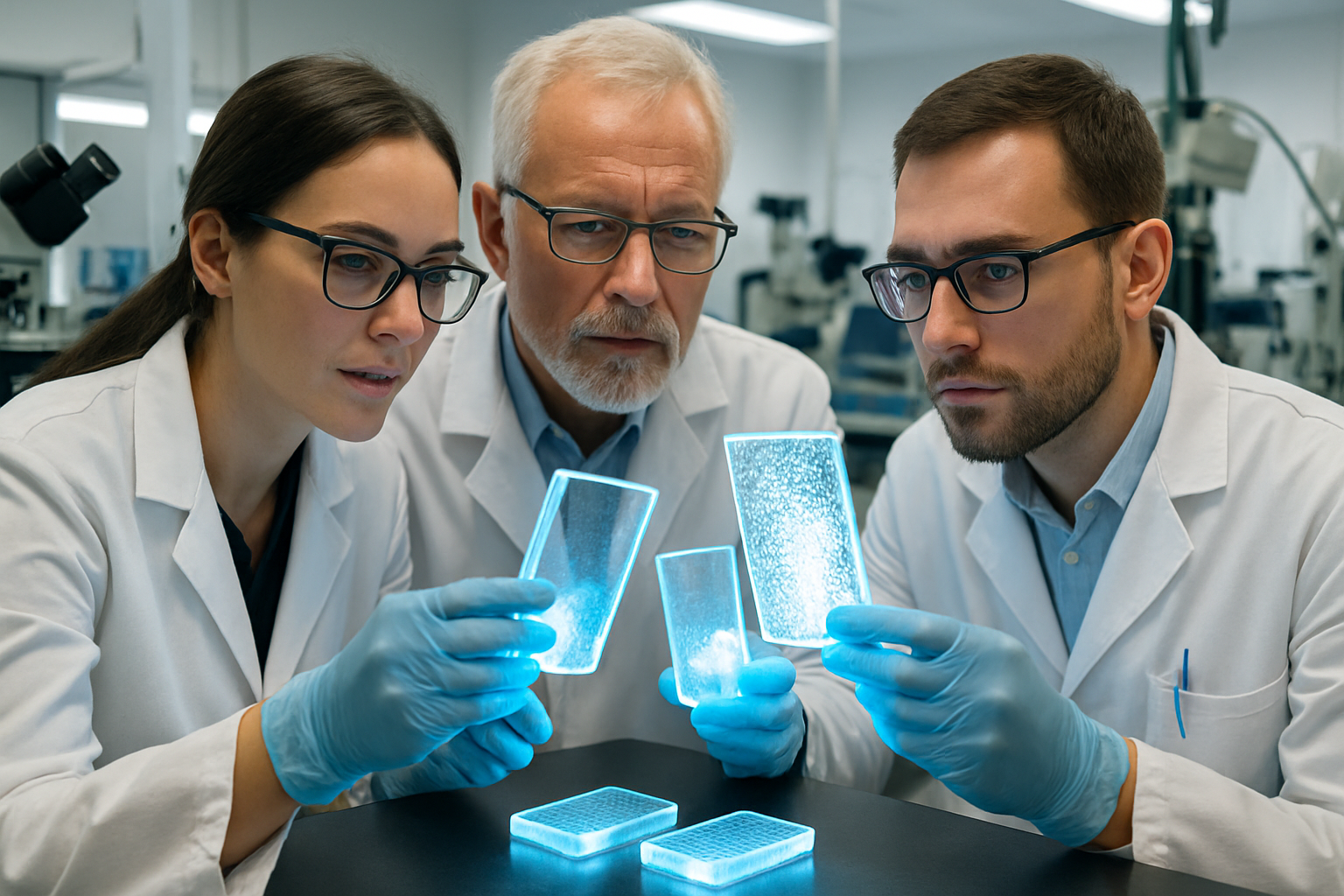
Scientists in Austria have achieved a groundbreaking discovery in materials science, successfully creating what researchers are calling "ideal glass" - a theoretical material state declared impossible in 1948 but now proven achievable in two-dimensional systems.
The revolutionary finding, announced by Austrian researchers this week, represents the culmination of decades of scientific pursuit into a material that uniquely combines the properties of both amorphous substances (like conventional glass) and crystalline structures. This hybrid material challenges fundamental assumptions about matter states that have dominated scientific thinking for nearly eight decades.
Overturning 78 Years of Scientific Doctrine
In 1948, physicists definitively declared that an "ideal glass" material state was theoretically impossible. The scientific consensus held that materials could exist either as amorphous substances - lacking long-range atomic order like window glass - or as crystals with highly organized atomic arrangements, but never both simultaneously.
The Austrian research team has now demonstrated that this supposedly impossible material state can indeed be achieved in two-dimensional systems, opening entirely new avenues for materials engineering and technological applications.
"This discovery fundamentally challenges our understanding of how matter can organize itself," explained one researcher familiar with the project. "We're witnessing the creation of a material that exhibits properties previously thought to be mutually exclusive."
The Science Behind "Ideal Glass"
Traditional glass materials are amorphous, meaning their atomic structure lacks the regular, repeating patterns found in crystals. Crystals, conversely, have atoms arranged in highly ordered, predictable configurations. The newly discovered "ideal glass" somehow manages to exhibit characteristics of both states.
The breakthrough appears to have been achieved through sophisticated two-dimensional material manipulation techniques, allowing researchers to create conditions where the material displays crystal-like order in some aspects while maintaining glass-like amorphous properties in others.
This dual nature could potentially unlock unprecedented material properties, including enhanced strength, unique optical characteristics, and novel electrical or thermal conductivity patterns.
Decades of Scientific Pursuit
The quest for ideal glass has been one of materials science's longest-running challenges. Since the initial theoretical framework was established in the mid-20th century, researchers worldwide have attempted various approaches to create materials that could bridge the gap between amorphous and crystalline states.
Previous attempts focused primarily on three-dimensional bulk materials, which consistently failed to achieve the delicate balance necessary for ideal glass formation. The Austrian team's success appears to stem from their innovative approach using two-dimensional systems, where atomic arrangements can be more precisely controlled.
The research builds upon recent advances in nanotechnology and precision material manipulation, fields that have experienced rapid development over the past decade. These technological capabilities finally provided researchers with the tools necessary to achieve what was previously considered impossible.
Implications for Technology and Industry
The successful creation of ideal glass could have far-reaching implications across multiple industries. Materials with hybrid amorphous-crystalline properties could revolutionize everything from electronics manufacturing to construction materials.
In the electronics sector, ideal glass could potentially enable the development of new types of semiconductors, optical components, or energy storage devices with unprecedented performance characteristics. The unique combination of properties might allow for materials that are simultaneously transparent like glass yet structurally organized like crystals.
Construction and engineering applications could benefit from materials that combine glass's moldability with crystal's structural integrity, potentially leading to stronger, lighter, and more versatile building materials.
Part of 2026's Scientific Renaissance
This discovery joins a remarkable series of scientific breakthroughs that have characterized 2026 as a year of unprecedented scientific advancement. Recent months have witnessed major discoveries across multiple fields, from archaeological findings that have rewritten human development timelines to medical breakthroughs in cancer treatment and space exploration achievements.
The ideal glass discovery exemplifies the accelerating pace of scientific innovation, driven by enhanced international cooperation, advanced analytical techniques, and breakthrough technologies that enable researchers to manipulate matter at previously impossible scales.
The convergence of theoretical physics, materials engineering, and nanotechnology has created a unique environment where long-standing scientific barriers can finally be overcome through interdisciplinary collaboration and cutting-edge methodologies.
Future Research Directions
While the Austrian team has successfully demonstrated the feasibility of ideal glass creation, significant research remains to be conducted. Scientists must now work to understand the precise mechanisms that enable this hybrid material state and develop methods for scaling production beyond laboratory conditions.
Key research priorities include investigating whether similar ideal glass states can be achieved in three-dimensional materials, exploring the full range of properties these materials might exhibit, and developing practical manufacturing techniques that could bring ideal glass applications to market.
The discovery also raises fundamental questions about material physics that could reshape scientific understanding of how atoms and molecules organize themselves under different conditions.
International Scientific Collaboration
The breakthrough represents the power of sustained international scientific collaboration and long-term research commitment. The decades-long pursuit of ideal glass required contributions from researchers across multiple countries and institutions, sharing knowledge and building upon each other's work.
This collaborative approach has become increasingly characteristic of major scientific advances in 2026, as complex challenges require diverse expertise and resources that transcend individual national capabilities.
The success also demonstrates the importance of fundamental research that may not have immediate practical applications but ultimately leads to revolutionary discoveries that transform entire fields of science and technology.
Looking Forward
The creation of ideal glass marks a pivotal moment in materials science, opening possibilities that were literally considered impossible just months ago. As researchers continue to explore this new frontier, the full implications of the discovery will likely unfold over the coming years.
The achievement stands as a testament to the power of persistent scientific inquiry and the importance of challenging established assumptions. By refusing to accept that ideal glass was impossible, the Austrian research team has not only achieved a remarkable breakthrough but also demonstrated that the boundaries of scientific possibility are constantly evolving.
As 2026 continues to unfold as a year of extraordinary scientific advancement, the ideal glass discovery joins a growing list of achievements that are fundamentally reshaping our understanding of the natural world and expanding the horizons of human technological capability.