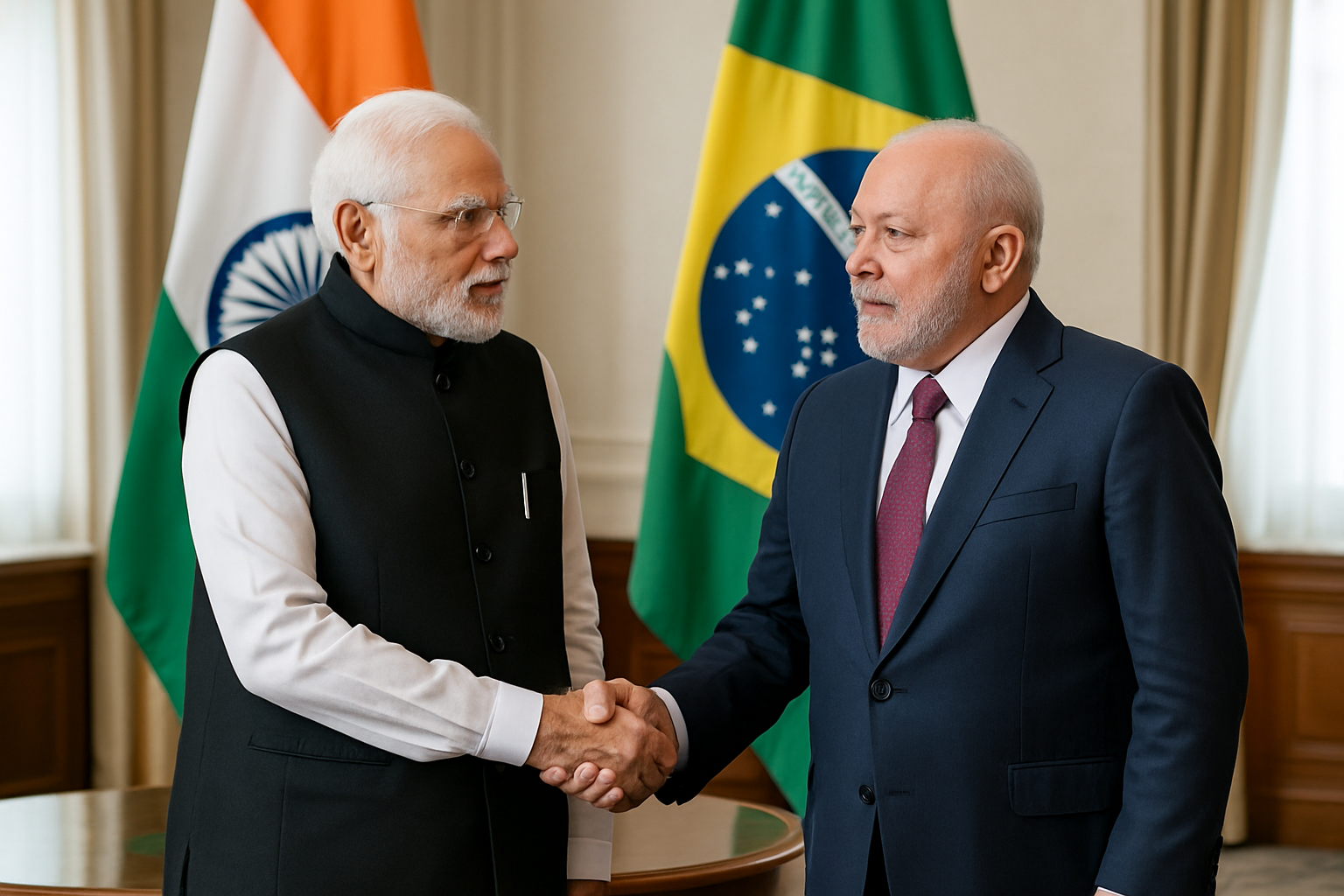
India and Brazil signed a pioneering cooperation agreement on critical minerals and rare earth elements during Saturday's high-level talks in New Delhi, with Prime Minister Narendra Modi declaring the partnership "a major step towards building resilient supply chains" as both nations seek to reduce dependence on Chinese-dominated global markets.
The agreement, finalized during Brazilian President Luiz Inácio Lula da Silva's official visit to India, capitalizes on Brazil's position as holder of the world's second-largest reserves of critical minerals essential for manufacturing electric vehicles, solar panels, smartphones, jet engines, and guided missile systems.
Strategic Shift from Chinese Dominance
The partnership addresses a critical vulnerability in global supply chains, with China currently controlling approximately 60% of global critical minerals production and an overwhelming 90% of processing capacity. India, which has been actively expanding domestic production and recycling capabilities while scouting for alternative suppliers, views the Brazilian partnership as fundamental to its long-term strategic autonomy.
"India, seeking to cut its dependence on top exporter China, has been expanding domestic production and recycling while scouting for new suppliers," according to sources familiar with the negotiations. The timing reflects broader global efforts by major economies to diversify critical materials sourcing beyond traditional Chinese suppliers.
Brazil's Strategic Mineral Wealth
Brazil's vast mineral reserves position the South American giant as an ideal partner for India's diversification strategy. The country possesses substantial deposits of lithium, rare earth elements, and other materials crucial for renewable energy infrastructure and advanced manufacturing sectors that both nations are prioritizing for economic development.
"The agreement on critical minerals and rare earths is a major step towards building resilient supply chains"
— Prime Minister Narendra Modi
Brazilian President Lula characterized the critical minerals component as the "core of the pioneering agreement," emphasizing the transformative potential of the partnership for both economies and the broader Global South.
Economic and Geopolitical Implications
The agreement represents more than a bilateral trade arrangement—it signals a fundamental shift in how emerging economies approach strategic resource security. By establishing direct cooperation frameworks outside traditional North-South paradigms, India and Brazil are creating templates for South-South partnerships that could influence global supply chain architecture.
The partnership builds on existing diplomatic momentum between the two BRICS nations, with both countries having demonstrated sophisticated approaches to international economic cooperation while maintaining strategic autonomy in foreign policy decisions.
Implementation Framework
While specific implementation details remain under negotiation, the framework encompasses several key areas:
- Joint exploration and development of critical mineral resources
- Technology transfer and knowledge sharing in mining and processing
- Investment facilitation for bilateral mineral sector projects
- Coordination on international standards and best practices
- Regular consultation mechanisms for strategic planning
The agreement aligns with India's broader "Atmanirbhar Bharat" (self-reliant India) initiative, which emphasizes reducing strategic dependencies while building domestic capabilities across critical sectors.
Global Supply Chain Security
The India-Brazil partnership joins a growing network of alternative critical minerals arrangements emerging globally. The United States, European Union, and Japan have established their own Critical Minerals Partnership involving 55 countries, while various bilateral agreements seek to create resilient supply chains independent of single-source dependencies.
These materials are essential for the global transition to renewable energy, electric vehicle adoption, and advanced technology manufacturing—sectors where supply security has become synonymous with national security for major economies.
Regional and International Context
The agreement occurs within a broader transformation of international economic relationships, with countries increasingly prioritizing supply chain resilience alongside cost efficiency. Both India and Brazil have demonstrated commitment to diversified international partnerships while maintaining pragmatic relationships with China on other economic fronts.
For India, the partnership complements recent agreements including the interim trade framework with the United States and expanding cooperation arrangements with various Gulf nations. Brazil, under Lula's leadership, has pursued balanced international engagement that advances national interests while contributing to Global South leadership initiatives.
Future Prospects
Success of the India-Brazil critical minerals partnership will likely depend on several factors, including sustained political commitment across electoral cycles, adequate financing for infrastructure development, and technical cooperation that builds genuine bilateral capabilities rather than simple trading relationships.
The partnership positions both nations to benefit from the global renewable energy transition while reducing strategic vulnerabilities. As climate change acceleration demands rapid scaling of clean energy infrastructure worldwide, secure access to critical minerals becomes increasingly vital for national competitiveness and energy security.
Industry observers suggest the agreement could serve as a model for other emerging economy partnerships seeking to balance economic development objectives with strategic autonomy requirements. The emphasis on building "resilient supply chains" reflects lessons learned from recent global disruptions that exposed the risks of over-concentration in critical sectors.
With implementation mechanisms still under development, the coming months will determine whether the India-Brazil critical minerals partnership can deliver the strategic diversification both nations seek while contributing to more stable global supply chains for essential materials driving the 21st century economy.