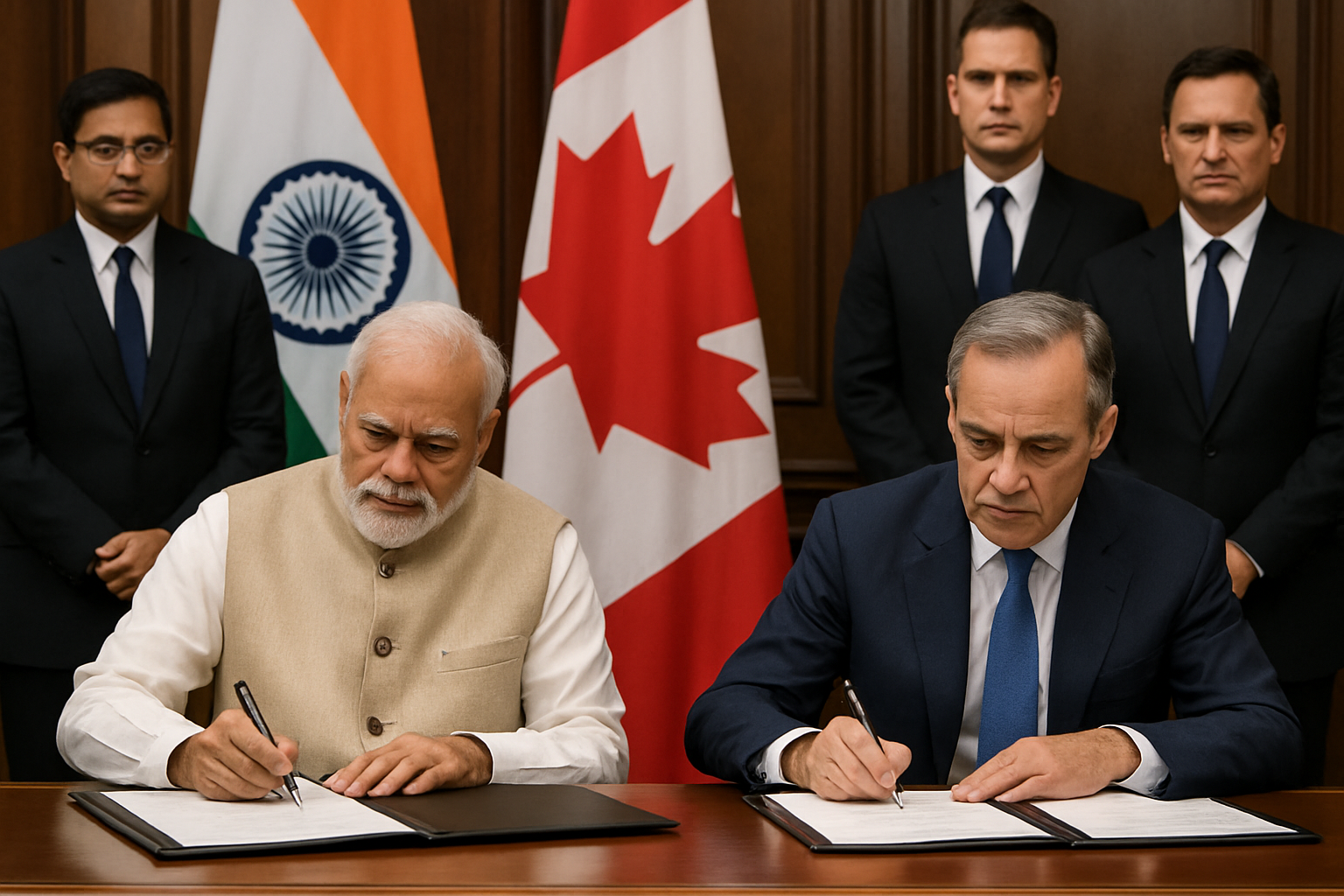
India and Canada have signed a series of landmark bilateral agreements, including a "landmark" uranium supply deal and comprehensive critical minerals cooperation framework, marking a dramatic diplomatic breakthrough that resets strained bilateral relations after years of tensions.
Prime Minister Narendra Modi and Canadian Prime Minister Mark Carney announced the historic agreements during Carney's first official visit to India since taking office, with the leaders declaring their intention to finalize a comprehensive trade pact by the end of 2026. The deals span nuclear energy, critical minerals, technology cooperation, and renewable energy sectors.
Nuclear Cooperation at the Forefront
The centerpiece uranium supply agreement represents a major strategic partnership in nuclear energy, with Canada leveraging its substantial uranium reserves to support India's expanding nuclear power program. The deal comes as India seeks to diversify its energy sources and reduce dependence on fossil fuel imports.
"Our ties have seen a new energy, mutual trust, and positivity," Modi said during the joint announcement with Carney at Hyderabad House in New Delhi on Monday. The nuclear cooperation builds on decades of collaboration between the two democracies, despite previous diplomatic setbacks.
The uranium agreement is particularly significant given Canada's position as one of the world's largest uranium producers, controlling approximately 13% of global production. For India, which operates 23 nuclear reactors and has ambitious plans to expand its nuclear capacity, securing reliable uranium supplies is crucial for energy security.
Critical Minerals Partnership
Beyond uranium, the agreements encompass comprehensive cooperation on critical minerals and rare earth elements, sectors where both nations seek to reduce dependence on Chinese supply chains. China currently controls approximately 60% of global critical minerals production and 90% of refining capacity.
The critical minerals partnership includes joint exploration, technology transfer, investment facilitation, and international standards coordination. This aligns with global efforts to diversify supply chains for materials essential to renewable energy infrastructure, electric vehicles, and advanced manufacturing.
The timing is strategic, as both countries participate in broader international initiatives including the US-EU-Japan Critical Minerals Partnership, which encompasses 55 countries and seeks to establish alternative supply networks to Chinese dominance.
Trade Expansion Targets
The bilateral trade component of the agreements sets ambitious targets, with Modi declaring expectations that bilateral trade will reach $50 billion by 2030, representing significant growth from current levels. The comprehensive trade pact planned for completion by year-end would formalize this economic relationship.
"This represents a fresh start in the relationship between our nations,"
— Prime Minister Mark Carney
The trade framework addresses technology cooperation, renewable energy promotion, and standards harmonization across multiple sectors. For Canada, the agreements provide access to one of the world's fastest-growing major economies, while India gains crucial partnerships in resource sectors and clean technology.
Diplomatic Breakthrough Context
The agreements mark a dramatic turnaround in India-Canada relations, which effectively collapsed in 2023 after Ottawa accused New Delhi of orchestrating campaigns against Sikh activists in Canada – accusations India rejected. The diplomatic crisis had frozen cooperation across multiple sectors and strained what had been traditionally strong ties between the two democracies.
Carney's visit, his first to India since taking office last year, was explicitly aimed at resetting these strained ties while advancing both countries' efforts to diversify trade partnerships beyond traditional relationships. The success of these talks demonstrates the potential for diplomatic engagement to overcome significant bilateral tensions when mutual interests align.
Regional and Global Implications
The India-Canada partnership fits within broader patterns of democratic nations seeking to strengthen economic and strategic ties amid global geopolitical competition. The agreements complement India's expanding relationships with other democratic partners, including recent framework agreements with the United States and ongoing cooperation with European allies.
For Canada, the partnership represents successful diversification beyond North American trade relationships, particularly important as the country navigates complex dynamics with both the United States and China. The uranium and critical minerals agreements position Canada as a reliable partner for democratic nations seeking secure supply chains.
The renewable energy component addresses both countries' climate commitments while creating commercial opportunities in clean technology sectors. This dual focus on energy security and environmental responsibility reflects contemporary approaches to international economic cooperation.
Implementation Challenges Ahead
Despite the positive diplomatic breakthrough, successful implementation of these agreements will require sustained political commitment across electoral cycles, adequate financing mechanisms, and technical cooperation frameworks. The complexity of nuclear cooperation agreements, critical minerals extraction, and comprehensive trade deals typically requires years of detailed implementation work.
The year-end deadline for the comprehensive trade pact represents an ambitious timeline, requiring intensive negotiations across multiple government departments and agencies. Success will depend on both countries maintaining political momentum while addressing technical complexities in sectors ranging from agriculture to advanced manufacturing.
Market access issues, regulatory harmonization, and investment protection frameworks must be resolved to achieve the $50 billion trade target by 2030. Both countries will need to address domestic industry concerns while pursuing broader economic integration objectives.
Strategic Energy Security
The uranium supply agreement addresses India's long-term energy security needs as the country pursues carbon reduction goals while meeting growing electricity demand from its 1.4 billion population. Nuclear power represents a crucial bridging technology as India transitions toward renewable energy sources while maintaining economic growth.
For Canada, the agreement provides market certainty for its uranium mining sector while advancing the country's role as a reliable energy partner for democratic allies. The partnership also supports Canada's broader strategy of leveraging natural resource advantages in the global clean energy transition.
The agreements position both nations to benefit from the expanding global nuclear energy sector, as numerous countries pursue nuclear power as part of clean energy strategies. International projections suggest significant growth in nuclear capacity over the next decade, creating opportunities for uranium suppliers and technology partners.
Future Trajectory
The success of these initial agreements could serve as a template for broader India-Canada cooperation across multiple sectors, potentially extending to defense technology, space cooperation, and digital infrastructure. Both countries have emphasized the importance of democratic partnerships in addressing 21st-century global challenges.
Regular consultations, technical working groups, and joint investment committees will monitor implementation progress while identifying additional cooperation opportunities. The institutional frameworks established through these agreements could facilitate expanded partnership as both countries' economies continue growing.
The diplomatic breakthrough demonstrates that even severely strained relationships between democratic partners can be repaired when leaders prioritize mutual interests and long-term strategic cooperation over short-term political tensions. The India-Canada reset may influence other strained democratic partnerships worldwide.