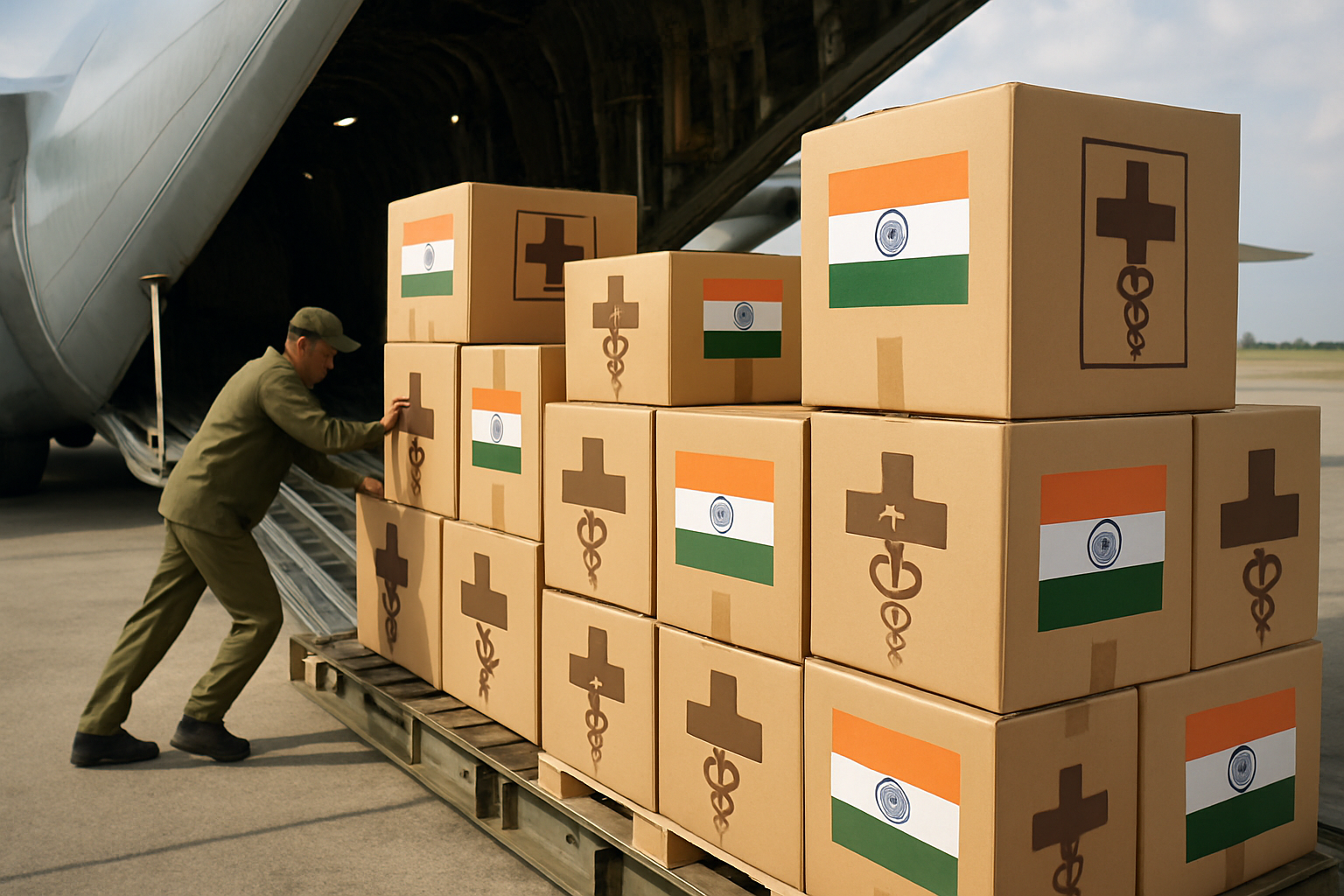
India has delivered 2.5 tons of emergency medical supplies to Afghanistan's capital Kabul, providing critical humanitarian assistance as the country reels from recent violence and an ongoing healthcare crisis that has left millions without adequate medical care.
The medical shipment, announced by India's Ministry of External Affairs spokesperson Randhir Jaiswal on March 20, includes emergency medicines, medical disposables, kits, and essential equipment specifically designed to support hospitals treating victims of the March 16 attacks that devastated parts of Kabul.
The aid delivery comes amid one of Afghanistan's most severe humanitarian crises in decades, with the World Health Organization confirming that only 23 hospitals across the country currently have access to emergency medical oxygen supplies. This critical shortage has forced hundreds of health centers to close, creating a healthcare vacuum that affects millions of Afghans.
Regional Context and Pakistan Crisis
India's humanitarian gesture unfolds against the backdrop of escalating violence between Pakistan and Afghanistan, which has entered its fourth week since Pakistani Defense Minister Khawaja Asif declared "open war" against the Taliban government on February 27. The conflict began following a February 16 attack by the Tehrik-e-Taliban Pakistan (TTP) in Bajaur district that killed 11 Pakistani soldiers.
According to the UN Assistance Mission in Afghanistan (UNAMA), the cross-border violence has resulted in 185 civilian casualties between February 26 and March 5 alone, with 56 people killed and 129 wounded. The Office for the Coordination of Humanitarian Affairs reports that 16,370 families have been newly displaced across 10 Afghan provinces due to the conflict.
"India stands with the people of Afghanistan and will continue to provide all possible humanitarian assistance."
— Randhir Jaiswal, India's Ministry of External Affairs Spokesperson
The March 16 incident that prompted India's medical aid involved disputed Pakistani airstrikes in Kabul. Taliban officials claimed that Pakistani forces struck the Omid Addiction Treatment Hospital in the Pul-e-Charkhi area, resulting in over 400 casualties at the 2,000-bed facility. Pakistan categorically denies targeting the hospital, maintaining that its strikes hit the Camp Phoenix military installation "several kilometers away."
India's Strategic Humanitarian Role
India's decision to provide emergency medical aid reflects its broader strategic approach to Afghanistan, positioning itself as a responsible regional power committed to humanitarian principles despite complex geopolitical circumstances. This marks a continuation of India's engagement with Afghanistan focused on civilian welfare rather than political recognition of the Taliban government.
The medical supplies delivery demonstrates India's capacity to navigate the challenging logistics of providing aid to Afghanistan while the country remains largely isolated from international recognition. The shipment was coordinated through diplomatic channels to ensure rapid deployment to medical facilities treating emergency cases.
India's approach contrasts sharply with the military confrontation between Pakistan and Afghanistan. While Pakistan has conducted Operation Ghazab lil-Haq, targeting what it claims are terrorist infrastructure and military facilities, India has chosen the path of humanitarian assistance to address civilian suffering.
Afghanistan's Healthcare Emergency
Afghanistan's healthcare system faces unprecedented challenges, with the WHO reporting that hundreds of health centers have closed due to funding cuts and security concerns. The systematic exclusion of women from most employment sectors since August 2021 has particularly affected healthcare delivery, as cultural and religious norms often require female medical professionals to treat women patients.
UN assessments indicate that 88% of female-headed households are unable to meet minimum living requirements, compared to 75% of the general population. This represents one of the world's most severe humanitarian crises, affecting a population already weakened by decades of conflict and economic instability.
The collapse of bilateral trade between Pakistan and Afghanistan has exacerbated the crisis, with exports dropping by 59% from $550 million to $228 million over seven months. Traditional trade routes through Chaman-Spin Boldak and Torkham have faced repeated closures, disrupting the flow of essential goods including medical supplies.
International Response and Diplomatic Significance
India's medical aid delivery comes as international mediation efforts intensify to resolve the Pakistan-Afghanistan crisis. Saudi Arabia, Qatar, and Turkey have emerged as key mediators, leveraging religious and cultural influence during Ramadan to push for de-escalation.
The timing of India's humanitarian gesture—announced just days before the temporary Eid al-Fitr ceasefire between Pakistan and Afghanistan—underscores India's role as a stabilizing force in South Asian diplomacy. Unlike the military approaches adopted by others in the region, India's focus on civilian welfare demonstrates an alternative model of regional engagement.
Chinese Foreign Minister Wang Yi has also been active in mediation efforts, with special envoys shuttling between capitals to promote dialogue and reconciliation. Religious scholars, including Ali al-Qaradaghi from the International Union of Muslim Scholars, have issued fatwas calling for immediate ceasefires during the holy month, adding moral pressure to diplomatic initiatives.
Historical Context of India-Afghanistan Relations
India's medical assistance continues a long tradition of development cooperation with Afghanistan, despite the complex political landscape since the Taliban's return to power in August 2021. India has previously provided vaccines, including 131 cartons of Td vaccines containing over 100,000 doses in February 2026, supporting national immunization programs.
This humanitarian approach allows India to maintain practical engagement with Afghanistan while navigating the political sensitivities surrounding the Taliban government. India has consistently emphasized that its assistance targets civilian needs rather than political recognition, focusing on healthcare, education, and basic services.
The medical aid delivery also reflects India's broader concerns about regional stability. With Pakistan and Afghanistan locked in military confrontation, India's humanitarian diplomacy represents an effort to prevent further deterioration of the security situation in South Asia.
Looking Forward: Challenges and Opportunities
The success of India's medical aid delivery will likely depend on several factors, including the continuation of the temporary ceasefire between Pakistan and Afghanistan, the Taliban government's capacity to distribute supplies effectively, and the international community's ability to maintain humanitarian access despite political constraints.
As the region faces what experts describe as the most serious Pakistan-Afghanistan confrontation since the Taliban's return to power, India's humanitarian approach offers a potential model for sustained engagement that prioritizes civilian welfare over political considerations.
The medical supplies are expected to provide immediate relief to hospitals treating victims of recent violence, but the underlying healthcare crisis requires sustained international support. With only 23 hospitals having access to emergency medical oxygen and hundreds of health centers closed, Afghanistan's medical infrastructure needs comprehensive rehabilitation.
India's commitment to provide "all possible humanitarian assistance" suggests that this 2.5-ton shipment may be part of a larger, ongoing effort to support Afghanistan's civilian population. As diplomatic efforts continue to resolve the regional crisis, India's humanitarian diplomacy demonstrates that practical cooperation on civilian needs can continue even amid broader political uncertainties.
The ultimate test of this approach will be whether humanitarian assistance can help stabilize the situation and create space for broader diplomatic solutions to the complex challenges facing Afghanistan and the wider South Asian region.