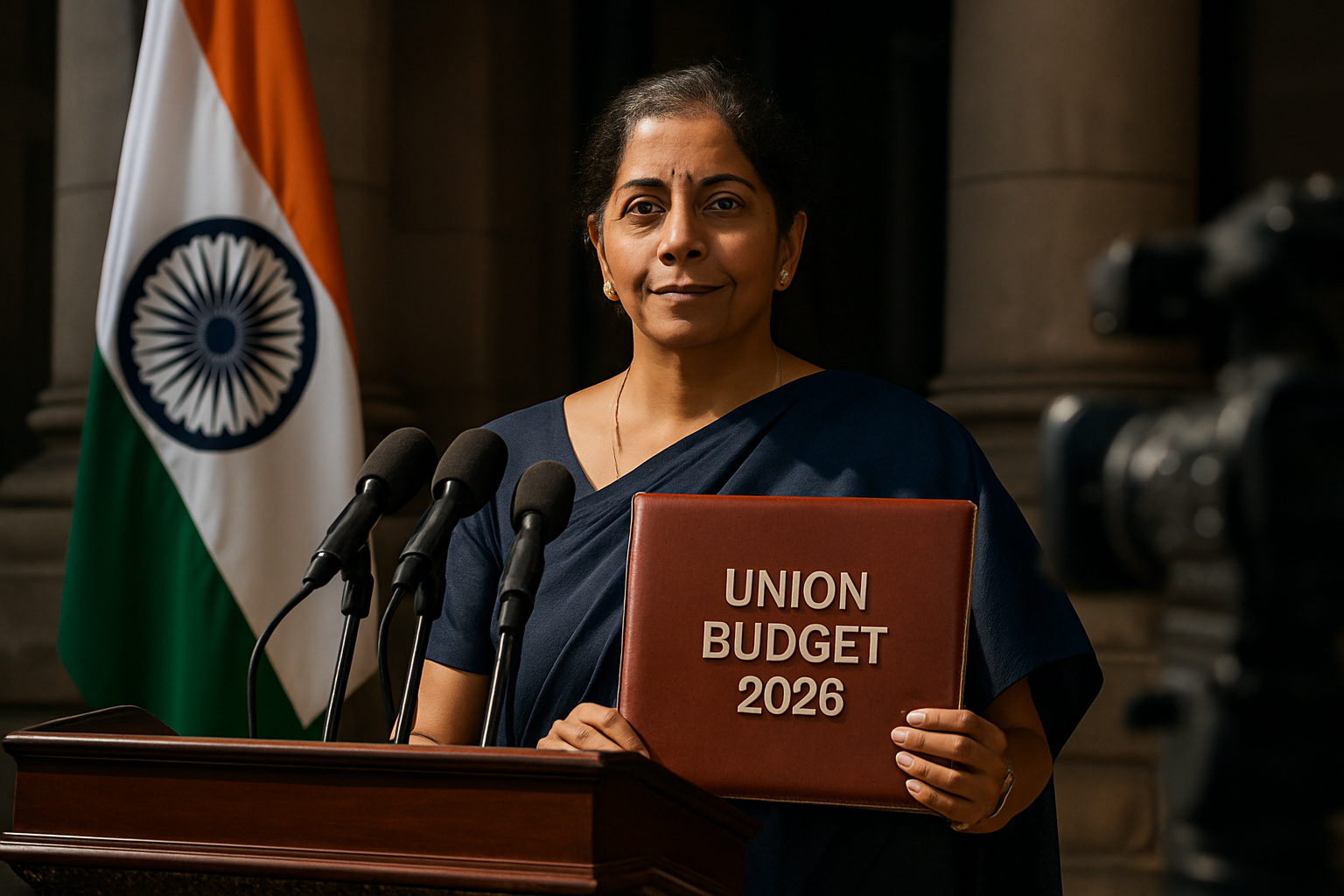
Finance Minister Nirmala Sitharaman presented India's Union Budget 2026-27 on February 1, featuring record allocations of ₹7.85 lakh crore for defence and $133 billion for infrastructure development, marking her ninth consecutive budget presentation as the nation charts its course toward becoming a developed economy by 2047.
Prime Minister Narendra Modi hailed the budget as "historic" and a "high flight toward Viksit Bharat" (Developed India), describing it as a comprehensive roadmap that reflects the aspirations of 140 crore Indians and strengthens the country's reform trajectory.
Defence Allocation Reaches New Heights
The Union Budget 2026 allocated ₹7.85 lakh crore to the Ministry of Defence, representing a significant increase that covers defence services revenue, capital outlay, defence pensions, and civil establishments under the ministry. This allocation underscores India's commitment to strengthening its security apparatus amid evolving geopolitical challenges.
Defence Minister Rajnath Singh welcomed the budget announcement, stating that it "reinforces commitment to strengthen the nation's defence systems" and will further enhance India's defence capabilities across all domains.
"This budget will further strengthen India's defence capabilities and demonstrates our unwavering commitment to national security."
— Rajnath Singh, Defence Minister
Infrastructure and Transportation Revolution
The budget outlined an unprecedented $133 billion allocation for infrastructure and manufacturing capabilities, positioning India as a global manufacturing hub. A key highlight is the announcement of seven high-speed rail corridors, which will revolutionize transportation connectivity across the country and boost economic growth in tier-2 and tier-3 cities.
The infrastructure push extends beyond transportation, encompassing digital infrastructure, renewable energy projects, and urban development initiatives that align with India's sustainable development goals and climate commitments.
Tax Reforms and Financial Market Impact
The budget introduced significant tax reforms, including a simplified Income Tax Act designed to reduce compliance burden and improve transparency. However, the announcement of increased Securities Transaction Tax (STT) on futures and options (F&O) trades triggered immediate negative reactions in the stock markets.
The Nifty50 and BSE Sensex experienced sharp declines following the budget presentation, with investors expressing concerns over the higher STT rates on derivatives trading. Market analysts attributed the crash primarily to this specific tax measure, which affects the highly active F&O segment.
Social Welfare and Economic Vision
Uttar Pradesh Chief Minister Yogi Adityanath praised the budget as an "inspiring blueprint for building Viksit Bharat," emphasizing its multi-faceted approach. According to Adityanath, the budget will provide "opportunities to the youth, security to farmers, encouragement to entrepreneurs, relief to the middle class, respect to workers, and new impetus for innovation."
The budget includes substantial allocations for education and healthcare sectors, with specific focus on skill development programs and digital literacy initiatives aimed at preparing India's workforce for the future economy.
Regional and International Dimensions
The budget maintains India's commitment to regional cooperation, with ₹12.8 billion allocated as aid for Nepal, while Bhutan remains the largest recipient of Indian development assistance. These allocations underscore India's role as a regional economic leader and its soft power diplomacy in South Asia.
International observers have noted the budget's strategic focus on self-reliance (Atmanirbharta) while maintaining openness to foreign investment, particularly in manufacturing and technology sectors where India has received billions in commitments from global tech giants.
Political Reactions and Analysis
The budget has generated sharp political debate across the country. While the ruling BJP and its allies view it as a reform-driven, growth-oriented roadmap toward developed nation status, opposition parties argue it lacks direction and fails to adequately address unemployment, inflation, rural distress, and state-specific concerns.
Editorial analysis suggests that Budget 2026-27 "chose prudence over adventurism, and multipronged measures over Big Bang reforms," indicating a measured approach to economic policy amid global uncertainties.
"This budget reflects the aspirations of 140 crore Indians and provides a highway of opportunities that will give fresh momentum to Make in India and Atmanirbhar Bharat."
— Narendra Modi, Prime Minister
Support for Strategic Industries
The budget includes specific provisions for rare-earth mineral development, recognizing their critical importance for technology manufacturing and national security. This initiative aligns with global supply chain diversification trends and India's ambition to become a key player in critical mineral processing.
Manufacturing incentives have been enhanced to attract both domestic and international investment, with particular focus on electronics, pharmaceuticals, and clean energy equipment production.
Looking Ahead
Budget 2026-27 represents a comprehensive approach to India's economic transformation, balancing immediate needs with long-term strategic objectives. The emphasis on infrastructure, defence, and manufacturing reflects the government's vision of positioning India as a global economic powerhouse while maintaining its democratic values and inclusive growth model.
As implementation begins, the success of these ambitious allocations will depend on effective execution mechanisms, state-level coordination, and the global economic environment. The budget's impact on job creation, rural development, and technology adoption will be closely monitored as key indicators of its effectiveness in advancing India's development agenda.