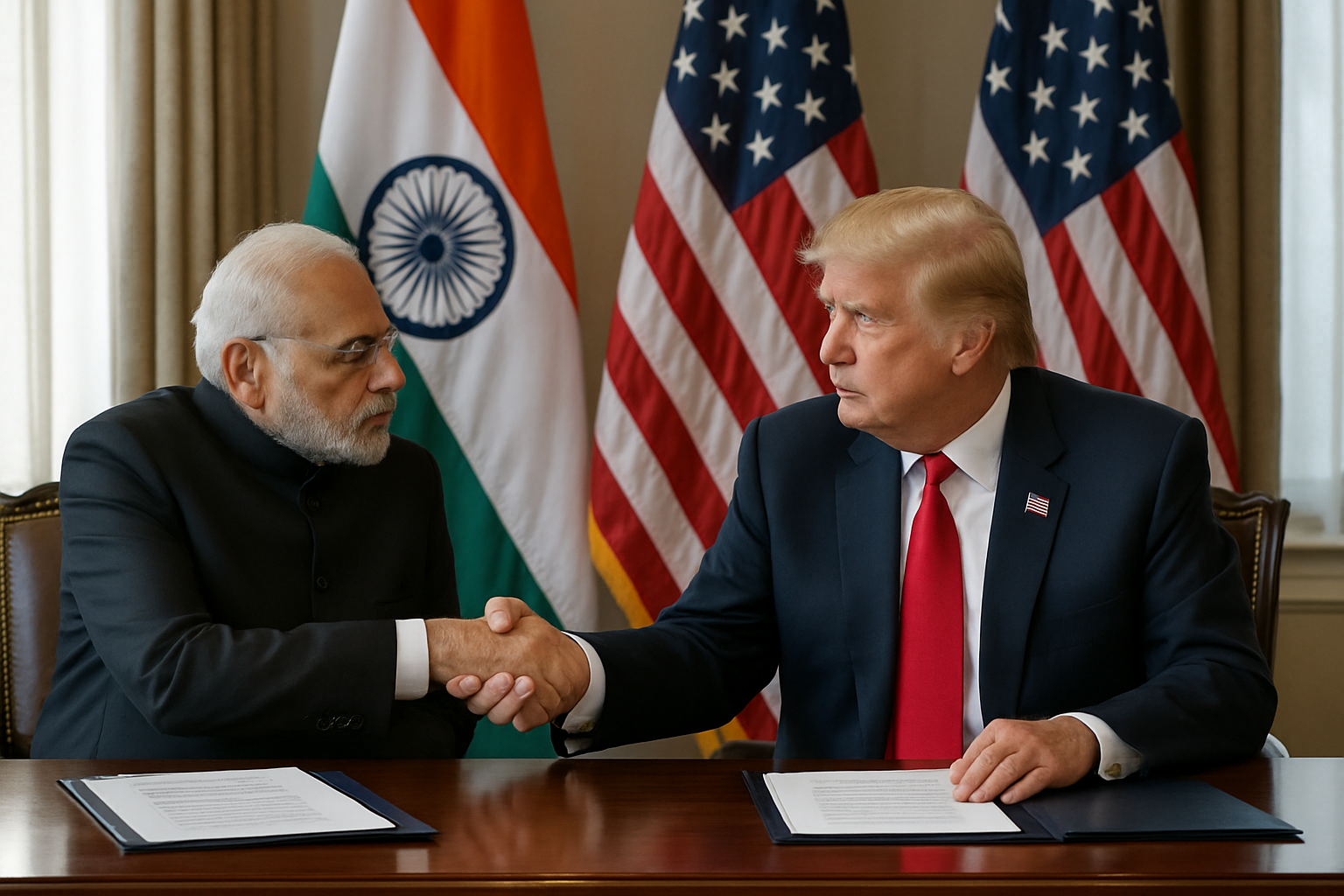
India and the United States unveiled a groundbreaking interim trade framework on February 7, 2026, marking a significant de-escalation of recent trade tensions and setting the stage for expanded bilateral economic cooperation, while President Donald Trump simultaneously signed an executive order lifting the contentious 25% penalty tariffs imposed on Indian goods over New Delhi's Russian oil imports.
The comprehensive agreement, announced jointly by Prime Minister Narendra Modi and the Trump administration, represents a major diplomatic breakthrough that addresses multiple friction points in the world's two largest democracies' trade relationship. The framework signals both nations' commitment to advancing toward a broader bilateral trade agreement while providing immediate relief to businesses and consumers in both countries.
Key Provisions of the Trade Framework
Under the interim agreement, India will eliminate or substantially reduce tariffs on all US industrial goods and a wide range of American food and agricultural products. The comprehensive list includes dried distillers' grains, red sorghum for animal feed, tree nuts, fresh and processed fruits, soybean oil, wine and spirits, among numerous other agricultural commodities.
In a significant reciprocal gesture, the United States will reduce import duties on Indian goods to 18%, down from previous levels that had reached as high as 50% in some sectors. This represents a substantial improvement in market access for Indian exporters across multiple industries.
"India and the United States share a commitment to promoting innovation and this framework will further deepen investment and technology partnerships between us," Prime Minister Modi stated in his official response to the agreement.
— Narendra Modi, Prime Minister of India
The framework includes the elimination of tariffs on selected aircraft and related components, according to a separate joint statement issued by the White House. This provision is particularly significant for both countries' aerospace industries and could facilitate expanded defense cooperation.
Resolution of the Russian Oil Dispute
Perhaps the most diplomatically sensitive aspect of the agreement involves the resolution of tensions over India's Russian oil imports. President Trump signed an executive order officially lifting the 25% penalty tariffs that had been imposed on Indian goods due to New Delhi's continued purchases of Russian crude oil.
India had been importing approximately 1.5 million barrels per day of Russian oil, taking advantage of discounted prices following international sanctions against Moscow. The punitive US tariffs had created significant strain in bilateral relations, with Indian officials arguing that the country was pursuing energy security while maintaining its traditional non-aligned foreign policy stance.
The lifting of these penalty tariffs comes as India has already begun scaling back its Russian oil acquisitions, though the specific timeline and extent of this reduction remains a subject of ongoing negotiation between the two governments.
Enhanced Cooperation Mechanisms
Beyond tariff reductions, the framework establishes enhanced cooperation on standards and conformity assessment procedures designed to simplify compliance for businesses operating across both markets. The agreement includes provisions allowing for adjustments to commitments if either side changes agreed tariff levels, providing flexibility for future negotiations.
The two countries have also committed to strengthening investment and technology partnerships, with particular emphasis on innovation sectors where both nations maintain competitive advantages. This cooperation is expected to facilitate greater technology transfer and joint research initiatives.
Political and Economic Significance
Prime Minister Modi characterized the framework as strengthening India's "Make in India" initiative by opening new opportunities for farmers and manufacturers to access expanded US markets. The agreement is expected to benefit Indian agricultural producers particularly, given the substantial reduction in US market access barriers.
For the United States, the framework represents the Trump administration's continued emphasis on bilateral trade agreements rather than multilateral frameworks. The deal follows the pattern established with other recent US trade initiatives, focusing on sector-specific market access improvements and reciprocal tariff reductions.
The agreement comes at a time when both countries are seeking to diversify their trade relationships and reduce dependence on Chinese supply chains. The framework includes provisions for cooperation on critical minerals and strategic materials, aligning with broader US efforts to secure alternative supply sources for essential commodities.
Implementation Timeline and Congressional Approval
While the interim framework provides immediate benefits through executive action, particularly the lifting of penalty tariffs, broader implementation will require careful coordination between both governments. The two countries have committed to regular consultations to monitor progress and address implementation challenges as they arise.
Congressional approval may be required for certain aspects of the broader trade relationship, though the interim framework is structured to maximize benefits that can be achieved through existing executive authorities. Both governments have emphasized their commitment to swift implementation while ensuring compliance with domestic legal requirements.
Regional and Global Implications
The India-US trade framework has significant implications for regional trade dynamics in South Asia and the broader Indo-Pacific region. The agreement strengthens economic ties between the world's two largest democracies at a time of increased geopolitical competition in the region.
The resolution of the Russian oil dispute also has broader implications for international sanctions policy and energy security considerations. India's ability to maintain energy diversification while strengthening ties with the United States demonstrates the complex balancing act required in contemporary international relations.
Other countries in the region are likely monitoring the agreement closely, as it could serve as a template for similar bilateral arrangements with the United States. The framework's success could influence broader patterns of economic cooperation in the Indo-Pacific region.
Looking Ahead
The interim framework explicitly reaffirms both countries' commitment to pursuing a more comprehensive bilateral trade agreement. Officials from both governments have indicated that negotiations for a broader deal will continue, building on the foundation established by this interim arrangement.
Success in implementing the current framework will be crucial for maintaining momentum toward a more expansive trade relationship. Both governments have emphasized the importance of demonstrating concrete benefits for businesses and consumers in both countries.
The agreement represents a significant diplomatic achievement for both Prime Minister Modi and President Trump, demonstrating their ability to resolve complex trade disputes through sustained bilateral engagement. The framework provides a foundation for expanded economic cooperation between India and the United States while addressing immediate concerns in both countries.
As implementation begins, the true test of the framework will be its ability to deliver tangible economic benefits while maintaining the political support necessary for continued expansion of the bilateral trade relationship. The agreement marks an important milestone in India-US relations and sets the stage for potentially transformative economic cooperation between these two democratic powers.