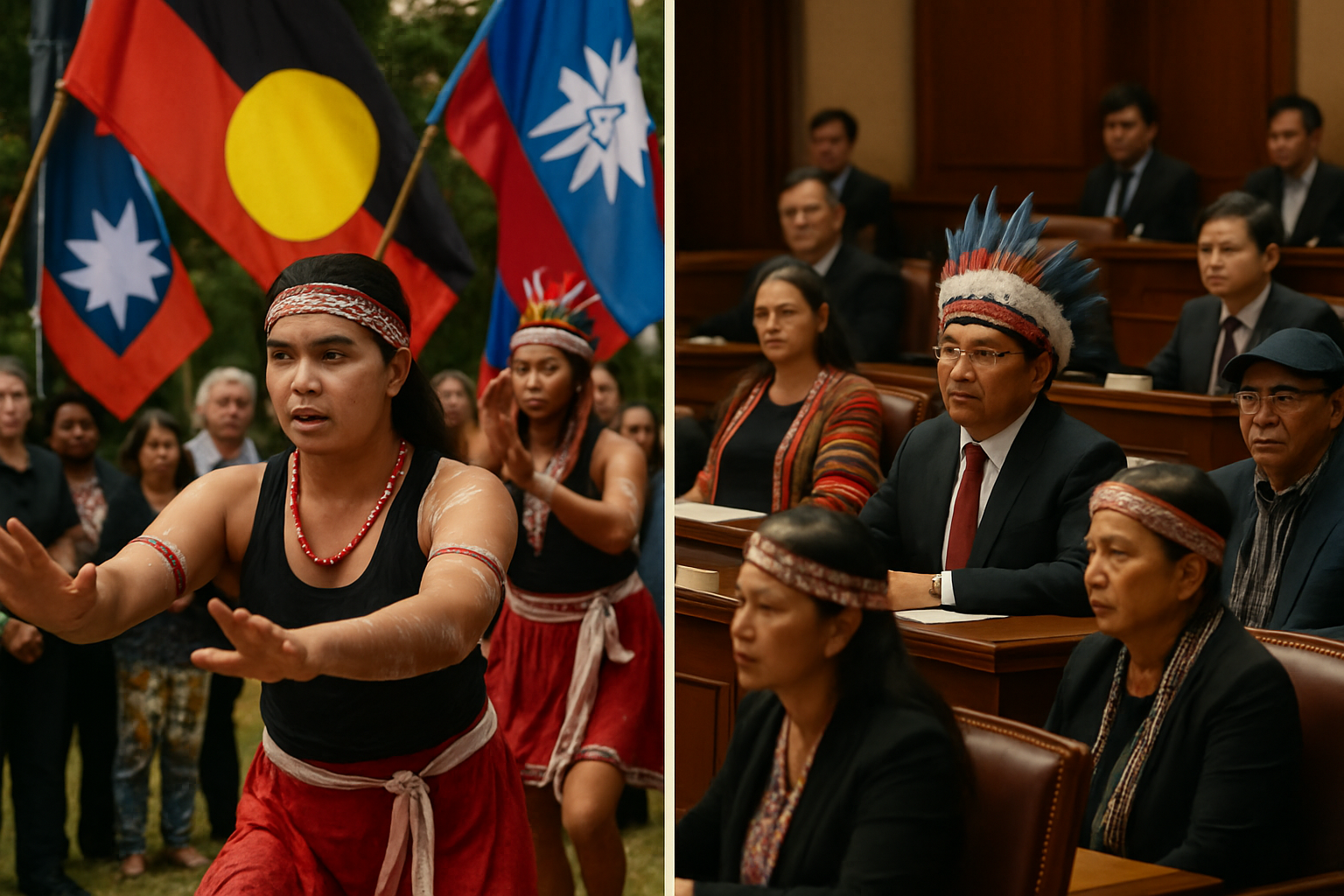
Indigenous communities across the Pacific are facing mounting political pressures as cultural recognition protocols come under attack, from flag removals in Australian government chambers to diplomatic interventions needed to preserve traditional performances at international sporting events.
Two significant incidents this week have highlighted the precarious position of Indigenous cultural rights in an increasingly polarized political environment, where administrative procedures and international diplomacy are colliding with fundamental questions of cultural recognition and sovereignty.
Australia: Protocol Violations Strip Indigenous Symbols from Government
In a controversial move that has sparked widespread opposition, the Federation Council on the New South Wales-Victoria border has voted to remove Indigenous flags from its chamber after revelations emerged that there were no formal protocols governing their display.
Despite strong community pushback and vocal protests from Indigenous rights advocates, council officials defended the decision as necessary compliance with procedural requirements. The removal has reignited debates about the institutional barriers that continue to limit Indigenous representation in Australian governance structures.
This incident reflects broader tensions within Australia's democratic institutions, where Indigenous communities have long fought for meaningful recognition while navigating complex bureaucratic systems originally designed without their input or participation. The flag controversy underscores how administrative technicalities can become tools for diminishing hard-won symbolic victories.
According to recent memory from Planet News archives, these developments occur within a broader context of Indigenous rights advancement in other regions. In February 2026, Canada achieved a historic milestone with the Musqueam rights recognition agreement covering Metro Vancouver territories, representing one of the most significant urban Indigenous rights recognitions in Canadian history. The contrast between Canadian progress and Australian setbacks illustrates the uneven trajectory of Indigenous rights globally.
Taiwan: Cultural Performance Survives Diplomatic Pressure
Meanwhile, in an equally telling incident, a Taiwanese Indigenous dance performance was nearly cancelled before the Taiwan-China football quarter-final on Saturday, requiring urgent diplomatic intervention to preserve the cultural display.
The dance, which was ultimately reinstated and performed as scheduled, had been threatened with removal in what sources suggest was an attempt to avoid potential diplomatic sensitivities with China during the Women's Asian Cup match. The successful intervention demonstrates both the vulnerability of Indigenous cultural expressions in politically charged environments and the power of advocacy when mobilized effectively.
The incident highlights the complex intersection of Indigenous rights, international sports, and geopolitical tensions, where cultural performances become inadvertent flashpoints in broader diplomatic relationships. That the performance was ultimately saved speaks to growing international recognition that Indigenous cultural rights should transcend political considerations.
A Pattern of Cultural Suppression
These incidents are not isolated events but part of a concerning global pattern where Indigenous cultural recognition faces increasing political pressure. The Australia-Taiwan developments follow documented challenges to Indigenous rights and cultural preservation efforts worldwide, where administrative procedures and diplomatic sensitivities are increasingly used to limit Indigenous visibility and voice.

The timing of these incidents is particularly significant given the broader global renaissance of Indigenous cultural recognition documented throughout 2026. From Vatican repatriations to First Nations communities in Canada to successful cultural exhibitions preserving Indigenous traditions worldwide, there has been unprecedented momentum for Indigenous rights advancement.
Historical Context and International Implications
The Australian flag removal comes amid a complex political environment where Indigenous rights have been both advancing and facing backlash. The Federation Council's decision represents a stark contrast to progress elsewhere, including the ongoing cultural renaissance documented across multiple nations throughout 2026.
In Canada, Prime Minister Mark Carney announced comprehensive Indigenous rights initiatives in March 2026, including the historic Musqueam agreement recognizing Aboriginal rights across Metro Vancouver. This established consultation frameworks for future development while respecting Indigenous sovereignty in heavily developed urban areas, creating precedents for urban reconciliation approaches.
The Taiwan incident reflects the increasingly complex international environment where Indigenous cultural expressions become entangled in broader geopolitical tensions. The successful preservation of the dance performance required diplomatic intervention, highlighting both the fragility and importance of protecting Indigenous cultural rights even in politically sensitive contexts.
Protocol Versus Recognition
The Australian controversy centers fundamentally on the question of whether administrative protocols should supersede cultural recognition and community will. Critics argue that the absence of formal flag display protocols represents an institutional failure to properly accommodate Indigenous symbols, rather than grounds for their removal.
"The lack of protocols is itself the problem that needs fixing, not the presence of the flags,"
— Indigenous Rights Advocate, Federation Council Area
This sentiment reflects broader frustrations within Indigenous communities who have experienced decades of bureaucratic obstacles to meaningful representation. The protocol argument highlights how institutional structures originally designed without Indigenous input continue to create barriers to their full participation in democratic governance.
Global Context and Cultural Renaissance
These setbacks occur within the broader context of what has been documented as the "February 2026 Cultural Renaissance," a period of unprecedented global cultural preservation and recognition activities. Indigenous communities worldwide have been successfully reclaiming cultural practices, achieving international recognition, and securing repatriation of cultural artifacts.
The March 10, 2026 Vatican-First Nations repatriation ceremony, where Assembly of First Nations National Chief Cindy Woodhouse Nepinak unveiled five sacred cultural items returned after over 100 years in Vatican collections, represents the positive trajectory of Indigenous cultural rights. This milestone in global cultural restitution provides a sharp contrast to the bureaucratic obstacles facing Indigenous communities in Australia and the diplomatic pressures confronted in Taiwan.
Technology and Cultural Preservation
Modern Indigenous rights movements have successfully leveraged technology to preserve and share cultural traditions while maintaining authentic community connections. Advanced 3D scanning and digital archiving have enabled comprehensive documentation of cultural items while respecting sacred protocols and Indigenous community ownership.
This technological integration amplifies rather than replaces authentic cultural connections, creating global accessibility while maintaining community ownership. The approach offers models for how Indigenous communities can use modern tools to strengthen rather than compromise traditional practices.
Economic and Political Implications
The economic implications of these cultural rights controversies extend beyond symbolic recognition. Countries and regions that successfully implement Indigenous cultural recognition often see benefits through cultural tourism, international reputation enhancement, and educational partnerships.
Research consistently shows that nations recognizing Indigenous rights demonstrate stronger community resilience, enhanced international relationships, and improved social cohesion. The Federation Council's flag removal potentially undermines these benefits while the successful preservation of Taiwan's Indigenous dance performance demonstrates positive economic and diplomatic possibilities.
International Cooperation and Future Pathways
Despite the challenges documented in Australia and Taiwan, international cooperation frameworks continue supporting Indigenous rights advancement. The success of Vatican repatriations, Canadian urban reconciliation agreements, and global cultural preservation initiatives provides templates for positive change.
Effective Indigenous rights protection requires sustained political commitment, adequate resources, comprehensive community engagement, and international cooperation. The diversity of approaches across different countries provides multiple pathways for advancement while respecting local contexts and cultural autonomy.
Looking Forward: Challenges and Opportunities
The March 2026 incidents in Australia and Taiwan highlight both the ongoing vulnerabilities facing Indigenous communities and the importance of sustained advocacy. While administrative protocols and diplomatic sensitivities create obstacles, the successful preservation of Taiwan's dance performance and international support for Indigenous rights demonstrate that progress remains possible.
The key to future advancement lies in recognizing Indigenous cultural rights as fundamental infrastructure for democratic societies, rather than optional additions subject to bureaucratic convenience or diplomatic expediency. This requires institutional reforms that embed Indigenous recognition into the basic structures of governance and international relations.
Success depends on continued vigilance against backsliding, innovative solutions to persistent challenges, and the transformation of symbolic recognition into sustained institutional change. The global Indigenous rights movement has demonstrated remarkable resilience and growing international support, suggesting that current setbacks may prove temporary rather than permanent.
As Indigenous communities worldwide continue their struggle for recognition and self-determination, the incidents in Australia and Taiwan serve as both warnings about ongoing vulnerabilities and proof of the continued relevance of Indigenous cultural rights in contemporary political discourse. The path forward requires sustained commitment to ensuring that administrative procedures serve Indigenous recognition rather than limiting it, and that diplomatic considerations enhance rather than diminish Indigenous cultural expression.