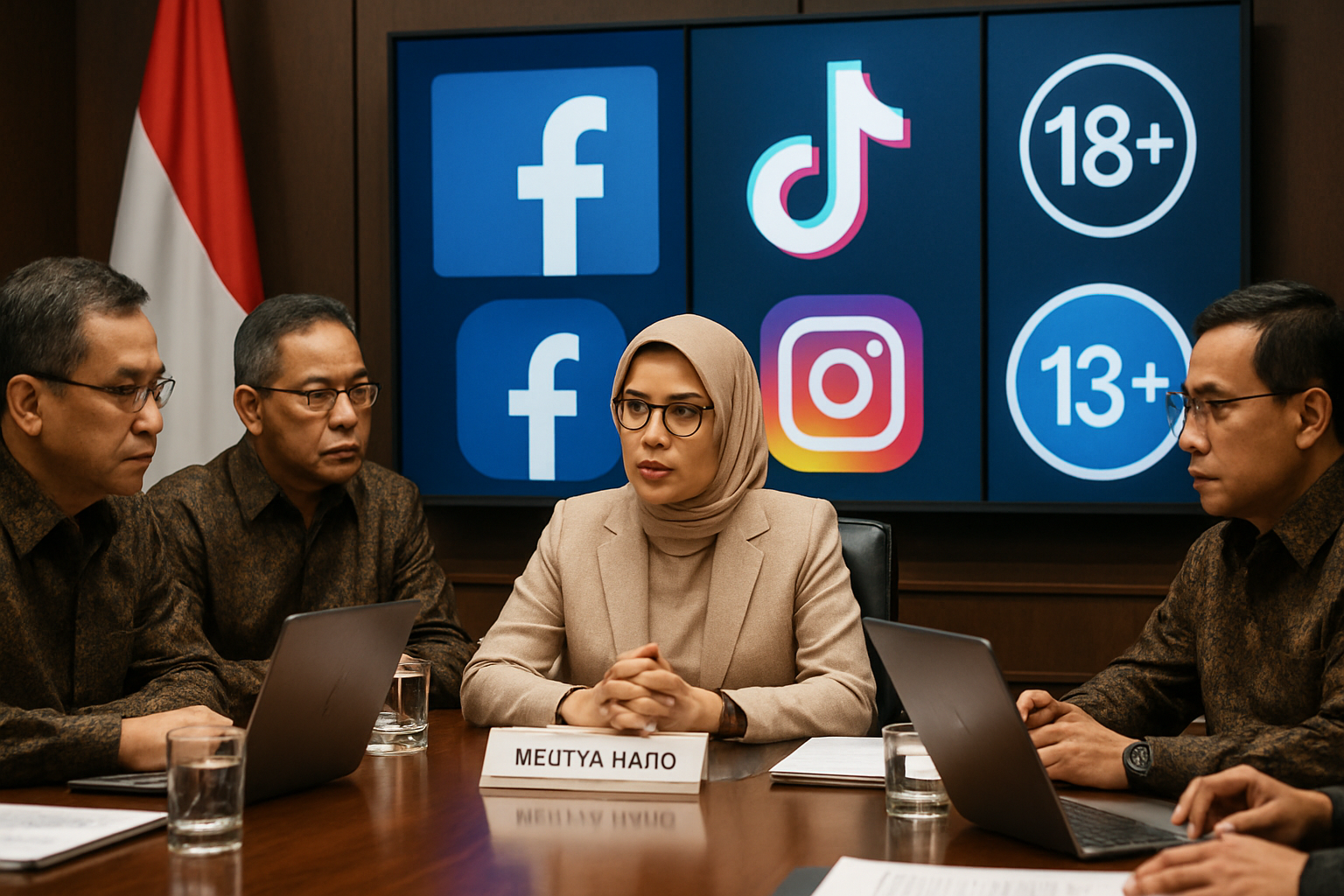
Indonesia has announced plans to ban children under 16 from accessing high-risk social media platforms starting March 28, 2026, marking Southeast Asia's most aggressive move yet to protect young users from harmful online content and joining an unprecedented global regulatory movement.
Communications and Digital Affairs Minister Meutya Hafid announced the sweeping new regulation on Friday, stating that the government had signed comprehensive measures that would gradually prevent children under 16 from holding accounts on platforms deemed "high risk" to youth development and mental health.
"We are taking this measure to regain control of our children's future," Minister Hafid emphasized during the announcement. "We want technology to humanize humans, not sacrifice our children."
Southeast Asia's First Comprehensive Ban
The Indonesian regulation represents the most significant social media restriction in Southeast Asia, establishing the country as the first in the region to implement age-based platform restrictions. This groundbreaking policy follows Australia's successful model, which eliminated over 4.7 million teen accounts in December 2025, proving the technical feasibility of comprehensive age restrictions.
The new Indonesian framework will apply to major social media platforms including Facebook, Instagram, TikTok, and Twitter/X, with mandatory age verification systems that go beyond simple checkbox confirmations. The government has indicated that robust biometric authentication measures will be required to ensure compliance.
Unlike partial restrictions implemented elsewhere, Indonesia's approach represents a complete prohibition on account creation and access for users under 16 on designated high-risk platforms, with significant penalties for non-compliance.
Global Regulatory Coordination
Indonesia's announcement comes amid the most significant social media regulation wave in internet history, with coordinated efforts across multiple continents to address mounting concerns about platform impacts on youth mental health and development.
Spain leads the global movement with its revolutionary five-point framework including under-16 social media bans, criminal executive liability for platform executives, and mandatory biometric age verification. The Spanish model has spread across Europe, with Greece implementing under-15 restrictions through its Kids Wallet system, while France, Denmark, Austria, and the UK conduct formal consultations on similar measures.
The coordinated timing of these implementations prevents "jurisdictional shopping," where platforms might relocate operations to avoid oversight, representing the most sophisticated international technology governance coordination since internet commercialization began.
"This represents a fundamental shift from industry self-regulation to government enforcement with meaningful legal consequences for protecting our children."
— Digital Policy Expert, commenting on global regulatory trends
Scientific Evidence Driving Policy
The Indonesian decision builds on compelling scientific research demonstrating the harmful effects of early social media exposure on developing minds. Dr. Ran Barzilay's University of Pennsylvania research shows that early smartphone exposure, particularly before age 5, causes persistent sleep disorders, cognitive decline, and weight problems that extend into adulthood.
Current statistics reveal that 96% of children aged 10-15 use social media platforms, with 70% experiencing harmful content exposure and over 50% encountering cyberbullying. Large-scale studies indicate that children spending four or more hours daily on screens face a 61% increased risk of depression through sleep disruption and decreased physical activity.
University of Macau research has definitively proven that short-form video consumption through "scrolling" behaviors negatively impacts cognitive development, causing social anxiety, academic disengagement, and reducing students' ability to focus on educational activities.
Implementation Challenges and Technical Requirements
The Indonesian government faces significant technical challenges in implementing comprehensive age verification systems. Real age verification requires sophisticated biometric authentication and identity document validation, raising important privacy concerns about government surveillance capabilities.
A global semiconductor crisis has created a sixfold increase in memory chip prices, affecting companies like Samsung, SK Hynix, and Micron, which could constrain the technological infrastructure needed for comprehensive age verification systems until new facilities come online in 2027.
Cross-border enforcement will require unprecedented international cooperation, as major social media platforms operate across multiple jurisdictions. The Netherlands' recent Odido data breach, affecting 6.2 million customers, demonstrates the vulnerabilities inherent in centralized databases that age verification systems would require.
Industry Resistance and Platform Responses
Technology executives have escalated their opposition to global regulatory measures, with Elon Musk characterizing European restrictions as "fascist totalitarian" overreach, while Telegram's Pavel Durov has warned about "surveillance state" implications. Government officials have used this industry resistance as evidence supporting the necessity of stronger regulatory intervention.
The "SaaSpocalypse" of February 2026 eliminated hundreds of billions in technology market capitalization amid regulatory uncertainty, demonstrating the financial stakes involved in the global platform accountability revolution.
The European Commission has found TikTok in violation of the Digital Services Act through "addictive design" features including unlimited scrolling, automatic video playback, and personalized recommendations that maximize user dependency over wellbeing, with potential penalties reaching 6% of global revenue.
Alternative Approaches and Philosophical Divides
While Indonesia joins the regulatory enforcement model, other nations have adopted alternative approaches emphasizing education and parental responsibility. Malaysia emphasizes digital safety campaigns led by Communications Minister Datuk Fahmi Fadzil, focusing on parents controlling device access rather than using technology as "babysitters."
Oman has implemented "Smart tech, safe choices" educational initiatives that focus on conscious digital awareness and teaching young people to recognize "digital ambushes" where attackers exploit curiosity to compromise security.
This represents a fundamental philosophical divide in digital governance between government intervention versus individual agency, market regulation versus user education, and collective protection versus personal rights.
Economic and Social Implications
The Indonesian ban will significantly impact the digital economy, affecting content creators, influencer marketing, and online businesses that depend on youth engagement. Thousands of young Indonesians have built profitable activities through social media platforms, and the restrictions will require alternative pathways for digital entrepreneurship.
Educational institutions will need to adapt their digital literacy programs to work within the new regulatory framework, while parents will require enhanced support to navigate the changing digital landscape with their children.
The policy could accelerate the development of age-appropriate digital platforms specifically designed for educational and developmental purposes, creating new opportunities in the EdTech sector.
Regional and Global Precedent
Indonesia's decision establishes crucial precedents for Southeast Asian digital governance, potentially influencing neighboring countries' approaches to platform regulation. The successful implementation could trigger a regional domino effect, with Malaysia, Thailand, and the Philippines considering similar measures.
The timing coincides with global recognition that democratic institutions must develop sophisticated capabilities to regulate multinational technology platforms while preserving beneficial aspects of digital connectivity.
Success in Indonesia would contribute to establishing criminal liability frameworks as a global standard, while failure might strengthen industry arguments against government intervention in platform operations.
Looking Ahead: Critical Test for Democratic Governance
The Indonesian social media ban represents more than child protection policy—it constitutes a critical test of whether democratic governments can effectively regulate global technology companies while balancing innovation, economic competitiveness, and fundamental rights.
The March 28 implementation date will provide crucial data about enforcement effectiveness during a global platform accountability revolution that affects millions of children worldwide and establishes precedents for 21st-century technology governance.
As Minister Hafid stated, the stakes extend far beyond social media regulation to fundamental questions about democratic accountability, childhood development, and human agency in an increasingly digital world where online and offline realities intersect with unprecedented complexity.
The international community will closely monitor Indonesia's implementation as a potential template for comprehensive youth protection in the digital age, with outcomes likely to influence global approaches to technology governance for decades to come.