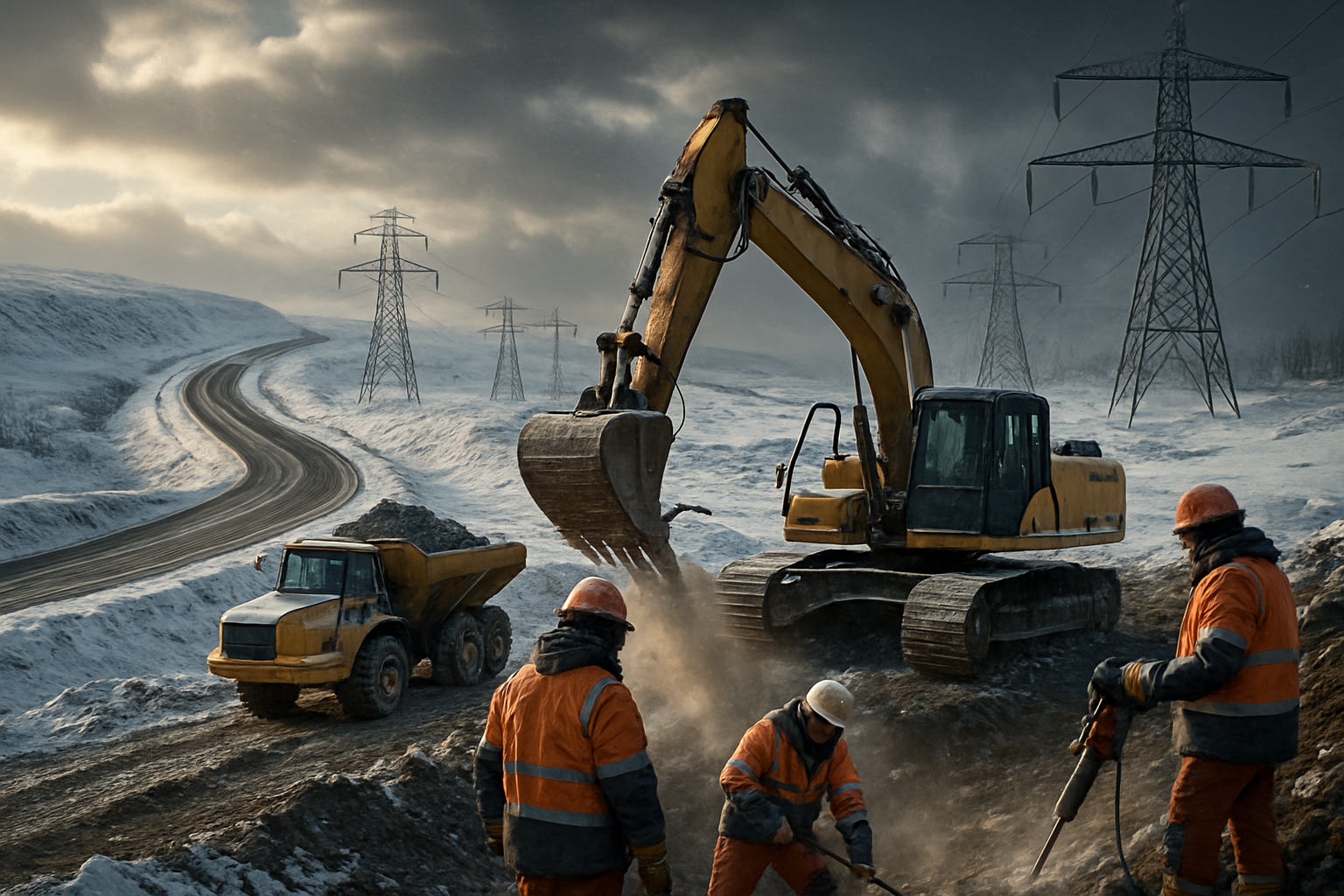
Infrastructure development projects worldwide face an unprecedented paradox in 2026: the urgent need for economic connectivity and modernization collides with escalating climate challenges that threaten both construction timelines and operational viability.
Two major developments this week illuminate this global infrastructure dilemma. In Canada's Arctic regions, the construction of critical transportation networks battles against thawing permafrost that shortens construction seasons and dramatically increases costs. Meanwhile, Guatemala's electrical sector has identified over $7 billion in investment opportunities, representing the scale of capital mobilization required for modern power infrastructure across developing economies.
Arctic Infrastructure Confronts Climate Reality
The Canadian Arctic presents perhaps the starkest example of climate change's impact on infrastructure development. The Inuvik to Tuktoyaktuk highway, a crucial transportation link serving remote northern communities, has been closed for over a week after being buried in snow. More fundamentally, researchers and construction specialists warn that warming ground temperatures are shortening the winter construction window while driving up project costs across Canada's northern territories.
The federal government's consideration of fast-tracking the Arctic Economic and Security Corridor adds urgency to these concerns. This ambitious infrastructure vision aims to strengthen Canada's sovereignty and economic development in the North, but faces the reality that traditional construction methods developed for stable permafrost may no longer be viable.
"The warming ground temperatures represent a fundamental challenge to how we approach Arctic construction. What worked for decades in stable permafrost conditions now requires complete rethinking."
— Research consensus from Canadian Arctic infrastructure studies
The implications extend beyond individual projects. Arctic infrastructure serves critical functions for national security, resource extraction, and community connectivity. Climate-driven construction challenges could compromise Canada's ability to maintain sovereignty over its northern territories while serving Indigenous and other northern communities that depend on reliable transportation links.
Guatemala's Electrical Infrastructure Investment Surge
Simultaneously, Guatemala demonstrates the massive capital requirements driving global infrastructure development. The electrical sector has identified at least $7 billion in investment opportunities for generation, transmission, and distribution projects. This announcement, made during a specialized forum, highlights both the scale of infrastructure needs across developing economies and the financial mechanisms emerging to address them.
Guatemala's electrical infrastructure development occurs within a broader context of Central American energy integration and climate adaptation. The country's power grid modernization aims to enhance reliability while incorporating renewable energy sources, reflecting global trends toward sustainable infrastructure development.
The forum's emphasis on existing financial channels for infrastructure projects indicates growing sophistication in development financing. International development banks, private-public partnerships, and multilateral funding mechanisms are converging to support large-scale infrastructure transformation across Latin America.
Global Infrastructure Investment Context
These developments reflect broader global infrastructure patterns documented throughout 2026. Recent Planet News analysis shows over $570 billion in transportation infrastructure investments spanning seven nations, including Vietnam's $120 billion commitment to 9,000 kilometers of expressways and Nicaragua's advancement of Chinese-engineered airport reconstruction.
The infrastructure surge encompasses diverse funding models and technological approaches. Hungary commenced Europe's largest nuclear construction project with Russian technology, while Estonia opened continental Europe's largest battery storage facility. African nations are advancing mining railways and renewable energy projects worth billions of dollars.
Climate Adaptation Becomes Infrastructure Priority
Climate considerations are reshaping infrastructure planning globally. Portugal's focus on permeable urban infrastructure for flood management, Cyprus's water consumption reduction requirements, and widespread integration of renewable energy systems demonstrate how climate adaptation has become inseparable from infrastructure development.
The challenge extends beyond individual project design to fundamental questions about infrastructure viability. Arctic permafrost thaw, increased extreme weather frequency, and changing precipitation patterns require infrastructure systems designed for climate conditions that may be substantially different from historical norms.
Financial Innovation Meets Development Needs
Infrastructure financing is evolving rapidly to address both traditional development needs and new climate challenges. Water utilities are increasingly viewed as defensive investment assets due to stable demand and regulated pricing frameworks. This shift reflects growing recognition that essential infrastructure provides consistent returns regardless of economic cycles.
The integration of public and private financing, particularly in developing economies, enables projects that would be impossible through traditional government funding alone. Guatemala's electrical infrastructure development exemplifies how multilateral partnerships can mobilize the massive capital required for modernization while ensuring technical standards and environmental compliance.
"Infrastructure has transformed from a basic utility to a sophisticated asset class reflecting the essential nature of connectivity in the modern economy."
— Global infrastructure investment analysis
Technology Integration and Smart Systems
Modern infrastructure projects increasingly incorporate smart technologies, renewable energy systems, and adaptive management capabilities. These technological integrations address both operational efficiency and climate resilience while creating platforms for future expansion and modification.
The Gulf-Africa infrastructure partnerships, European energy cooperation initiatives, and Asian transportation networks demonstrate how technology transfer accompanies financial investment. This knowledge sharing accelerates development while building local technical capacity for long-term sustainability.
Implementation Challenges and Opportunities
Infrastructure development faces persistent challenges including supply chain coordination, regulatory complexity, and environmental protection requirements. The global memory crisis affecting semiconductor production, for instance, impacts smart infrastructure systems while increasing costs for technology-integrated projects.
However, successful projects demonstrate that careful planning, international cooperation, and adaptive management can overcome these obstacles. Kenya's early completion of the Ngong Road-Naivasha Road flyover and Paraguay's advancement of historic railway revival show that modern project management can deliver infrastructure transformation even amid challenging conditions.
Regional integration initiatives, including the African Continental Free Trade Area and South American bioceanic corridors, create economic frameworks that support large-scale infrastructure investment. These continental approaches enable cost-sharing, technical cooperation, and unified standards that reduce individual project risks while maximizing economic benefits.
Future Infrastructure Imperatives
The intersection of climate challenges and development needs requires fundamental rethinking of infrastructure approaches. Traditional models assuming stable environmental conditions must evolve toward adaptive systems designed for changing climate conditions while maintaining economic viability.
Success will depend on continued innovation in construction methods, financing mechanisms, and international cooperation. The Arctic highway challenges and Central American electrical investments represent different aspects of this global infrastructure transformation, but both require sustained commitment to adaptive management and technological innovation.
As infrastructure becomes increasingly recognized as the foundation for economic development, climate resilience, and international connectivity, the projects underway in 2026 will establish precedents for decades of future development. The ability to balance immediate development needs with long-term sustainability will determine whether current infrastructure investments serve as foundations for prosperity or become stranded assets in a changing climate.