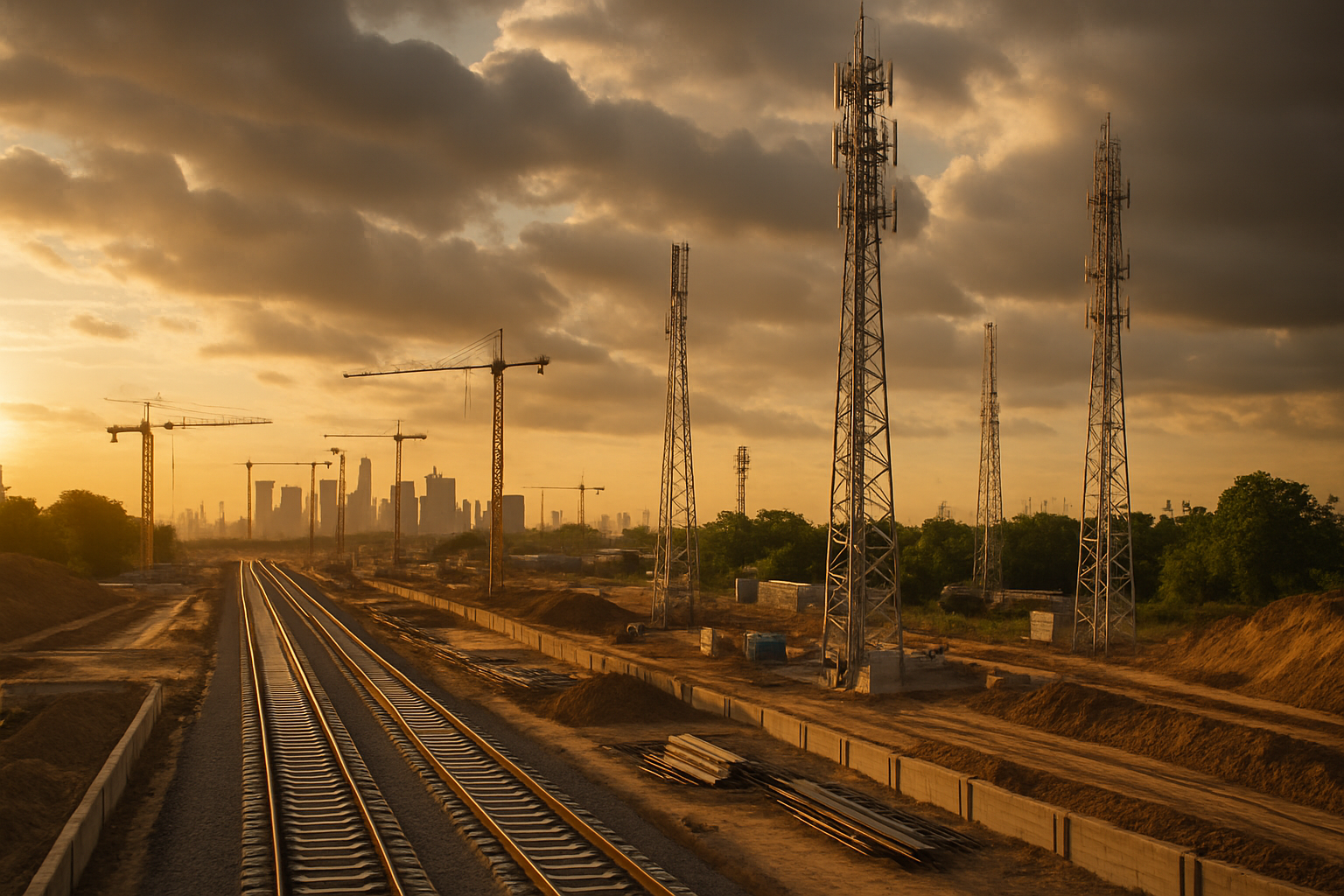
A remarkable surge in infrastructure development is reshaping countries across four continents, with major railway projects, telecommunications expansions, and urban development initiatives representing billions in investments aimed at modernizing transportation networks and improving regional connectivity.
From Algeria's mining railway breakthrough to India's ambitious high-speed rail corridors, and Paraguay's historic railway revival backed by international partnerships, nations are prioritizing infrastructure as the foundation for economic growth and regional integration in 2026.
Algeria's Strategic Railway Expansion
Algeria has achieved a significant milestone with its western mining railway project connecting Bechar-Tindouf-Gara Djebilet, earning international recognition from the International Union of Railways (UIC). François Davin, Director-General of the UIC, praised the project as reflecting the "deep forward-looking vision of the Algerian authorities."
The railway provides crucial access to the Gara Djebilet iron ore deposits, which contain the world's third-largest iron ore reserves with approximately 3.5 billion tons. This represents a transformative step in Algeria's economic diversification strategy, reducing dependence on hydrocarbon exports while connecting remote southwestern regions to transport hubs and export ports.
"We greatly value and appreciate the significant work carried out by the Algerian National Agency for Studies and Monitoring of Railway Investment Implementation."
— François Davin, Director-General of the International Union of Railways
The project, executed by the National Railway Transport Company (SNTF), represents a major milestone in developing Algeria's mineral resources that have remained largely dormant since independence. The timing coincides with global recognition of Africa's strategic importance in critical mineral supply chains.
India's High-Speed Rail Revolution
India is advancing its most ambitious transportation modernization program in decades, with Railway Minister Ashwini Vaishnaw announcing seven new high-speed rail corridors that will make the country "100% atmanirbhar (self-reliant) in making Bullet trains." This development builds on the substantial infrastructure allocations in India's Union Budget 2026-27, which designated $133 billion for infrastructure development.
Kerala state is investing Rs 1,905 crore in the Sabari rail project, demonstrating regional commitment to railway modernization. The comprehensive route and station list represents careful planning to connect previously underserved areas while supporting the broader national high-speed rail network vision.
These developments align with Prime Minister Narendra Modi's "Viksit Bharat" (Developed India by 2047) initiative, positioning advanced transportation infrastructure as central to the nation's economic transformation.
Paraguay's Historic Railway Revival
Paraguay is experiencing a railway renaissance with the Tren de Cercanías (Commuter Train) project, representing one of the country's most important infrastructure initiatives for both urban mobility and national economic development. Minister of Industry and Commerce Javier Giménez highlighted the project's significance in agreements signed between Paraguay and the United Arab Emirates.
The electric railway system secures approximately $450 million in investment, with $200 million from national capital and $150 million from international investors, demonstrating strong private sector confidence in long-term projects.
"I am very pleased to announce this initiative that will improve people's quality of life and mark a before and after in transportation in Paraguay."
— Javier Giménez, Minister of Industry and Commerce, Paraguay
The project carries profound historical significance, referencing President Don Carlos Antonio López's 1861 vision when trains first operated in Paraguay. This railway passenger service restoration represents the culmination of a national aspiration spanning over 160 years.
Bangladesh's Educational Infrastructure Expansion
Bangladesh is addressing its educational infrastructure challenges through targeted expansion projects. The Begum Rokeya University Rangpur (BRUR) is resolving its long-standing classroom crisis through strategic facility expansion on the fifth floor of existing buildings.
The Vice-chancellor emphasized that utilizing expanded classroom space will significantly reduce the university's persistent accommodation challenges, reflecting broader efforts across Bangladesh to modernize educational infrastructure and accommodate growing student populations.
Global Context and International Partnerships
These infrastructure developments occur within a broader global investment surge that has characterized 2026. Historical context from recent projects includes Mexico's completed "El Insurgente" train (100 billion pesos, 12 years construction), Malaysia's aviation expansion with AirBorneo ordering eight ATR aircraft, and the near-completion of Paraguay's Bioceanic Bridge connecting to Brazil.
International cooperation has become central to infrastructure success. Paraguay's UAE partnership, Algeria's engagement with international railway organizations, and India's self-reliance strategy all demonstrate different but complementary approaches to financing and implementing major projects.
Economic Impact and Regional Integration
The infrastructure surge extends beyond national boundaries, supporting continental integration initiatives including the African Continental Free Trade Area (AfCFTA) and South American connectivity goals through bioceanic corridors. These projects create employment, improve trade facilitation, and enhance cross-border connectivity supporting broader economic integration.
The timing coincides with global recognition of infrastructure as critical for climate adaptation, economic resilience, and technological advancement. Countries are increasingly viewing transportation networks as strategic assets requiring modernization to remain competitive in the global economy.
Technology Integration and Future Outlook
Modern infrastructure projects increasingly incorporate smart technologies, climate adaptation standards, and sustainability considerations. Paraguay's electric railway system, Algeria's mining efficiency improvements, and India's high-speed rail technology represent next-generation approaches to transportation development.
The international partnerships facilitating these projects—from UAE investment in Paraguay to international recognition of Algeria's achievements—demonstrate evolving models of infrastructure financing that combine public investment with private sector participation and multilateral cooperation.
As countries worldwide recognize infrastructure as the foundation for economic development, climate resilience, and regional integration, the 2026 global investment surge appears positioned to continue through the decade. These five nation examples illustrate diverse but coordinated approaches to addressing 21st century connectivity challenges while building foundations for sustainable economic growth.