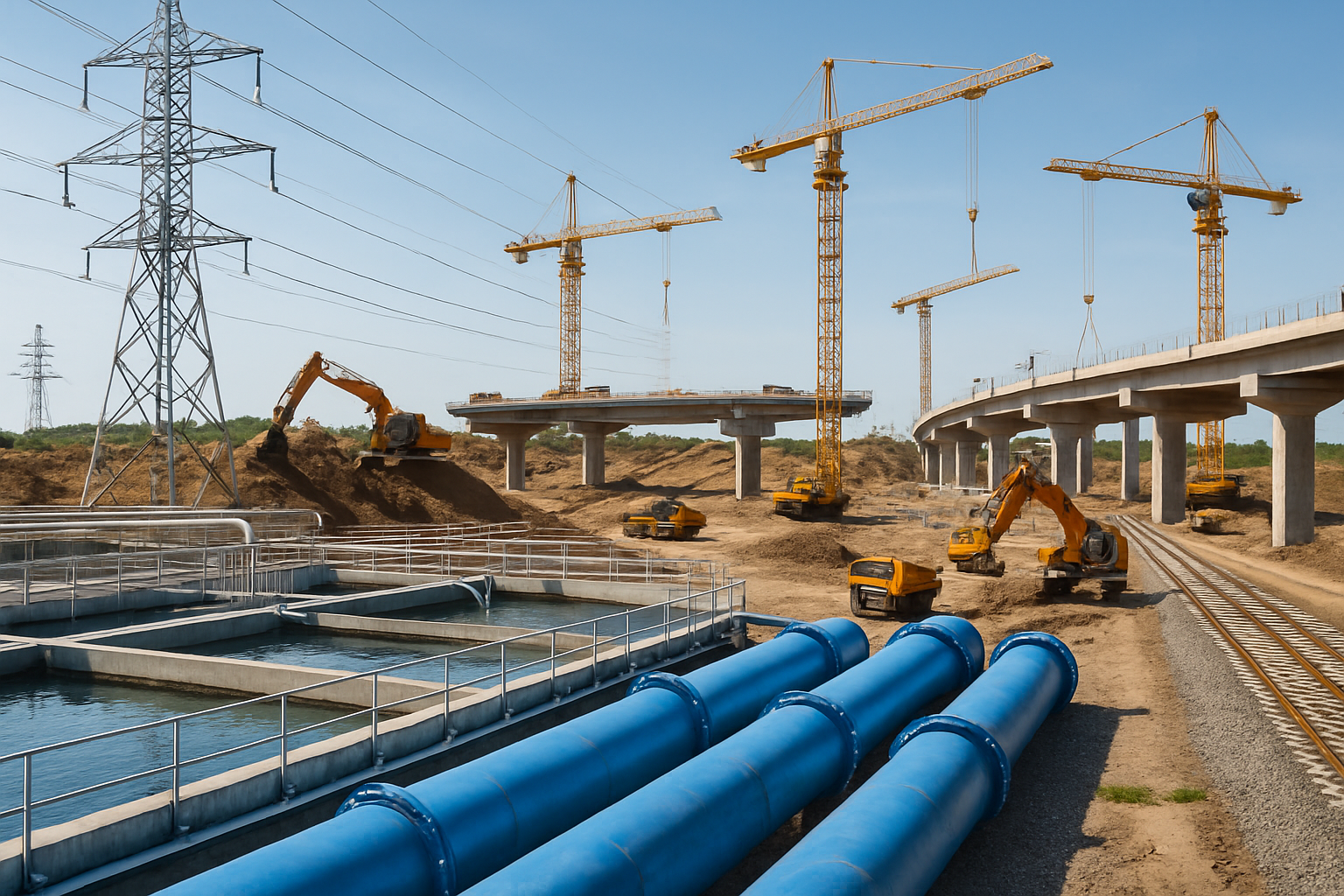
February 2026 has emerged as a watershed moment in global infrastructure development, with major projects spanning water systems, transportation networks, and utility improvements across three continents demonstrating unprecedented international cooperation and technological innovation.
From the Democratic Republic of Congo's crucial water infrastructure upgrades to Papua New Guinea's ambitious road connectivity initiatives and Kenya's traffic management solutions, this month's developments represent a coordinated global effort to address pressing infrastructure needs while adapting to climate challenges and evolving economic demands.
Water Infrastructure Breakthrough in Central Africa
The Democratic Republic of Congo has achieved a significant milestone in urban water infrastructure with REGIDESO's investment in new water production capabilities for Kabinda, the capital of Lomami province. The state water utility has equipped its secondary center with two new electric pump units and complete accessories, marking a transformative moment for water distribution in the city.
This development represents more than just infrastructure upgrading—it symbolizes a broader African commitment to water security and urban development. The project aligns with continental initiatives under the African Continental Free Trade Area (AfCFTA) framework, which emphasizes regional integration through improved infrastructure connectivity.
"Water production in Kabinda is experiencing a new lease of life with this critical infrastructure investment,"
— REGIDESO Officials, February 2026
The timing is particularly crucial as the region faces increasing urbanization pressures and climate variability. The new pumping systems incorporate modern energy-efficient technologies and digital monitoring capabilities, representing a shift toward smart infrastructure management that has become standard in contemporary development projects.
Papua New Guinea's Connectivity Revolution
Meanwhile, Papua New Guinea continues advancing its ambitious connectivity agenda through the Karamui road project, which demonstrates significant progress in linking remote communities to national transportation networks. The project represents a critical component of the broader Pacific nation's infrastructure modernization strategy, addressing the unique challenges of connecting over 800 languages across remote mountain valleys and scattered islands.
The Karamui road initiative exemplifies how developing nations are leveraging international partnerships and innovative financing mechanisms to overcome geographical constraints that have historically limited economic development and social integration. This project builds on the successful Civil Aviation Development Investment Program (CADIP) Phase 3, which has seen substantial progress with facilities like the Mt. Hagen Kagamuga Airport upgrades.
However, challenges remain. Works Secretary Gibson Holemba has highlighted that the Connect PNG program remains severely underfunded despite its vital importance for national integration, illustrating the complex prioritization decisions between urban infrastructure development and remote area connectivity that many developing nations face.
Kenya's Urban Traffic Solutions
In East Africa, Kenya Railways has taken proactive steps to address urban transportation challenges in Mombasa, issuing advance warnings about temporary traffic disruptions around the port area. This forward-thinking approach to traffic management reflects a broader trend toward predictive infrastructure planning and community engagement that has become increasingly important as urban areas experience rapid growth.
The Mombasa initiative demonstrates how established infrastructure systems are adapting to increasing demand through improved coordination and communication. Kenya's approach includes listing alternative routes and encouraging early travel planning, showcasing sophisticated urban management strategies that balance economic activity with transportation efficiency.
This development builds on Kenya's recent infrastructure successes, including the early completion of major flyover projects under President William Ruto's administration, which have demonstrated improved project management capabilities and political commitment to infrastructure modernization.
Technology Integration and Climate Adaptation
What distinguishes February 2026's infrastructure developments from previous eras is the systematic integration of smart technology, climate adaptation measures, and environmental sustainability considerations from the design phase rather than as retrofitted additions. These projects incorporate real-time monitoring systems, predictive maintenance capabilities, and renewable energy integration as standard requirements.
The global memory crisis, with semiconductor prices increasing sixfold, has actually accelerated innovation in alternative approaches, including more efficient algorithms and distributed processing systems. This challenge has pushed infrastructure planners to develop more resilient and adaptable systems that can function effectively even with supply chain constraints.
International Cooperation Models
The February 2026 infrastructure surge occurs within an unprecedented global investment framework exceeding $570 billion, representing a fundamental shift in viewing transportation and utility networks as strategic foundations for economic competitiveness, climate adaptation, and international cooperation. These projects demonstrate sophisticated financing models combining public-private partnerships, international development cooperation, and national investment strategies.
Success factors include comprehensive strategic planning from initial stages, transparent governance frameworks, extensive community consultation, and adaptive management approaches that can respond to changing conditions while maintaining core development objectives. The emphasis on "building back better" principles ensures that new infrastructure serves future climate conditions rather than historical patterns.
Regional Integration and Economic Impact
These infrastructure developments create substantial economic multiplier effects extending far beyond construction employment. Reduced logistics costs, enhanced market access, and improved business productivity support regional integration objectives under frameworks like AfCFTA and ASEAN cooperation initiatives.
The DRC water project supports urban development and industrial capacity, Papua New Guinea's road network enhances agricultural market access and tourism potential, and Kenya's transportation improvements facilitate trade efficiency through one of East Africa's most important ports.
Regional integration benefits include strengthening supply chains, reducing transportation bottlenecks, and creating economies of scale that make previously unviable projects financially sustainable through coordinated cross-border planning and investment.
Environmental Sustainability Standards
Modern infrastructure projects incorporate environmental sustainability as a core requirement rather than an optional consideration. This includes renewable energy systems, waste reduction measures, environmental protection protocols, and climate resilience planning designed for future environmental conditions rather than historical patterns.
The "build back better" principle has become standard practice, with projects required to demonstrate climate adaptation capabilities, flood management systems, enhanced drainage, weather-resistant materials, and backup power systems. Environmental compliance and community engagement have evolved into essential components for securing financing and regulatory approval.
Implementation Challenges and Solutions
Despite significant progress, infrastructure development faces ongoing challenges including funding sustainability, technical capacity building, environmental compliance, and coordination across multiple stakeholders and jurisdictions. Success requires sophisticated project management combining international best practices with local expertise and community engagement.
Supply chain management remains complex, with global semiconductor shortages affecting control systems and automation components. However, this has encouraged more diversified sourcing strategies and regional manufacturing capacity development, potentially creating more resilient supply chains in the long term.
Future Development Trends
The February 2026 infrastructure developments establish important precedents for balancing immediate development needs with long-term sustainability requirements. The convergence of technological advancement, environmental awareness, and international cooperation is creating new development models that prioritize comprehensive sustainability alongside economic growth.
Emerging trends include greater emphasis on climate resilience, enhanced digital technology integration from design phases, strengthened international cooperation frameworks, and sophisticated financing approaches that combine multiple funding sources while maintaining national ownership and development control.
The success of these initiatives will likely influence infrastructure planning and investment strategies worldwide, determining whether societies develop the adaptive capacity necessary to thrive in an increasingly interconnected and climate-challenged world. February 2026 may well be remembered as a turning point in global infrastructure development, marking the transition from traditional construction approaches to integrated, sustainable, and internationally coordinated development strategies.