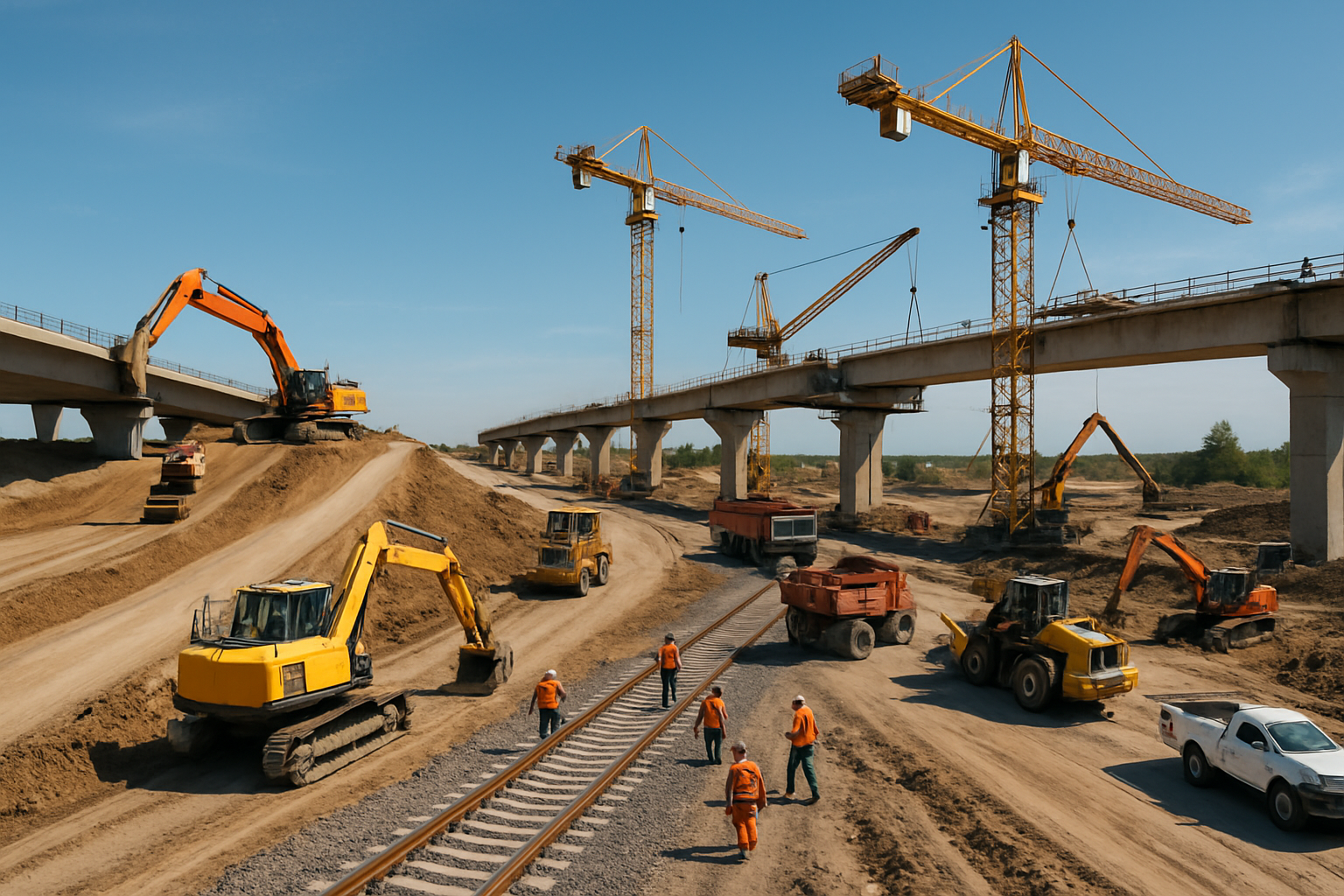
Four nations across three continents launched simultaneous infrastructure mega-projects worth billions of dollars March 12, 2026, demonstrating unprecedented global coordination in transportation and energy development as countries race to build climate-resilient systems for future economic growth.
Afghanistan announced China will construct nine strategic border facilities along the Tajikistan-Afghanistan frontier at a cost of 424.8 million Chinese yuan, covering 17,000 square meters with modern surveillance systems and engineering infrastructure. Jordan revealed a $626 million bridge project connecting Amman through a 15.8-kilometer elevated highway system. Kenya confirmed construction of a $507 billion gas-powered electricity plant at Dongo Kundu, while Vietnam fast-tracked metro extensions to Long Thanh International Airport under emergency government orders.
China's Strategic Border Infrastructure Investment
The Afghanistan-Tajikistan border facilities project, approved by Tajikistan's Majlisi Oli parliament, represents China's continued Belt and Road Initiative expansion into Central Asia. According to parliamentary bulletin Sadoi Mardum, the construction includes facilities equipped with advanced surveillance systems, communication technologies, and comprehensive engineering infrastructure designed to enhance regional border security.
First Deputy Chairman Murodali Rajabzoda confirmed the funding comes entirely from the Chinese government at no cost to Tajikistan, demonstrating Beijing's strategic commitment to Central Asian stability and connectivity. The project aligns with China's broader infrastructure diplomacy across the region, building on successful partnerships in Pakistan, Kazakhstan, and other Belt and Road participants.
Jordan's Transformational Highway Project
Jordan's Ministry of Investment announced the Amman Bridge and Alternative Roads project, spanning from Safout intersection north to Naour intersection south. The 15.8-kilometer elevated highway system represents one of the most significant infrastructure investments in the kingdom's modern history, designed to revolutionize urban transportation and reduce chronic traffic congestion in the capital region.
The elevated design incorporates modern urban planning principles, featuring multiple access points, integrated public transportation connections, and climate-adaptive engineering to withstand regional weather challenges. The project aims to enhance connectivity between Amman's districts while reducing surface-level traffic pressure on existing road networks serving over 2.1 million greater Amman residents.
Kenya's Energy Infrastructure Milestone
Kenya's $507 billion gas-powered electricity plant at Dongo Kundu marks a critical test for the country's energy sector after previous projects faced extensive delays. The facility represents Kenya's largest single energy infrastructure investment, designed to provide reliable power generation supporting the nation's industrial development goals and regional electricity export potential.
The project incorporates advanced clean energy technologies and environmental safeguards, addressing concerns about fossil fuel dependence while providing immediate grid stability. Success could establish templates for similar East African energy projects, supporting regional integration and industrial development across the continent.
Vietnam's Airport Connectivity Crisis Solution
Vietnam's government approved emergency fast-track construction for metro line extensions connecting Ho Chi Minh City to Long Thanh International Airport, addressing critical transportation bottlenecks before the mega-airport opens for commercial operations. The current three-hour journey downtown will be reduced to 30 minutes, essential for the airport's success as Southeast Asia's planned largest aviation hub.
The emergency designation allows accelerated environmental approvals and construction timelines, demonstrating government recognition that airport success depends entirely on efficient ground transportation connections. The project includes integration with existing Metro Line 1 and future city transportation networks, creating seamless connectivity for millions of passengers annually.
Global Infrastructure Renaissance Context
These simultaneous announcements continue 2026's unprecedented $570+ billion global infrastructure surge, representing fundamental recognition that modern connectivity serves as strategic foundation for economic competitiveness, climate adaptation, and international cooperation. Recent months witnessed major projects across six continents, from Vietnam's $120 billion expressway commitments to African mining railways worth billions.
Contemporary infrastructure incorporates sophisticated technology integration from design phases: real-time monitoring, predictive maintenance, digital payments, environmental optimization, and climate adaptation measures become standard requirements rather than premium additions. Projects increasingly feature renewable energy integration, weather-resistant materials, enhanced drainage systems, and backup power infrastructure designed for future climate conditions rather than historical patterns.
Technology and Climate Integration
Modern infrastructure projects demonstrate evolution from traditional construction toward integrated smart systems. Afghanistan's border facilities include advanced surveillance and communication networks. Jordan's elevated highway incorporates intelligent traffic management systems. Kenya's power plant features automated efficiency monitoring. Vietnam's metro extensions include digital passenger information and predictive maintenance capabilities.
Climate adaptation represents central design requirement, with January 2026 marking the 18th consecutive month temperatures exceeded 1.5°C above pre-industrial levels. Infrastructure must demonstrate resilience to extreme weather events, incorporating flood management, enhanced materials, and backup systems ensuring operational continuity during increasingly frequent climate disruptions.
Economic Multiplier Effects
Infrastructure development creates substantial economic multiplier effects beyond construction employment. Afghanistan's border facilities enhance regional trade security and connectivity. Jordan's highway system reduces logistics costs and improves business productivity across the capital region. Kenya's power plant supports industrial development and potential electricity exports. Vietnam's airport connectivity enables tourism growth and business development.
Regional integration benefits include support for continental free trade agreements, enhanced cross-border connectivity, shared infrastructure enabling coordinated development strategies. Projects demonstrate shift toward viewing infrastructure as strategic assets enabling international cooperation rather than simple domestic improvements.
Implementation Challenges and Success Factors
Contemporary infrastructure projects face complex implementation challenges including supply chain constraints, with global semiconductor shortages affecting control systems deployment. Environmental compliance requires comprehensive assessments and community engagement. Cross-border coordination demands sophisticated diplomatic and technical cooperation between multiple government agencies and international partners.
Success factors include sustained political commitment transcending electoral cycles, transparent governance frameworks ensuring quality control and cost management, adaptive management capabilities responding to changing conditions, and comprehensive community engagement maintaining public support throughout extended construction periods.
International Cooperation Models
The projects demonstrate diverse international cooperation approaches. China's financing of Afghanistan border facilities represents direct bilateral infrastructure diplomacy. Jordan's domestic investment shows national commitment to strategic development. Kenya's energy project combines international partnerships with domestic capacity. Vietnam's emergency approval process demonstrates governmental priority-setting for critical connectivity.
These models reflect broader trends in infrastructure financing and development, combining traditional state investment with innovative private-public partnerships, international development cooperation, and sophisticated project management approaches adapted to local conditions while meeting international standards.
Future Infrastructure Development Trends
March 2026 infrastructure announcements establish precedents influencing global development strategies for decades ahead. Successful projects demonstrate coordination between technological advancement, environmental protection, economic development, and social connectivity. Integration of smart technology, climate resilience, and international cooperation becomes standard rather than optional.
The convergence of immediate development needs with long-term sustainability requirements creates new infrastructure paradigms emphasizing adaptive capacity, operational efficiency, and comprehensive regional integration. Countries implementing successful infrastructure strategies position themselves advantageously for sustained economic growth and international competitiveness.
Contemporary infrastructure development represents fundamental shift from reactive crisis management toward proactive system building, creating physical foundations for sustainable prosperity in an interconnected, climate-challenged world. Success depends on continued international cooperation, technological innovation, and strategic planning serving both immediate community needs and long-term global integration requirements.