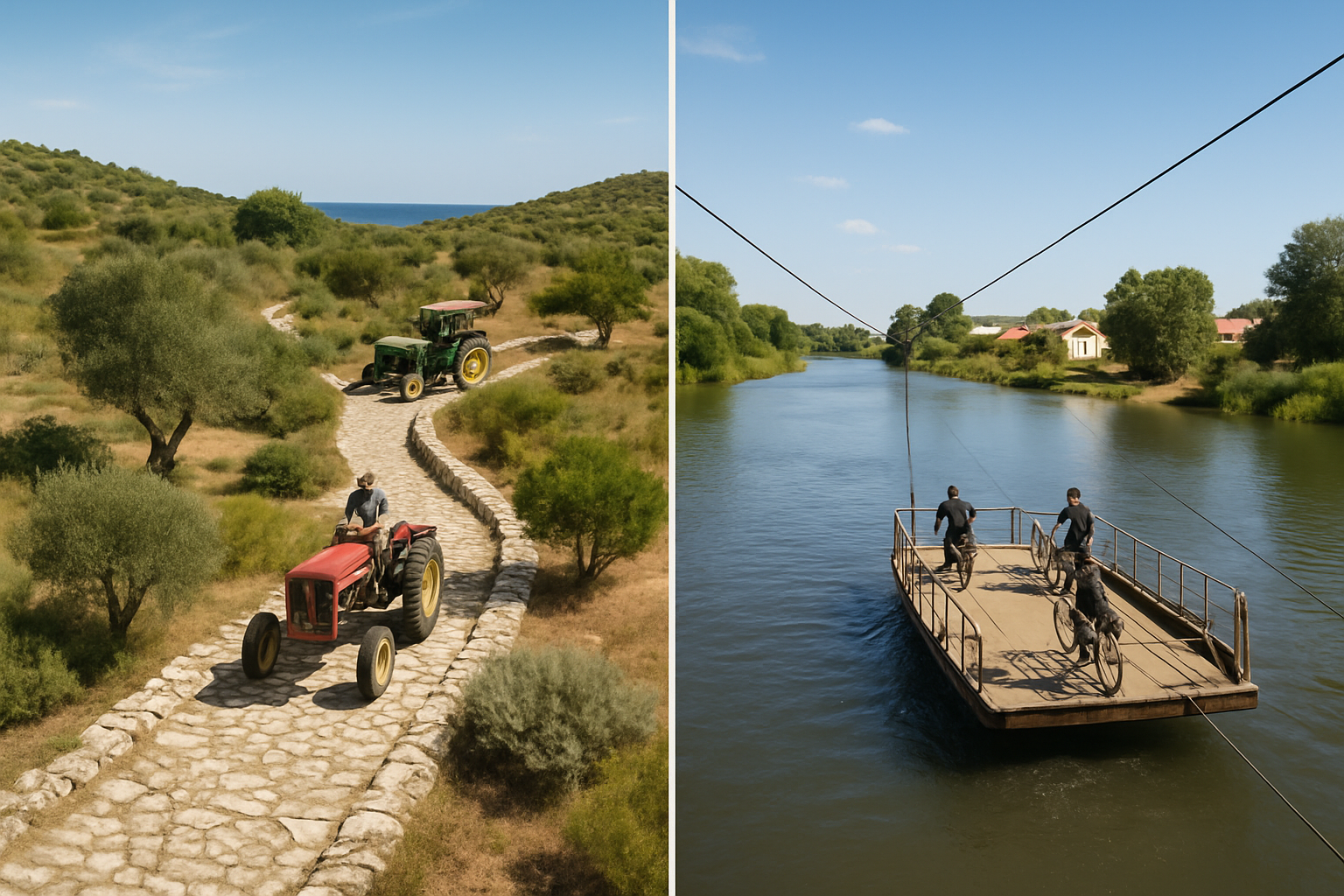
As global transportation faces mounting pressure to decarbonize while maintaining connectivity, innovative solutions are emerging from unexpected corners of the world. From Croatia's car-free island where tractors reign supreme to Colombia's ingenious motorless ferry system, these groundbreaking approaches offer sustainable alternatives to conventional transport infrastructure.
These developments come at a critical juncture for global transportation. With unprecedented infrastructure investment reaching $570+ billion worldwide and climate pressures intensifying through 21 consecutive months of temperatures exceeding 1.5°C above pre-industrial levels, communities worldwide are rethinking fundamental assumptions about mobility and connectivity.
Croatia's Tractor Paradise: Zlarin Island's Car-Free Vision
On the crystalline waters of the Adriatic Sea lies Zlarin, a remarkable Croatian island in Dalmatia that has achieved something increasingly rare in our motorized world: complete automotive freedom. This Mediterranean gem operates under a comprehensive vehicle ban, where life literally moves at a different pace and the humble tractor has become the primary mode of transport.
The island's unique transportation philosophy creates an environment where "life moves at a slower pace, the sun shines almost constantly," according to local tourism reports. This isn't merely an environmental statement but a functioning alternative transportation ecosystem that has operated successfully for years.
"There is something better than spending summer on an island: spending summer on an island where cars are totally banned."
— Putni Kofer/Lana Mindoljevic
The Croatian coast boasts numerous islands, some world-renowned for their beauty, others untouched by human development. Zlarin stands unique as a place specifically designed to "free visitors from the stress of driving, smog and exhaust fumes." The island represents a fascinating experiment in sustainable tourism and community planning.
Tractors on Zlarin serve multiple functions beyond transportation. They handle cargo delivery, emergency services, agricultural work, and passenger transport across the island's stone-paved paths. This practical solution addresses genuine transportation needs while maintaining environmental integrity and creating a distinctive visitor experience.
Colombia's Engineering Marvel: The Motorless Caramanta Ferry
Thousands of miles away in Colombia's Valle del Cauca region, another revolutionary transportation solution addresses community connectivity challenges through pure engineering ingenuity. The Barcaza Caramanta represents a "free and motorless" river transportation system that connects three municipalities across the Cauca River.
This innovative ferry solution reduces travel times by a full hour compared to previous crossing methods, significantly benefiting regional mobility and economic activity. The system operates without traditional motors, instead utilizing the river's natural flow and sophisticated cable mechanisms to provide reliable transportation across the waterway.
The Colombian innovation addresses a fundamental challenge in developing regions: providing essential transportation infrastructure with minimal environmental impact and operational costs. The motorless design eliminates fuel requirements, reduces maintenance complexity, and creates a sustainable transportation solution that communities can operate independently.
According to reports, the ferry system specifically benefits "the mobility and economy of the zone," demonstrating how innovative transportation solutions can simultaneously address connectivity needs and economic development objectives.
Global Context: Transportation Innovation Renaissance
These initiatives emerge within a broader global transportation revolution characterized by technological advancement, environmental awareness, and innovative financing approaches. Recent developments worldwide illustrate this transformation:
- Estonia's Tallinn achieved 99.25% EU funding absorption rate for sustainable transport, the highest among member states
- Philippines launched Bus Rapid Transit systems providing free rides during peak hours
- Flying car developers secured $200 million in funding, approaching commercial viability
- Vietnam plans $120 billion in expressway development through 2050
- Paraguay began construction of the longest viaduct in its national history
The convergence of ground-level innovations like car-free islands with aerial mobility development suggests future integrated transportation ecosystems serving diverse urban and rural mobility needs. Technology integration has become standard, incorporating real-time monitoring, digital payments, and environmental optimization from the design phase.
Environmental and Economic Impact
Both Croatian and Colombian solutions demonstrate how transportation innovation can address multiple challenges simultaneously. Zlarin's car-free model supports sustainable tourism while preserving Mediterranean ecosystem integrity. The revenue from visitors seeking authentic, environmentally conscious experiences supports local economic development without compromising environmental values.
Colombia's motorless ferry creates substantial economic multiplier effects. Beyond immediate transportation benefits, the system reduces logistics costs, enhances market access between communities, and enables more efficient movement of goods and people across the region. The hour reduction in crossing time translates to significant productivity gains for local businesses and residents.
These innovations also address climate adaptation requirements. As extreme weather events increase globally, transportation systems must become more resilient and less dependent on fossil fuels. Car-free islands eliminate emissions entirely from ground transport, while motorless ferry systems provide climate-resilient connectivity that doesn't depend on fuel supply chains.
Technology Meets Tradition
Both solutions exemplify successful integration of traditional knowledge with innovative engineering. Zlarin's tractor-based system builds on Mediterranean agricultural traditions while creating a modern transportation network. The island's stone paths, designed for pedestrian and agricultural use, perfectly accommodate tractor traffic while preserving historical character.
Colombia's ferry system demonstrates sophisticated engineering that respects local geographic conditions and community needs. The cable-and-current system likely incorporates knowledge of river patterns developed over generations, enhanced by modern engineering to create reliable, safe transportation infrastructure.
This synthesis of traditional wisdom with contemporary innovation appears repeatedly in successful transportation projects worldwide. From Estonia's integration of renewable energy with public transit to Paraguay's multi-level transport systems combining heritage preservation with modernization, the most effective solutions respect existing community structures while introducing sustainable technologies.
Scaling Innovation: Lessons for Global Implementation
The success factors emerging from these diverse transportation innovations provide templates for global implementation. Community ownership appears critical – both Zlarin's car-free model and Colombia's ferry system emerged from local needs and enjoy strong community support.
Economic viability proves equally important. Zlarin generates tourism revenue that supports the car-free infrastructure, while Colombia's ferry reduces transportation costs that benefit the entire regional economy. Successful transportation innovation must address genuine economic needs rather than imposing theoretical solutions.
Environmental sustainability provides both constraint and opportunity. Transportation solutions that reduce emissions while improving connectivity create competitive advantages in an increasingly climate-conscious world. Croatia's tourism success with car-free islands and Colombia's fuel-free ferry system demonstrate market demand for sustainable transportation alternatives.
Challenges and Implementation Considerations
Despite their success, these innovative solutions face ongoing challenges that offer lessons for broader implementation. Seasonal variations affect island accessibility and ferry operations, requiring robust planning and backup systems. Integration with existing transportation networks demands careful coordination to ensure seamless connectivity.
Regulatory frameworks often lag behind transportation innovation, requiring adaptive governance approaches that can accommodate novel solutions while ensuring safety and reliability. Croatia's car-free island operates within specific regulatory permissions that might not easily transfer to other contexts.
Technology transfer remains challenging when solutions depend on specific geographic or cultural conditions. Colombia's river ferry system requires particular hydrological conditions, while car-free islands need specific economic foundations typically related to tourism or agriculture.
Future Implications: Integrated Transportation Ecosystems
These innovations suggest future transportation systems might integrate multiple modal solutions addressing different community needs and geographic constraints. Car-free zones could become standard in environmentally sensitive areas, while motorless ferry systems might expand to serve isolated communities worldwide.
The convergence of sustainable transportation innovation with digital integration offers additional possibilities. Smart scheduling systems could coordinate tractor services on car-free islands, while GPS tracking could optimize ferry operations across multiple river crossings.
International cooperation frameworks are evolving to support such innovation transfer. The African Continental Free Trade Area enables cross-border transportation projects, European Union funding prioritizes sustainable mobility, and South-South cooperation facilitates knowledge sharing between developing nations pioneering transportation solutions.
A Sustainable Transportation Future
Croatia's car-free Zlarin Island and Colombia's ingenious Caramanta ferry represent more than isolated transportation curiosities. They demonstrate practical pathways toward sustainable mobility that address environmental concerns while improving community connectivity and economic opportunities.
As global transportation infrastructure investment reaches unprecedented levels, these innovations provide proven models for sustainable development. They show how communities can maintain essential connectivity while reducing environmental impact, supporting local economies, and preserving cultural character.
The success of these diverse solutions – from Mediterranean island tractors to Andean river ferries – illustrates the importance of locally-adapted innovation in addressing global transportation challenges. Their experiences offer valuable lessons for communities worldwide seeking sustainable transportation alternatives that serve genuine needs while building climate resilience.
As the world confronts mounting climate pressures and transportation transformation requirements, these pioneering initiatives demonstrate that innovative solutions often emerge from the intersection of community needs, environmental constraints, and creative engineering. They point toward a transportation future where sustainability and connectivity advance together, creating more resilient and livable communities worldwide.