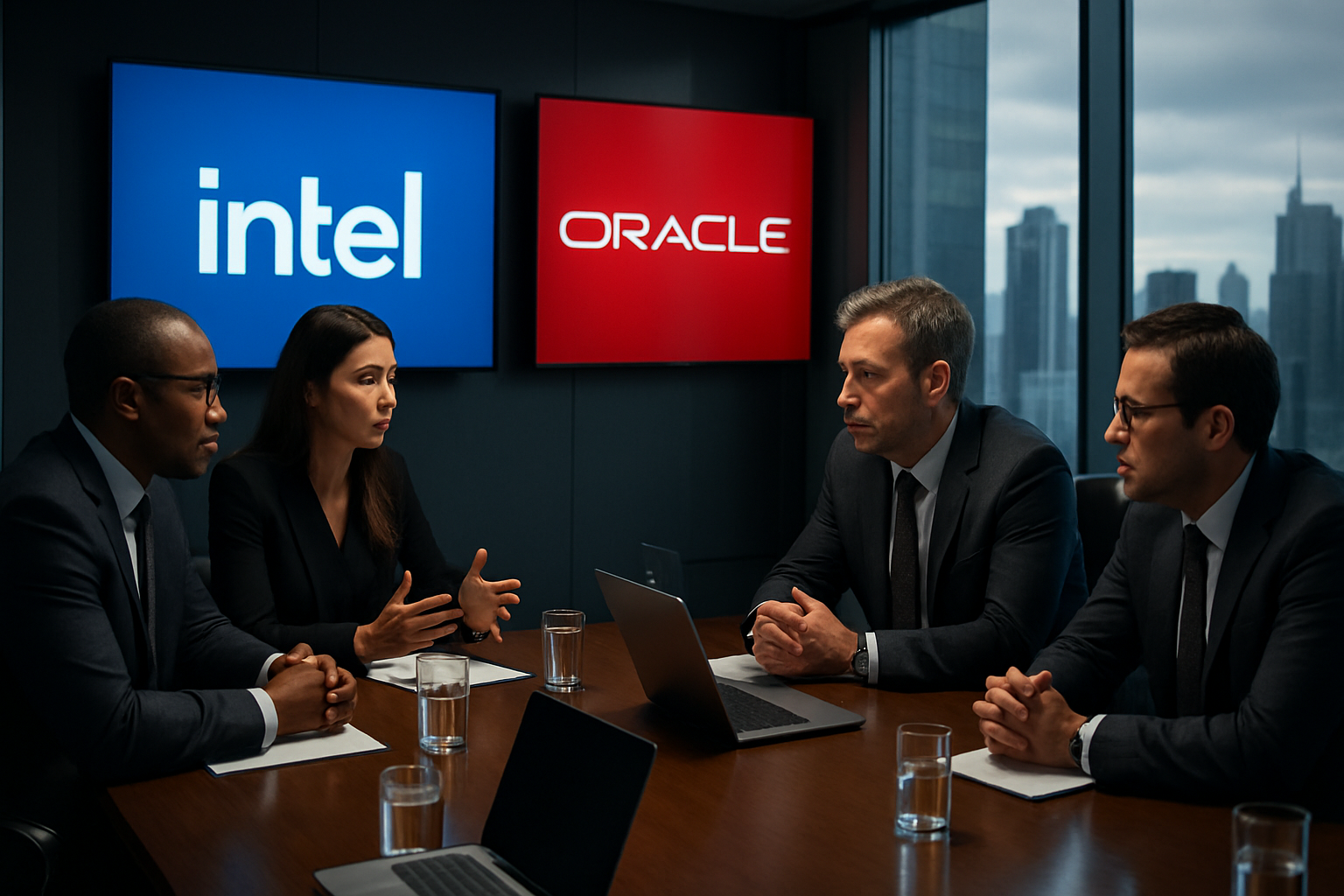
Intel Corporation is moving to buy back Apollo Global Management's stake in its critical Leixlip semiconductor plant in Ireland, while Oracle Corporation nears completion of $16 billion financing for data center expansion through Related Digital, marking significant strategic repositioning in the technology industry during a period of unprecedented infrastructure demands.
The developments come as the technology sector grapples with a global semiconductor crisis that has driven memory chip prices sixfold higher, affecting major manufacturers Samsung, SK Hynix, and Micron until new fabrication facilities come online in 2027. These moves reflect broader strategic shifts as companies navigate AI infrastructure demands, regulatory pressures, and workforce transformation challenges.
Intel's Strategic Reclamation
Intel's decision to reacquire Apollo's stake in the Leixlip facility represents a significant strategic pivot. Apollo Global Management had paid $11.2 billion in 2024 to acquire its position in the joint venture for the plant located in County Kildare, Ireland. The facility has been central to Intel's European semiconductor manufacturing operations and plays a crucial role in the company's global supply chain strategy.
The buyback occurs during what industry analysts are calling the "March 2026 Critical Inflection Point," where artificial intelligence transitions from experimental technology to essential business infrastructure across all sectors. With global memory demand exceeding manufacturing capacity, control over semiconductor production facilities has become strategically vital for technology companies.
Industry sources suggest the reclamation reflects Intel's recognition that semiconductor manufacturing assets are too critical to strategic operations to share control with financial partners, particularly during the current supply crisis. The Leixlip plant's advanced fabrication capabilities make it essential for Intel's competitive positioning in AI chip manufacturing and next-generation processor development.
Oracle's Data Center Expansion
Simultaneously, Oracle Corporation is nearing completion of a massive $16 billion financing arrangement through Related Digital for data center expansion, according to sources familiar with the negotiations. This represents one of the largest infrastructure financing deals in the technology sector's history, reflecting the extraordinary capital requirements for modern AI-capable data center facilities.
The financing comes as the World Bank projects AI infrastructure will require 4.2-6.6 billion cubic meters of water annually by 2027 for data center cooling alone—equivalent to four to six times Denmark's total annual water consumption. This massive resource requirement is driving companies to secure unprecedented financing for sustainable data center infrastructure that can meet environmental standards while supporting AI workloads.
Oracle's expansion strategy aligns with broader industry trends where major technology companies are investing unprecedented sums in AI infrastructure. Alphabet has committed $185 billion to AI infrastructure in 2026—the largest single-year corporate technology investment in history—while Amazon's AI development plans exceed $1 trillion over the coming decade.
Workforce Displacement Challenges
The strategic business moves occur against a backdrop of significant workforce transformation challenges within Oracle and across the technology industry. Recent reports from Greece indicate Oracle employees received termination notices early in the morning via email, part of what the company characterized as careful examination of current business needs and position elimination as part of organizational restructuring.
This reflects broader employment transformation patterns affecting the technology sector, where companies are implementing what analysts term the "SaaSpocalypse"—the systematic elimination of hundreds of billions in traditional software market capitalization as AI systems demonstrate direct replacement capabilities for conventional solutions.
Microsoft's Mustafa Suleyman has predicted AI will replace the majority of office workers within two years, with lawyers and auditors facing replacement within 18 months. However, regional variations are emerging, with Asian companies implementing comprehensive worker transition programs emphasizing reskilling over displacement, while Western companies more frequently pursue traditional layoff strategies.
Global Infrastructure Crisis Context
Both Intel's and Oracle's strategic moves must be understood within the context of the current global infrastructure crisis affecting the technology sector. Memory semiconductor prices have surged sixfold, with Samsung, SK Hynix, and Micron operating at full capacity but unable to meet explosive AI demand from companies like Nvidia, Microsoft, Google, and OpenAI.
Consumer electronics costs have increased 20-30% over the past year, with supply shortages expected to persist until 2027 when new fabrication facilities come online. This constraint environment is paradoxically spurring innovation in memory-efficient algorithms, sustainable deployment strategies, and alternative computing architectures that maximize AI capabilities while minimizing hardware requirements.
The infrastructure crisis has also intensified competition for existing manufacturing capacity and data center resources, making control over these assets strategically crucial for major technology companies. Intel's buyback of the Irish facility and Oracle's massive data center financing both reflect this competitive dynamic.
Regulatory and Geopolitical Considerations
The business moves occur during a period of intensifying regulatory scrutiny globally. Spain has implemented the world's first criminal executive liability framework for technology platforms, creating personal imprisonment risks for executives. France has conducted cybercrime raids on AI companies, while the European Union is investigating potential billions in penalties for Digital Services Act violations.
The United Nations has established an Independent Scientific Panel of 40 experts under Secretary-General António Guterres as the first fully independent global AI assessment body, representing the most sophisticated global technology governance framework since internet commercialization.
This regulatory intensification is creating competitive advantages for companies that build compliance capabilities from the design phase versus those attempting to retrofit safety measures. European companies, in particular, are positioning themselves to benefit from regulatory frameworks that emphasize transparency, accountability, and user protection.
Market Transformation Impact
The strategic decisions by Intel and Oracle reflect broader market transformation patterns affecting the entire technology sector. The emergence of what analysts call "SaaSpocalypse" has eliminated hundreds of billions in market capitalization from traditional software companies as AI systems demonstrate capability to directly replace rather than merely complement conventional software functions.
German analysts have described an "apocalypse for software houses" with 20% stock declines across traditional providers. Indian IT giants including Infosys, Wipro, and HCL Technologies have experienced significant declines as core business services face AI competition, though these companies are adapting through worker transition programs rather than mass layoffs.
The transformation represents more than cyclical industry change—it constitutes a fundamental shift in how technology infrastructure operates and how companies must position themselves for sustained competitiveness in an AI-integrated economy.
Success Models and Future Outlook
Despite the challenges, several organizations are demonstrating successful human-AI collaboration models that enhance rather than replace fundamental capabilities. Canadian universities have implemented AI teaching assistants that maintain critical thinking standards, Malaysia operates the world's first AI-integrated Islamic school combining technology with traditional learning, and Singapore's WonderBot 2.0 demonstrates successful heritage education AI applications.
These success models share common characteristics: treating AI as sophisticated amplification tools rather than replacement mechanisms, maintaining sustained commitment to human development, ensuring comprehensive stakeholder engagement, and demonstrating cultural sensitivity in implementation approaches.
For Intel and Oracle, success will depend on their ability to navigate the complex landscape of infrastructure constraints, regulatory compliance, competitive pressures, and workforce transformation while maintaining operational excellence and strategic flexibility.
Strategic Implications
March 2026 represents what industry experts characterize as a "civilizational choice point" determining whether AI serves human flourishing and democratic values versus becoming an exploitation tool beyond democratic accountability. The decisions made by major technology companies like Intel and Oracle during this period will establish patterns affecting billions globally for decades.
Success requires unprecedented coordination between governments, technology companies, educational institutions, and civil society to balance innovation acceleration with safety governance, commercial interests with human welfare, and national competitiveness with international cooperation.
The Intel buyback and Oracle financing represent critical tests of whether major technology companies can successfully navigate the transition from experimental AI to essential business infrastructure while preserving human agency, democratic governance, and sustainable business models that prioritize long-term value over short-term speculation.
As the window for proactive adaptation narrows, these strategic moves signal that 2026 decisions will determine the trajectory of human-AI relationships for the remainder of the 21st century, making them among the most consequential business decisions in modern corporate history.