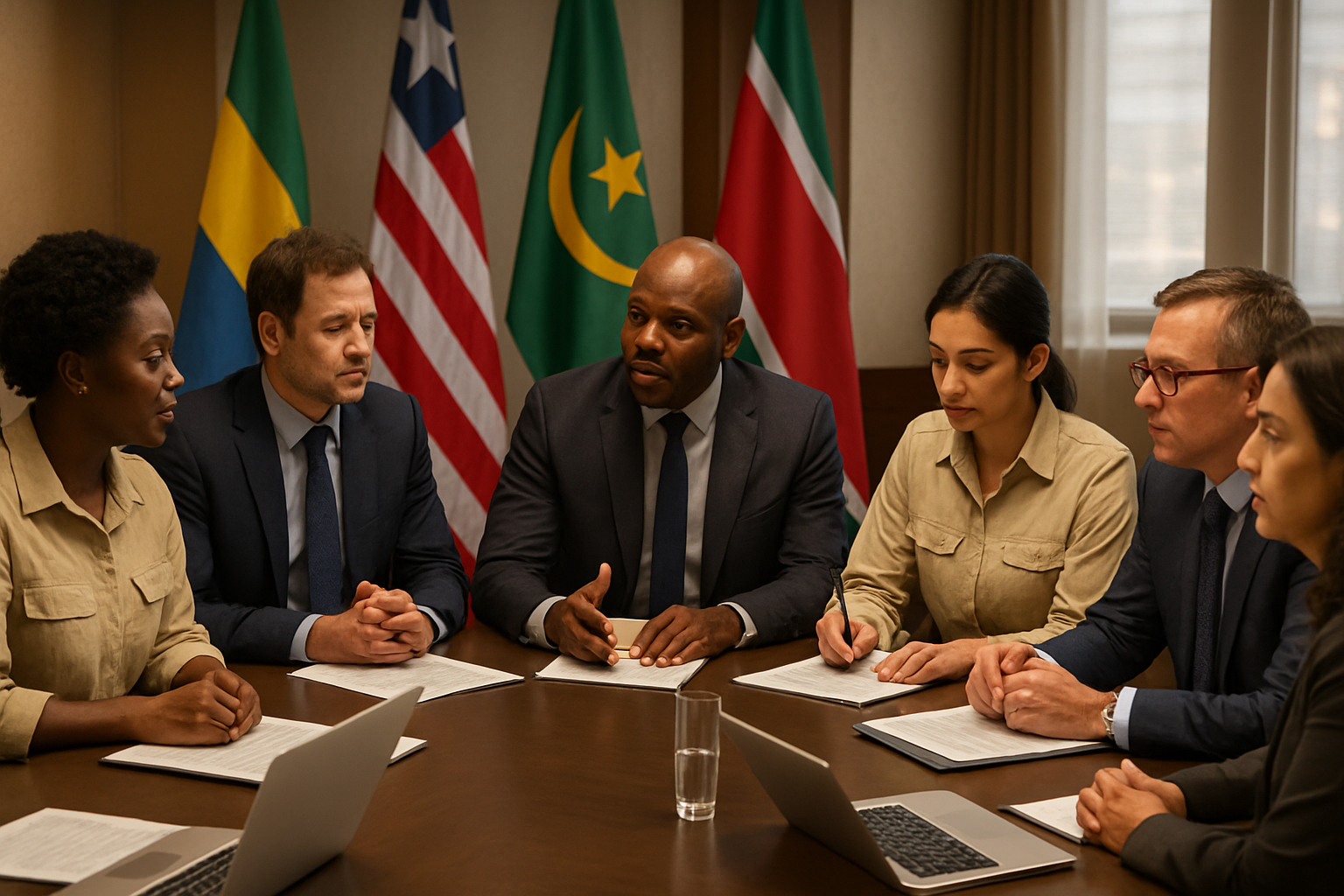
A series of significant international aid and development initiatives across four continents this week demonstrates the evolving nature of global cooperation, as traditional donor-recipient relationships give way to more sophisticated partnership models emphasizing mutual benefit and strategic alignment.
From Gabon's high-level mission to attract American investment to Trinidad and Tobago's enhanced disaster preparedness capabilities, the developments signal a maturation in international development cooperation that prioritizes long-term strategic outcomes over conventional aid approaches.
Gabon Pursues Strategic American Investment
Gabon has dispatched three senior ministers to Washington D.C. this week in an ambitious effort to attract American capital investment, according to sources from Gabonreview.com. The mission represents a proactive approach to economic development, with Gabonese officials seeking to leverage their nation's strategic position in Central Africa and natural resource endowments to build lasting economic partnerships with the United States.
The ministerial delegation's presence in the American capital underscores Gabon's commitment to diversifying its international partnerships beyond traditional francophone connections. This initiative aligns with broader trends across Africa, where nations are increasingly positioning themselves as strategic partners rather than aid recipients in international development cooperation.
Liberia-Japan Partnership Delivers Critical Infrastructure Investment
In a landmark development, the Government of Liberia has formalized a grant agreement worth ¥2.45 billion Japanese Yen (approximately US$16 million) with Japan to rehabilitate critical transportation infrastructure linking the Freeport of Monrovia to central sections of the capital. The agreement represents a significant milestone in addressing longstanding infrastructure challenges that have hampered economic development in Liberia's commercial center.
The project specifically targets the rehabilitation of the critical roadway connecting the Freeport of Monrovia to Gabriel Tucker Bridge Corridor, addressing a vital transportation link that supports both commercial activity and daily civilian movement. The infrastructure upgrade is expected to dramatically improve transport efficiency while demonstrating Japan's continued commitment to supporting Liberia's post-conflict development trajectory.
"This infrastructure investment represents more than road construction—it's about rebuilding the economic foundations that will enable sustainable growth and improved quality of life for Liberian citizens."
— Liberian Development Official
The Japan-Liberia partnership exemplifies successful bilateral cooperation that addresses immediate infrastructure needs while building institutional capacity for long-term development sustainability. The agreement reflects Japan's sophisticated approach to development assistance, combining financial resources with technical expertise and emphasis on local ownership.
Mauritania Secures Massive Development Finance Package
Mauritania has achieved a significant diplomatic and economic breakthrough with the signing of a framework partnership agreement worth up to $900 million with the Islamic Development Bank's International Islamic Trade Finance Corporation. Minister of Economic Affairs and Development Abdullah Ould Suleiman Ould Sheikh Sidia formalized the agreement during meetings in Jeddah, establishing a comprehensive three-year development framework covering 2026-2028.
The ambitious financial package targets strategic development projects, with particular emphasis on the transformative "Atoumay" mining and steel project in Tiris Zemmour province. The initiative encompasses development of iron ore mining operations, mineral enrichment facilities, and the construction of iron pellet manufacturing plants, alongside critical energy and water desalination infrastructure in the port city of Nouadhibou.
The scale and scope of the agreement demonstrate Mauritania's growing attractiveness as an investment destination and the Islamic Development Bank's confidence in the country's development trajectory. The project is expected to position Mauritania as a significant player in global steel and mining markets while creating thousands of jobs and establishing critical industrial infrastructure.
US-Trinidad Partnership Strengthens Caribbean Disaster Resilience
The United States Government has expanded its cooperation with Trinidad and Tobago through a comprehensive disaster preparedness initiative that provides training and equipment to strengthen the Trinidad and Tobago Emergency Management Agency (TEMA) disaster relief warehouse operations. The support, delivered through the United States Embassy in Port of Spain and United States Southern Command, represents a significant enhancement of Caribbean disaster response capabilities.
This latest initiative builds upon a successful foundation established in 2016, when the United States constructed a disaster relief warehouse for TEMA through the Humanitarian Assistance Programme of US Southern Command. The continued partnership demonstrates the evolution from emergency response to systematic capacity building, reflecting lessons learned from recent Caribbean hurricane seasons and the need for enhanced regional preparedness.
The US-Trinidad cooperation model exemplifies effective humanitarian partnership that combines immediate operational support with long-term institutional strengthening. The initiative recognizes that effective disaster response requires sustained investment in local capabilities rather than solely external emergency assistance.
Evolution of International Development Cooperation
These four diverse partnerships reflect broader transformations in international development cooperation that have emerged prominently throughout 2026. The shift away from traditional donor-recipient relationships toward strategic partnerships represents a maturation in global cooperation frameworks that recognizes the mutual benefits of well-designed development initiatives.
Historical context from previous development cooperation initiatives reveals that successful partnerships increasingly emphasize technology transfer, institutional capacity building, and sustainable financing mechanisms over simple resource transfers. The success of South-South cooperation models, including recent China-Africa tariff agreements and India-Canada nuclear cooperation frameworks, has influenced the evolution toward more sophisticated partnership arrangements.
Strategic Benefits of Modern Aid Partnerships
Contemporary development cooperation initiatives demonstrate several key advantages over traditional aid models. First, they create sustainable economic relationships that benefit all parties rather than creating dependency dynamics. Second, they address strategic priorities for both partners, ensuring sustained political commitment beyond electoral cycles. Third, they incorporate technology transfer and capacity building that creates lasting development benefits.
The partnerships also reflect geographic and economic diversification strategies. Gabon's American outreach, Mauritania's Islamic Development Bank agreement, and Liberia's Japanese partnership all represent efforts to diversify international relationships and reduce dependence on single donors or traditional colonial relationships.
Climate and Security Considerations
The timing of these initiatives gains additional significance against the backdrop of accelerating climate change, with January 2026 marking the 18th consecutive month of global temperatures exceeding 1.5°C above pre-industrial levels. This environmental context makes infrastructure resilience, disaster preparedness, and sustainable development approaches increasingly critical for international cooperation effectiveness.
The Trinidad-US disaster preparedness partnership directly addresses climate vulnerability, while infrastructure projects in Liberia and Mauritania incorporate climate adaptation principles in their design and implementation. These considerations reflect the integration of environmental resilience into development planning that has become standard practice for contemporary international cooperation initiatives.
Economic Multiplier Effects and Regional Integration
The economic implications of these partnerships extend well beyond their immediate scope. Mauritania's mining and steel development initiative creates potential for regional value chains and cross-border economic integration. Liberia's infrastructure upgrade supports both domestic commerce and regional trade connectivity. Gabon's investment attraction efforts position the nation as a platform for broader Central African economic development.
These multiplier effects align with broader regional integration initiatives, including the African Continental Free Trade Area (AfCFTA), which has created frameworks for enhanced intra-African trade and development cooperation. The partnerships demonstrate how bilateral cooperation can support broader regional integration objectives while addressing specific national development priorities.
Implementation Challenges and Success Factors
Despite their promising scope, these partnerships face implementation challenges common to complex international development initiatives. Success requires sustained political commitment across electoral cycles, effective project management spanning multiple institutions, and adaptive management capabilities to address unexpected challenges during implementation phases.
Historical analysis of similar initiatives reveals that success factors include transparent governance frameworks, clear performance metrics, regular stakeholder consultation, and robust monitoring and evaluation systems. The partnerships also require coordination between multiple government agencies, private sector actors, and civil society organizations to achieve their ambitious objectives.
The diversity of partnership models—from grant agreements to investment frameworks to capacity building initiatives—reflects the recognition that different development challenges require tailored approaches rather than standardized solutions.
Broader Implications for Global Development Architecture
The March 2026 development initiatives occur within a broader transformation of global development cooperation that has accelerated throughout the current year. The success of innovative partnership models, including the unprecedented China-Africa tariff elimination framework and expanded bilateral cooperation agreements across multiple continents, has demonstrated the potential for development cooperation that transcends traditional aid paradigms.
These partnerships also reflect the growing capacity of developing nations to engage as equal partners in international cooperation rather than passive recipients of external assistance. The sophistication of Mauritania's development planning, Gabon's investment strategy, and Trinidad's disaster preparedness coordination demonstrates institutional capabilities that enable genuine partnership relationships.
"The evolution of international development cooperation toward strategic partnerships represents one of the most significant changes in global governance since the end of the Cold War."
— International Development Expert
Future Trajectories and Strategic Significance
The success or failure of these partnerships will significantly influence the trajectory of international development cooperation for years to come. They serve as test cases for whether strategic partnership models can deliver superior development outcomes compared to traditional aid approaches while maintaining the mutual benefit characteristics that ensure sustained political support.
The initiatives also contribute to broader questions about global governance and international cooperation in an increasingly multipolar world. The ability of diverse nations to forge effective bilateral and multilateral partnerships may determine the international community's capacity to address complex challenges including climate change, economic inequality, and regional security threats.
As March 2026 unfolds, these four development partnerships represent more than individual cooperation agreements—they exemplify the potential for international relations based on mutual respect, shared benefits, and strategic alignment rather than traditional power dynamics and dependency relationships. Their success could establish templates for global development cooperation that serves both national interests and collective human development objectives in the decades ahead.