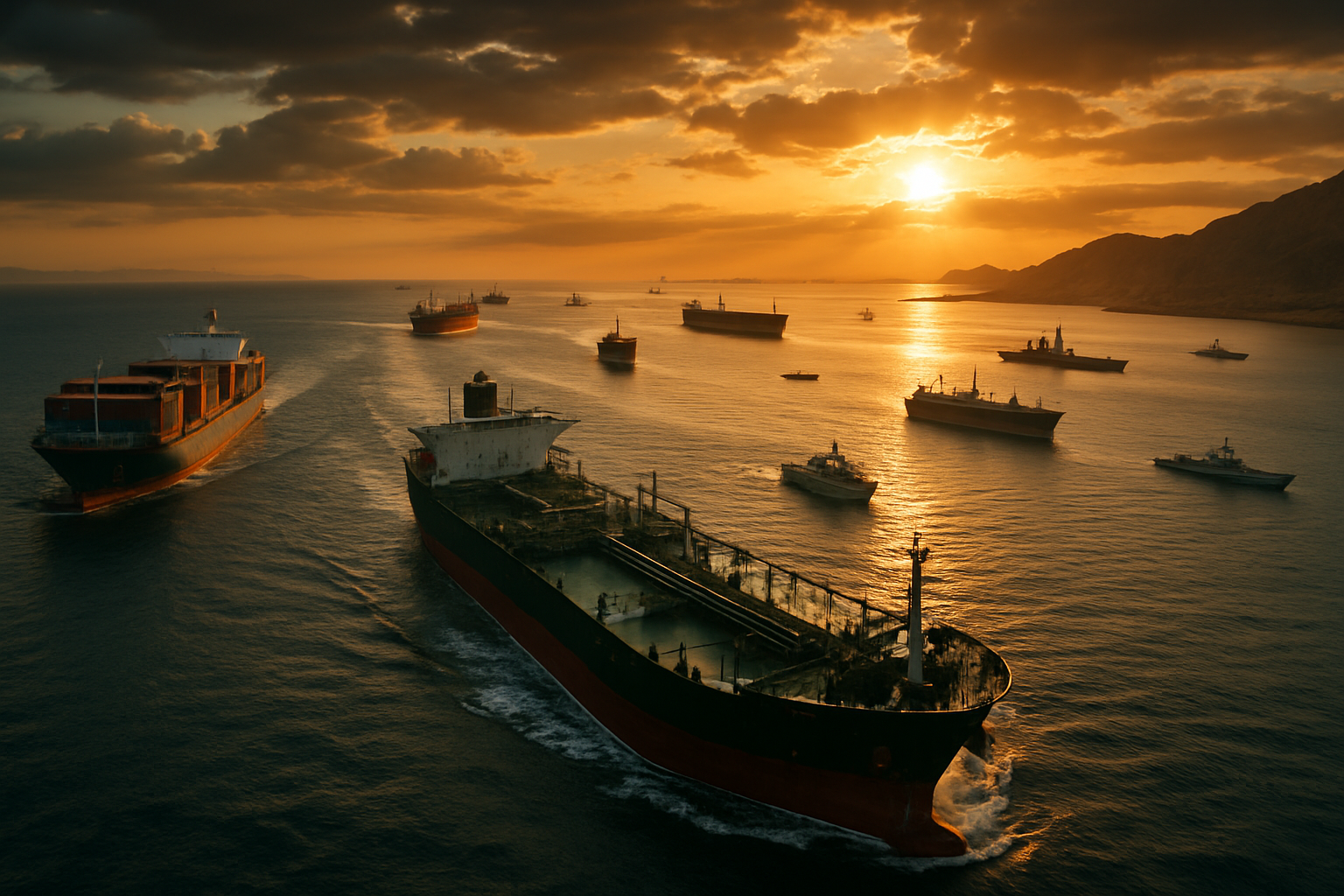
An unprecedented international coalition is mobilizing to address the ongoing Strait of Hormuz energy crisis, as Iran's Revolutionary Guard maintains control over the strategic waterway that handles 40% of global seaborne oil transit, triggering the most severe energy disruption since the 1970s oil shocks.
The crisis has reached critical proportions following Italy's Prime Minister Giorgia Meloni's declaration that there would be "no military mission to force the Hormuz blockade," while simultaneously working to build international consensus for securing the vital shipping route through diplomatic means. Speaking at a European summit in Brussels, Meloni emphasized the need for "eventual contribution to security in a post-conflict phase."
European Coalition Takes Shape
European Union leaders meeting in Brussels have announced plans for a multinational mission to secure safe passage through the strait. According to reports from La Repubblica, the coalition would include Italy, France, Germany, Netherlands, Canada, and Japan, representing the most significant international maritime cooperation effort in decades.
"The plan involves seven countries to liberate the Strait of Hormuz, but the war must end immediately," French officials stated, emphasizing that while military intervention remains possible, the primary focus is on achieving a ceasefire and returning to diplomatic solutions.
The European response has taken on unprecedented urgency following Iranian attacks on energy infrastructure across the Gulf region. European Commission President Ursula von der Leyen condemned Iranian attacks on Qatar's energy infrastructure, warning of "future risks" for European Union energy supplies and acknowledging that Europe is "not immune" to escalating prices.
Oil Markets in Historic Turmoil
Global oil prices have breached $100 per barrel for the first time since 2022, with Brent crude peaking at $119.50 and West Texas Intermediate recording an unprecedented 18.98% single-day jump to $108.15. The International Energy Agency has announced the largest strategic petroleum reserve release in its 50-year history, deploying 400 million barrels from 32 countries—more than double the response to the 2022 Ukraine crisis.
Japan is releasing 80 million barrels from its strategic reserves, marking the first such deployment since the 2011 Fukushima disaster. This action underscores Japan's extreme vulnerability, with 95% of its oil imports originating from the Middle East and 70% transiting through the now-blocked Hormuz Strait.
"Oil could hit $200 per barrel if the situation continues to deteriorate."
— Israeli Prime Minister Benjamin Netanyahu
The crisis has prompted Qatar Energy Minister Saad Al Kaabi to warn that Gulf states may be forced to declare force majeure "within weeks," with oil prices approaching $150 per barrel threatening to "bring down the economies of the world."
Global Supply Chain Disruption
The impact extends far beyond oil markets. Major shipping companies Maersk and MSC have suspended all Persian Gulf operations, leaving over 150 oil and LNG tankers stranded in the region representing billions in cargo value. Iran has deployed an estimated 2,000-6,000 naval mines throughout the 21-mile chokepoint, effectively making the waterway impassable despite U.S. forces destroying 28 Iranian mine-laying vessels.
The aviation industry faces parallel disruption, with over 18,000 flights cancelled worldwide—the most extensive since the COVID-19 pandemic. Eight Middle Eastern countries maintain simultaneous airspace closures, while Dubai International Airport, the world's busiest with 86 million passengers annually, remains shut down following missile damage.
Financial markets have responded with panic. Pakistan's KSE-100 index suffered its largest single-day decline in history at -8.97%, while South Korea's KOSPI fell 12% triggering circuit breakers. The Korean won has hit a 17-year low as foreign capital flees the region.
Diplomatic Efforts and Alternative Solutions
According to Swedish media reports, the International Maritime Organization may initiate talks with Iran within the coming week to negotiate reopening the strait. IMO Chairman Victor Jimenez Fernandez confirmed to the BBC that discussions are being planned, representing a potential diplomatic avenue amid the military tensions.
Alternative routing proposals have emerged, with Israeli Prime Minister Benjamin Netanyahu suggesting replacing Strait of Hormuz transit with pipelines through Israel. "This transformation of logistics could happen because of the hostilities in the region," Netanyahu noted, proposing Israel as a strategic bypass for Middle Eastern energy exports.
Consumer Impact Worldwide
The crisis has triggered immediate consumer price increases globally. European natural gas prices have surged 24% to €47.32/MWh, the highest level since February 2025, while U.S. natural gas has jumped 78%. Qatar's halt of LNG production at its Ras Laffan and Mesaid facilities—representing approximately 20% of global exports—has intensified supply shortages.
Consumer fuel prices are rising across multiple continents. Swedish authorities predict electricity increases of 10-20 öre and gasoline price rises of 1-2 kronor, with the Malmö region most exposed due to continental European market integration. Ireland faces heating oil prices approaching €2 per liter, while Pakistan has implemented wartime austerity measures including four-day government work weeks.
Bangladesh has initiated fuel rationing for 170 million people, while Bosnia-Herzegovina maintains only two days of gas reserves. The crisis demonstrates the global interconnectedness of energy markets and the vulnerability of supply chains to geopolitical disruptions.
Nuclear Diplomacy Breakdown
The current crisis stems from the complete collapse of U.S.-Iran nuclear negotiations despite achieving a "broad agreement on guiding principles" breakthrough—the most significant progress since the JCPOA's collapse in 2018. The fundamental disagreement centered on scope: Iran excluded ballistic missiles and regional proxies as "red lines" while demanding nuclear-only talks, versus U.S. insistence on comprehensive agreements addressing missiles, armed groups, and human rights.
This diplomatic breakdown led to Operation Epic Fury, the largest U.S.-Israeli coordinated military operation since 2003, which prompted Iran's massive retaliation known as "Operation True Promise 4." The crisis occurs amid broader nuclear governance challenges, with the New START treaty having expired in February 2026—the first time in over 50 years without U.S.-Russia nuclear constraints.
Regional Coalition Under Strain
The unprecedented Saudi-UAE-Qatar-Egypt diplomatic consensus supporting peaceful resolution faces severe strain as Iranian attacks have targeted coalition member territories. The UAE suffered one civilian death in Abu Dhabi, Kuwait reported 32 injuries from airport strikes, and Qatar intercepted 65 missiles and 12 drones with Patriot systems, resulting in 8 wounded.
Egyptian President Abdel Fattah el-Sisi condemned attacks on "sisterly Arab countries," warning of "comprehensive chaos" if the situation continues to deteriorate. The regional coalition's unity, which had represented the most significant Middle Eastern consensus in decades, now faces its greatest test.
International Response Mechanisms
The crisis has prompted the largest coordinated international evacuation since the Arab Spring of 2011. Australia reports 115,000 nationals trapped in the region, while Germany has 30,000 stranded tourists. The European Union activated its ESTIA Cyprus evacuation plan for the first time in the bloc's history following Iranian drone strikes on RAF Akrotiri—marking the first attack on European territory since World War II.
Central banks including the European Central Bank and Bank of Japan are coordinating emergency liquidity provisions to prevent broader financial contagion, though traditional monetary policy tools show limited effectiveness against structural geopolitical disruptions.
Energy Architecture Transformation
The crisis has exposed dangerous over-dependence on strategic chokepoints, with the 21-mile Strait of Hormuz representing a single-point failure for modern logistics systems. Alternative Arabian Peninsula routes lack adequate capacity and involve significant time and cost penalties, highlighting the need for fundamental energy architecture restructuring.
Strategic petroleum reserves, while providing temporary relief, cannot address sustained disruptions. The urgency for supply diversification and renewable energy transitions has accelerated, though such transformations require years or decades to implement fully.
"This is the most severe energy security crisis in decades, exposing single-chokepoint vulnerabilities."
— Samuel Ciszuk, Energy Security Analyst
Template-Setting Crisis Management
The March 2026 Strait of Hormuz crisis represents the most dangerous international situation since the Cold War's end, affecting regional war prevention, global energy security, nuclear governance credibility, and international law enforcement simultaneously. UN Secretary-General António Guterres has described it as the "greatest test of multilateral cooperation and crisis management in the modern era."
The recovery timeline remains uncertain, dependent on military operations resolution and diplomatic normalization rather than predictable weather or technical disruptions. Aviation industries cannot maintain long-term scheduling with closed airspace, while energy markets remain volatile with critical transit routes blocked.
The crisis's resolution will establish precedents for 21st-century conflict management, determining whether diplomatic or military solutions prevail in addressing nuclear disputes, territorial conflicts, and energy security challenges. Success in containing the situation could provide a framework for future nuclear crisis resolution while strengthening diplomatic precedents. Failure may accelerate military solutions, reshape Middle Eastern geopolitics for decades, encourage nuclear proliferation globally, and undermine diplomatic credibility worldwide.
As international coalition forces prepare for potential maritime operations while pursuing diplomatic channels, the stakes extend far beyond the immediate energy crisis. The coming weeks will determine whether multilateral cooperation can effectively address the most consequential energy and security challenge of the modern era, with implications extending decades into the future for international stability mechanisms globally.