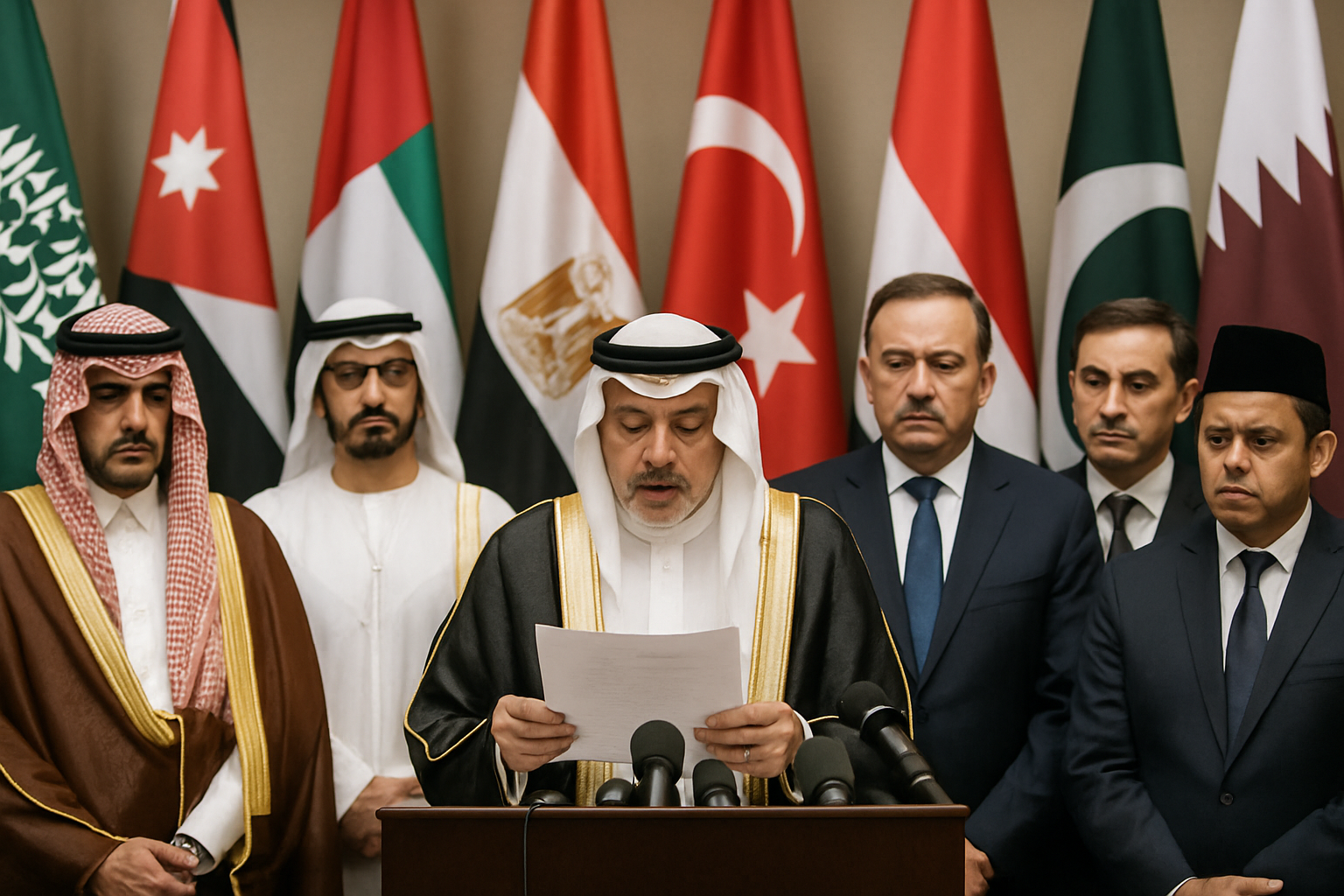
An unprecedented coalition of fourteen Arab and Islamic nations has issued a scathing condemnation of US Ambassador to Israel Mike Huckabee's controversial remarks suggesting he would support Israeli control over vast swaths of the Middle East, creating a significant diplomatic crisis for the Trump administration amid already heightened regional tensions.
The joint statement, led by Kuwait and including Saudi Arabia, Jordan, Egypt, United Arab Emirates, Qatar, Turkey, Indonesia, Pakistan, Bahrain, Lebanon, Oman, Syria, and Palestine, represents one of the most unified international responses to US diplomatic statements in recent years. The coalition, supported by the Gulf Cooperation Council, Arab League, and Organization of Islamic Cooperation, described Huckabee's comments as "dangerous and provocative" and a "clear violation of international law."
Biblical Rights Claims Spark Diplomatic Crisis
The controversy erupted following Huckabee's interview with former Fox News host Tucker Carlson on Friday, during which the US Ambassador to Israel argued that scripture entitles Israel to control much of the Middle East. When questioned about Israel's biblical borders, Huckabee, a Baptist minister and self-described Christian Zionist, referenced territorial boundaries "from the Nile to the Euphrates" - encompassing parts of Egypt, Lebanon, Syria, Jordan, and Iraq.
"It would be fine if they took it all," Huckabee stated when pressed about Israel potentially controlling these biblical territories.
— Mike Huckabee, US Ambassador to Israel
The ambassador later attempted to clarify his remarks as "hyperbolic," but the diplomatic damage had already been done, with regional powers expressing alarm at what they interpreted as official US endorsement of aggressive territorial expansion.
Widespread Regional Opposition
The joint condemnation statement, released through Kuwait's Ministry of Foreign Affairs, expressed "deep concern and categorical rejection" of Huckabee's remarks, warning they pose "a serious threat to regional security and stability." The statement emphasized that such comments "represent a clear violation of international law and the principles of the United Nations Charter."
Pakistan's Foreign Office separately confirmed its participation in the fourteen-nation response, with officials describing the remarks as supporting Israeli expansion across the Middle East in direct contradiction of established international law and territorial sovereignty principles.
The Arab League characterized Huckabee's statements as "highly extremist" and "inconsistent with the fundamental principles and norms of diplomacy," while the Gulf Cooperation Council Secretary-General Jasim Al-Budaiwi called them "irresponsible and unacceptable," violating international charters.
European and International Response
Beyond the Arab and Islamic coalition, the controversy has attracted international attention across Europe and the wider international community. Over 400 European Union diplomats have separately called for increased pressure on Israeli authorities regarding ongoing regional violations, while a European Left Coalition petition against EU-Israel partnerships has exceeded 400,000 signatures.
The Czech Republic joined other European nations in expressing concern over what they view as inflammatory diplomatic rhetoric that could destabilize ongoing peace initiatives in the region.
Timing Complicates Regional Diplomacy
The diplomatic crisis comes at an extraordinarily sensitive moment for Middle East relations, coinciding with multiple high-stakes regional initiatives. The Trump administration is currently pursuing nuclear negotiations with Iran through Swiss-Omani mediation, while maintaining an unprecedented dual-carrier naval deployment in the Persian Gulf with the USS Gerald R. Ford and USS Abraham Lincoln.
Huckabee's comments threaten to undermine these diplomatic efforts, particularly the Trump administration's Board of Peace initiative, which aims to secure over $5 billion in Gaza reconstruction commitments from 27 member nations. Regional partners including Saudi Arabia, UAE, Qatar, and Egypt have been providing crucial support for various diplomatic processes, making their unified condemnation particularly significant.
The controversy also emerges against the backdrop of escalating Israeli military actions across the region. Israeli forces recently conducted deadly airstrikes in Lebanon's Bekaa Valley, killing at least ten people including senior Hezbollah commander Hussein Mohammed Yaagi, in what represents the most significant escalation since the November 2024 US-brokered ceasefire.
Legal and Strategic Implications
International legal experts have noted that the "Greater Israel" concept referenced by Huckabee - encompassing biblical boundaries from the Nile to the Euphrates - would represent a massive violation of existing state sovereignty and territorial integrity principles enshrined in international law.
The Palestinian Authority warned against legitimizing such expansive territorial concepts through religious justification, with President Mahmoud Abbas condemning what he described as "dangerous decisions" that systematically violate international law while undermining the possibility of a viable Palestinian state.
"These statements represent a departure from traditional US diplomatic language that has historically respected regional partners' sovereignty while supporting Israeli security within recognized borders."
— Regional diplomatic source
Impact on US-Regional Relations
The unified regional response highlights the potential consequences of inflammatory diplomatic rhetoric on carefully cultivated relationships with key Middle Eastern allies. The coalition of condemning nations includes several countries that have normalized relations with Israel in recent years, suggesting that even traditionally moderate voices view Huckabee's remarks as crossing diplomatic red lines.
Regional analysts note that the timing coincides with complex diplomatic initiatives requiring trust and cooperation from the very nations now expressing condemnation. The dual-track US approach of maintaining diplomatic engagement while supporting potentially destabilizing rhetoric creates contradictions that could undermine broader strategic objectives.
Broader Context of Regional Tensions
The controversy unfolds amid what observers describe as the most complex period of Middle Eastern diplomacy in decades. Beyond the Israeli-Palestinian conflict, the region faces multiple overlapping crises including:
- Ongoing violations of the Gaza ceasefire, with over 1,600 documented incidents since October 2025
- Israeli expansion of administrative control over West Bank territories in what experts describe as de facto annexation
- Escalating tensions between the US and Iran, with nuclear talks ongoing despite military buildups
- The breakdown of the November 2024 Israel-Hezbollah ceasefire following recent deadly airstrikes
The fourteen-nation condemnation suggests that Huckabee's biblical justification for territorial expansion is viewed as potentially encouraging unilateral actions that could destabilize an already volatile regional environment.
Diplomatic Damage Control
While Huckabee later attempted to moderate his statements, claiming his remarks were "hyperbolic" and noting that Israel is not actively seeking territorial expansion, the diplomatic damage appears substantial. The unprecedented nature of the coordinated response - spanning traditional regional divisions and including both Sunni and Shia-majority nations - underscores the gravity with which the international community views such rhetoric.
The crisis tests the Trump administration's ability to maintain regional partnerships essential for its broader Middle East strategy, including counter-terrorism cooperation, energy security arrangements, and diplomatic initiatives aimed at regional stabilization.
As regional tensions continue to escalate across multiple fronts, the international community faces growing pressure to develop effective mechanisms for preventing inflammatory rhetoric from undermining fragile diplomatic processes essential for regional stability and conflict resolution.