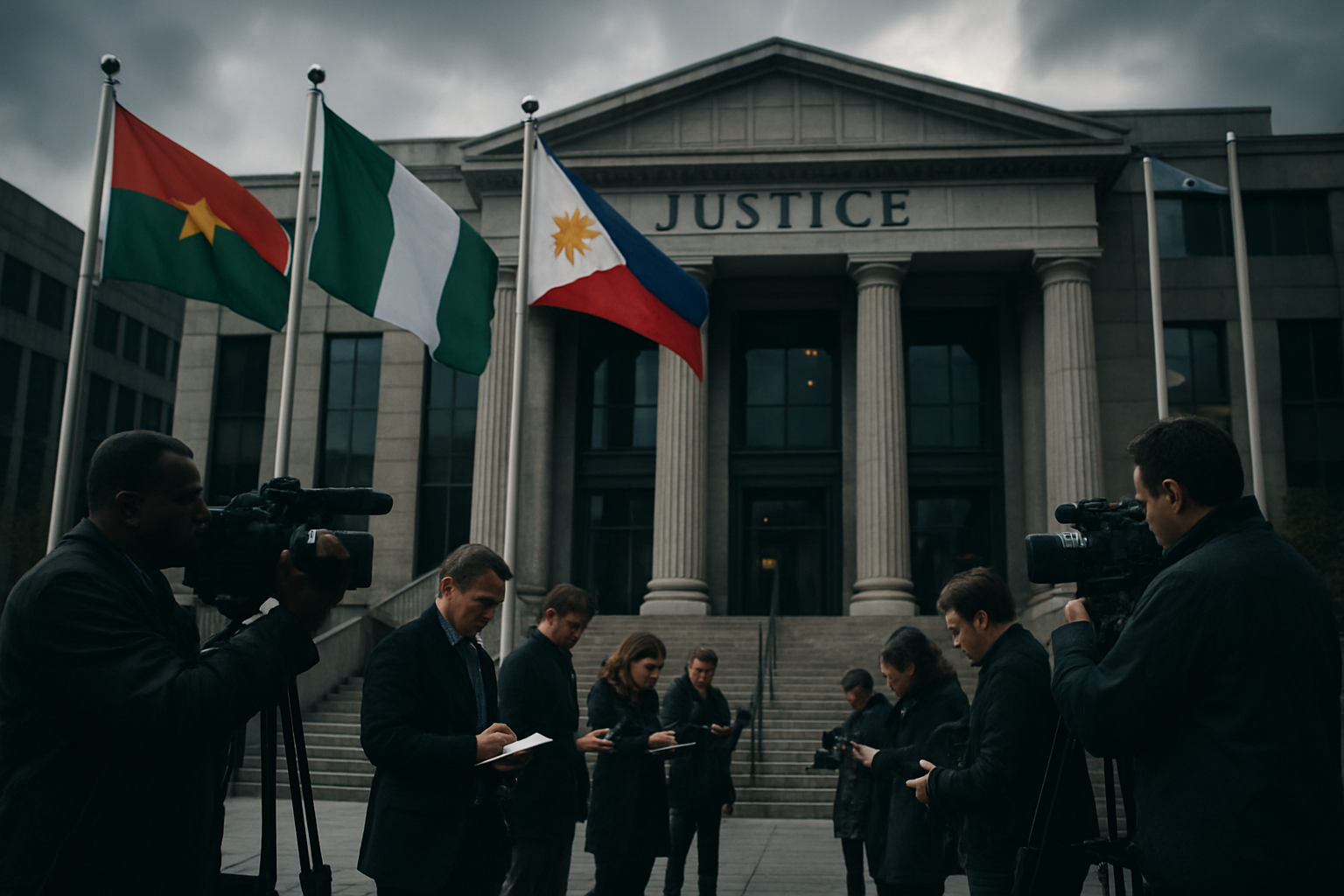
Courts across three continents delivered significant rulings this week as international anti-corruption efforts reached a new intensity, with former government officials facing prison sentences while ongoing investigations target luxury properties and frozen assets worth hundreds of millions of dollars.
The convergence of these high-profile cases demonstrates an unprecedented global momentum in pursuing corruption at the highest levels of government, as judicial institutions show increasing coordination and determination to hold powerful figures accountable regardless of their political connections or attempts to evade justice.
Burkina Faso: Former Defense Official Sentenced to Seven Years
In the most decisive ruling this week, the Ouaga I High Court's Economic and Financial Division (ECO-FI) sentenced former Chief of Staff of the Armed Forces (CSAF) Wendegoudi Stanislas Kinda to seven years imprisonment and fines exceeding one billion CFA francs for embezzlement of public funds and money laundering.
The case, stemming from an October 2024 investigation by the General Inspectorate of Finance, exposed major irregularities in the management of the Center for the Promotion of Aviculture (ex-CPAV). Co-defendant Salam Kaboré also received significant penalties in what prosecutors described as systematic abuse of public resources.
"This verdict demonstrates that no one is above the law in Burkina Faso's fight against corruption,"
— Court spokesperson, ECO-FI Division
The investigation began following alerts from the State Judicial Agent (AJE), with the Ouagadougou gendarmerie's research section conducting detailed forensic analysis that revealed the full scope of the financial irregularities. The case represents a significant victory for Burkina Faso's specialized anti-corruption courts.
Nigeria: Luxury Egyptian Properties Traced to Former Governor
The Independent Corrupt Practices and Other Related Offences Commission (ICPC) achieved a major breakthrough in tracing multi-million-dollar luxury villas and apartments in Egypt to former Kaduna State Governor Nasir Ahmad El-Rufai, according to sources familiar with the investigation.
The properties, located in upscale districts of Cairo, include three luxury villas and multiple high-end apartments representing one of the most significant international asset recovery cases in recent Nigerian anti-corruption efforts. The discovery required sophisticated financial forensics and international cooperation between Nigerian and Egyptian authorities.
TheCable, which first reported the investigation, noted that the probe demonstrates the ICPC's enhanced capacity to pursue complex international money laundering schemes involving former high-ranking officials. The case highlights growing coordination between African anti-corruption agencies and international partners.
Philippines: Court Orders Asset Seizure of Fugitive Lawmaker
The Sandiganbayan Fifth Division granted a preliminary attachment against 16 properties belonging to fugitive lawmaker Elizaldy "Zaldy" Co, securing over ₱215 million in alleged civil liabilities connected to graft and malversation charges.
In a comprehensive 13-page decision made public this week, the anti-graft court found "sufficient grounds" for the prosecution's motion, with the properties spanning multiple high-value locations: eight properties in Pasig City, four in Makati City, three in Quezon City, and one in Lipa, Batangas.
The case relates to Co's alleged involvement in flood control corruption during his tenure in office. Despite his fugitive status, Philippine prosecutors continue pursuing both criminal charges and civil asset recovery, demonstrating the justice system's commitment to comprehensive accountability.
"Let a WRIT OF PRELIMINARY ATTACHMENT issue against accused Elizaldy 'Zaldy' Salcedo Co requiring the Sheriff of this court to attach so much of the property in the Philippines,"
— Sandiganbayan Fifth Division ruling
International Coordination Reaches New Sophistication
These cases reflect a broader pattern of enhanced international cooperation in corruption investigations, building on lessons learned from previous high-profile prosecutions across multiple jurisdictions. Legal experts note the increasing sophistication of cross-border asset tracing and evidence sharing.
The timing of these developments occurs against a backdrop of intensified global anti-corruption efforts, with specialized courts and prosecution offices demonstrating unprecedented technical capabilities and political commitment to pursuing complex financial crimes.
Technological and Legal Innovations
Modern anti-corruption investigations increasingly rely on advanced digital forensics, blockchain analysis, and satellite financial monitoring systems. The Egyptian property investigation required coordination between multiple intelligence agencies and financial regulatory bodies across two continents.
Similarly, the Burkina Faso case employed sophisticated accounting analysis and document recovery techniques that revealed patterns of systematic embezzlement over multiple years. The Philippines proceedings showcase enhanced legal frameworks for asset preservation even when defendants attempt to flee jurisdiction.
Challenges and Institutional Resilience
Despite these successes, significant challenges remain in international corruption prosecution. Fugitive defendants, complex jurisdictional issues, and resource constraints continue to test judicial systems worldwide. However, the coordination evident in this week's developments suggests institutional capacity is strengthening.
The cases also demonstrate how specialized anti-corruption courts are becoming more effective at processing complex financial crimes while maintaining due process protections. This balance between efficiency and fairness represents a crucial evolution in global justice systems.
Regional and Global Implications
These prosecutions send clear signals to officials worldwide that corruption will face serious legal consequences regardless of political connections or attempts to hide assets internationally. The Egyptian property case, in particular, demonstrates that luxury investments in foreign jurisdictions offer no protection from determined investigators.
For international investors and development partners, these cases provide evidence of strengthening rule of law institutions in countries that have historically struggled with corruption. This progress could influence future investment decisions and development assistance strategies.
The successful coordination between national prosecutors, international partners, and specialized courts suggests that the global anti-corruption architecture is maturing rapidly, with enhanced capabilities for pursuing complex transnational financial crimes.
As these cases proceed through various stages of prosecution and asset recovery, they will likely influence anti-corruption strategies worldwide, providing templates for investigating and prosecuting similar complex financial crimes while maintaining respect for due process and international legal cooperation frameworks.