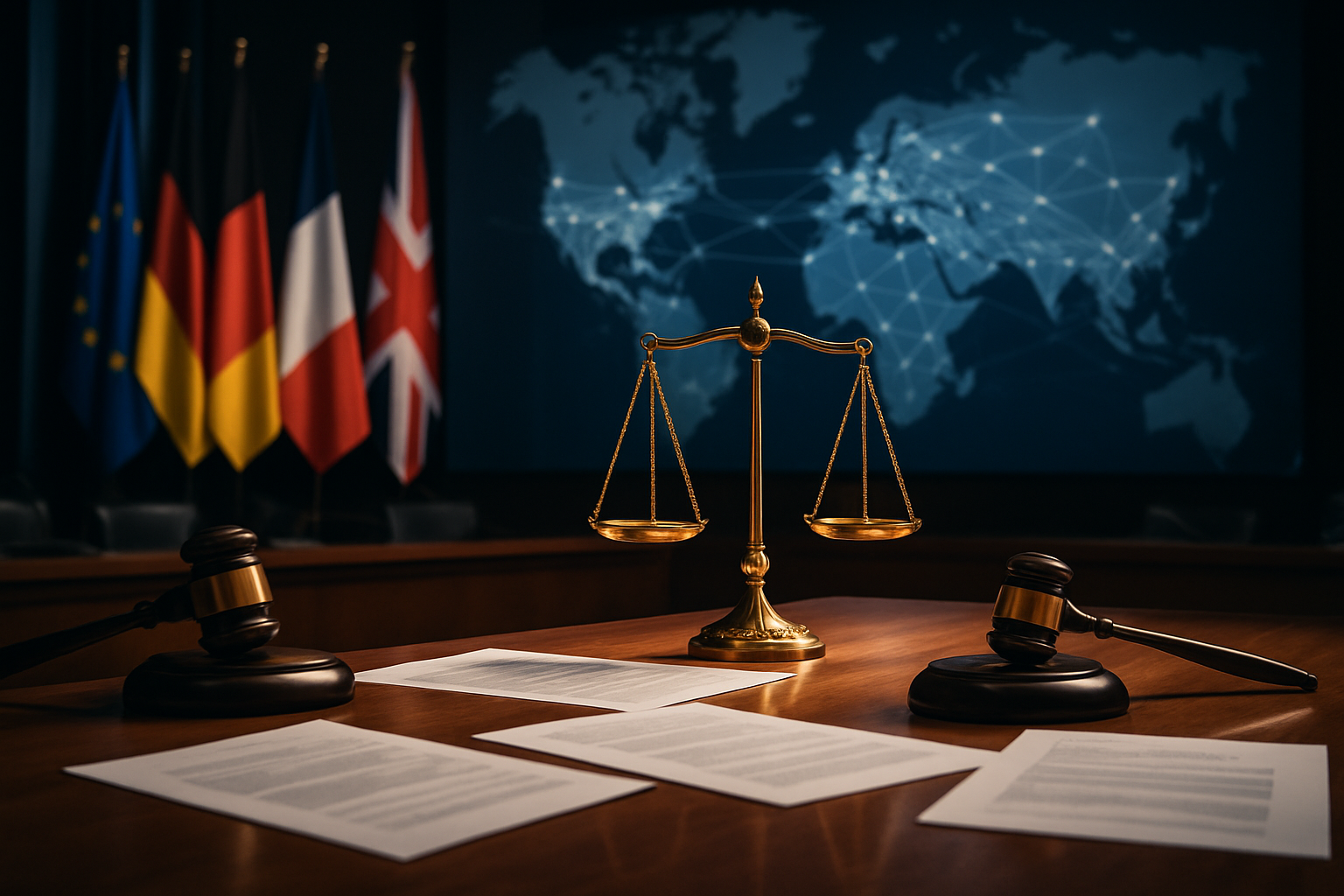
A convergence of high-profile international criminal cases is testing the limits of global justice systems, with courts from Kenya to Italy processing complex proceedings that challenge traditional concepts of accountability and international cooperation.
The strain on international criminal justice has reached critical levels in April 2026, as evidenced by multiple simultaneous cases that reveal both the system's vulnerabilities and its fundamental resilience. From Hollywood actor George Clooney's explosive accusations of war crimes against former U.S. President Donald Trump to Kenya's controversial application of death penalty sentences, the global legal landscape is navigating uncharted territory.
High-Profile Political Confrontations
The most dramatic development emerged from Italy, where George Clooney addressed 3,000 high school students in Cuneo, delivering a scathing critique of Trump's threats against Iran. Clooney specifically targeted Trump's statement that "an entire civilization will die tonight," characterizing it as a war crime. The White House's response was swift and personal, dismissing the actor's comments while attacking his filmography as "terrible."
This exchange, documented across Italian and Cypriot media, represents more than celebrity political commentary—it illustrates the increasing intersection between international humanitarian law discourse and public figures willing to invoke formal legal frameworks. Clooney's use of "war crime" terminology demonstrates how international criminal justice concepts have entered mainstream political debate.
Death Penalty Resurgence in Kenya
Simultaneously, Kenya's judicial system delivered a stark reminder of the continuing role of capital punishment in international criminal justice. Four convicts in the George Muchai murder case received death sentences, with the magistrate emphasizing that "superior courts have time and again held that the death sentence in robbery with violence cases is still legal."
This decision comes against the backdrop of global trends toward death penalty abolition, highlighting the tension between national judicial autonomy and international human rights standards. Kenya's position reflects the complex relationship between domestic criminal justice systems and evolving international norms.
"The magistrate was of the view that superior courts have time and again held that the death sentence in robbery with violence cases is still legal."
— Kenyan Court Ruling, April 2026
Systemic Challenges Across Jurisdictions
The current crisis extends far beyond individual cases, reflecting what legal experts describe as unprecedented strain on judicial institutions worldwide. Courts are experiencing case backlogs requiring years for resolution, while criminal networks demonstrate "state-like capabilities" that include encrypted communications, compartmentalized international structures, and advanced surveillance systems rivaling legitimate government institutions.
This sophistication was dramatically illustrated in March 2026 with the capture of Uruguayan drug kingpin Sebastian Marset, whose organization processed narcotics proceeds through American financial institutions while maintaining operations across multiple continents. The Shield of the Americas coalition, comprising 17 nations, demonstrates the level of international cooperation now required to combat transnational criminal networks.
International Criminal Court Under Pressure
The International Criminal Court faces its own crisis of legitimacy and effectiveness. The ongoing proceedings against former Philippine President Rodrigo Duterte represent the largest victim-centered case in ICC history, with over 500 victims granted participation rights. However, Duterte's refusal to participate and the Philippines' withdrawal from the Rome Statute highlight the court's limitations when dealing with non-cooperative states.
The Duterte case epitomizes broader challenges facing international criminal justice: how to pursue accountability when defendants claim sovereignty protections, and how to balance victim participation with practical enforcement capabilities.
European Coordination and Innovation
European nations have emerged as leaders in adapting to these challenges through enhanced law enforcement coordination and specialized corruption courts. The European model demonstrates new levels of sophistication in international cooperation, with intelligence sharing protocols, coordinated training programs, and real-time communication enabling effective responses to transnational networks.
Austria's ongoing investigation into prosecutorial corruption, Spain's historic pandemic-related fraud trials, and Cyprus's explosive judicial scandals illustrate both the scope of corruption challenges and the system's capacity for self-correction. These cases establish crucial precedents for democratic institutional responses to 21st-century criminal challenges.
Technology and Democratic Oversight
The integration of advanced technology presents both opportunities and risks for international criminal justice. Digital case management, AI-assisted analysis, and encrypted communication monitoring have become standard investigative tools. However, criminal innovation often exceeds institutional adaptation, creating persistent vulnerabilities that require sustained investment in both technology and training.
The balance between security imperatives and civil liberties protection remains central to institutional evolution. Success in addressing sophisticated modern threats while preserving fundamental principles designed to protect civil society determines the future effectiveness of democratic governance.
Regional Security Implications
The interconnected nature of modern criminal networks means that failures in one jurisdiction create vulnerabilities globally. The collapse of Venezuela's criminal justice system, for example, has generated refugee flows and criminal organization expansion across South America, requiring coordinated regional responses.
Similarly, the ongoing conflicts in Eastern Europe and the Middle East have created new categories of international crimes while straining existing accountability mechanisms. The UN Human Rights Council's determination that the Jeffrey Epstein network potentially meets the threshold for crimes against humanity demonstrates how international legal frameworks are being applied to previously unrecognized forms of systematic abuse.
Democratic Resilience and Adaptation
Despite mounting pressures, democratic judicial institutions continue to demonstrate fundamental resilience. The willingness to prosecute powerful figures—from Australia's most decorated soldier Ben Roberts-Smith to former French President Nicolas Sarkozy—reinforces equal treatment under law principles that remain central to public confidence in democratic governance.
Professional accountability mechanisms are strengthening with expanded transparency requirements and specialized training becoming standard practice. Courts are successfully serving their constitutional guardian role beyond dispute resolution, protecting civil rights and maintaining social order under unprecedented pressures.
Future Adaptation Requirements
The path forward requires comprehensive strategies that combine enforcement with prevention, technological advancement with human expertise, and local adaptation with global coordination. Enhanced international cooperation, technology integration that preserves due process, professional development addressing contemporary challenges, and resource allocation matching modern criminal justice complexity represent essential elements of successful adaptation.
Success depends on sustained political commitment to judicial independence, adequate resources for specialized training and equipment, robust international cooperation frameworks, and continued public support for rule of law principles. The outcomes of current high-profile cases will establish templates for democratic governance in an interconnected but politically fragmented world.
The convergence of cases in April 2026 represents a critical juncture for international criminal justice. Criminal organizations with state-like capabilities challenge traditional sovereignty concepts, testing institutions designed for different eras and threat levels. Whether democratic societies can balance accountability demands with institutional integrity while maintaining constitutional protections will determine the strength of international criminal justice for generations to come.